 Whalesbook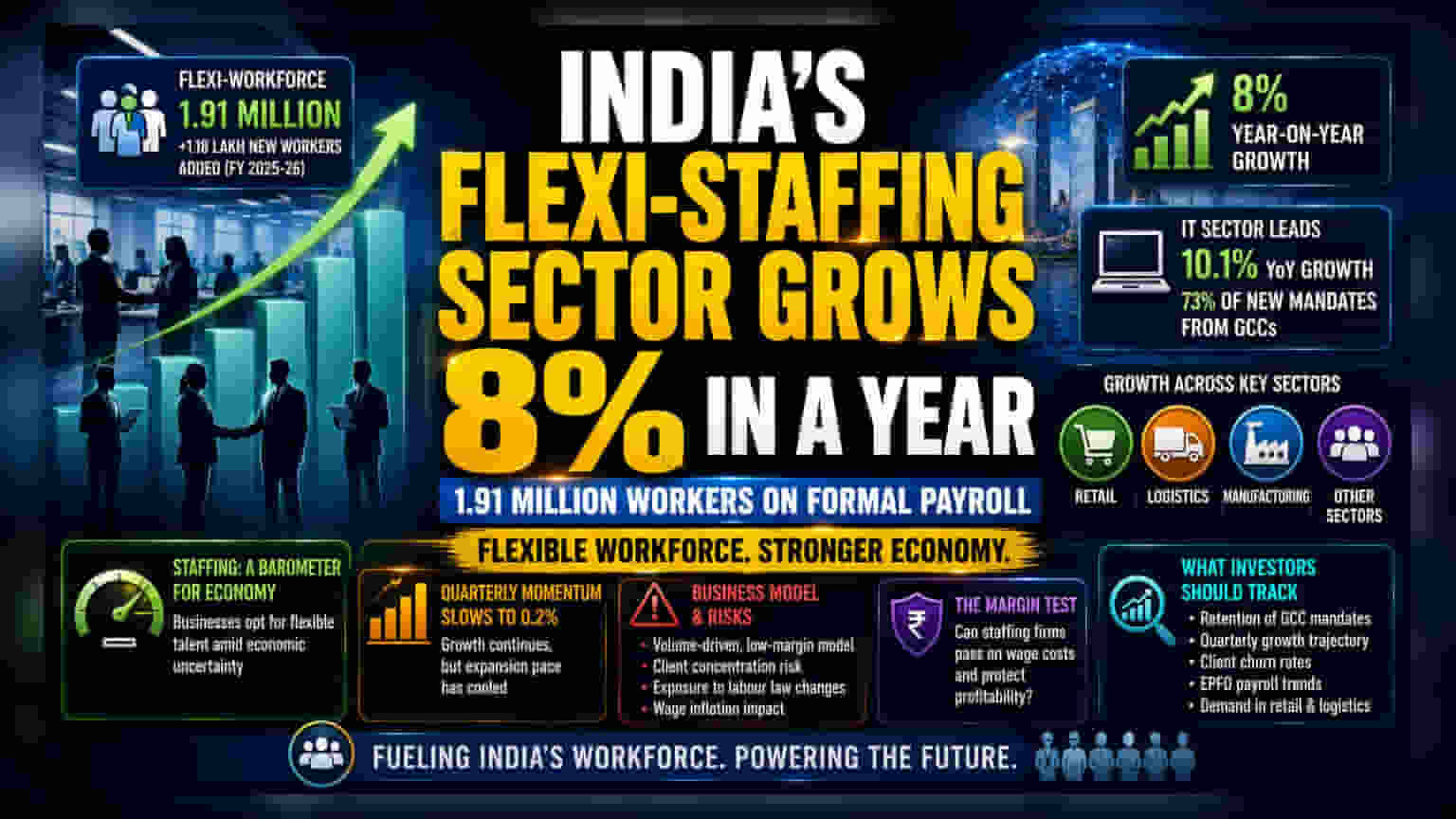


What Happened
India's flexi-staffing sector reported an 8% growth in the past year, according to data from the Indian Staffing Federation (ISF). The industry successfully added 1.18 lakh new workers to its formal payroll, bringing the total flexi-workforce to 1.91 million for the fiscal year 2025-26. This expansion reflects a continued trend of workers moving from the informal to the formal economy, a shift that benefits both the individuals and the companies hiring them.
The Role of GCCs and IT
Within the broader staffing ecosystem, the IT sector has become a major driver, posting a 10.1% year-on-year increase. A significant portion of this demand—about 73% of new mandates—originated from Global Capability Centres (GCCs). These centres, which are essentially the back-office or innovation hubs for multinational corporations operating in India, have become the primary engines for formal staffing demand. Beyond IT, sectors like retail, logistics, and manufacturing are also contributing to this growth, which helps diversify the staffing industry's revenue streams.
Why This Matters For Investors
For investors, staffing companies act as a barometer for broader economic activity. When businesses are cautious about hiring full-time employees due to global economic uncertainty, they often turn to flexi-staffing to manage their workforce needs with greater flexibility.
However, there is a nuance to watch. While the year-on-year growth is solid, the sector’s sequential quarterly momentum has slowed to 0.2%. This flattening suggests that while the industry is still expanding, the pace of that expansion has cooled, likely due to clients becoming more careful with their budgets.
Business Model and Risks
It is important to understand that flexi-staffing is a volume-based business. Companies in this space typically operate on very thin profit margins, meaning that profitability is tied directly to the scale of operations and the ability to control costs.
One of the primary risks for investors to monitor is client concentration. Staffing firms often rely on a few large clients for a significant portion of their revenue. If those clients decide to reduce their headcount or bring operations in-house, the staffing firm faces immediate revenue pressure. Additionally, since the business model relies on labor, any sudden change in labor laws, minimum wage requirements, or compliance costs can directly affect the bottom line.
The Margin Test
Investors often look at how these companies manage wage inflation. As the demand for specialized talent—particularly in IT and GCCs—remains high, staffing firms must ensure they can pass on wage costs to their clients. If they cannot, their profit margins will come under pressure. The current 10.1% growth in IT staffing is positive, but sustaining these margins while managing a large, distributed workforce remains a constant challenge for management teams in this sector.
What Investors Should Track
Moving forward, the key monitorables are the retention of GCC mandates and the overall pace of quarterly growth. Investors should watch for comments in company earnings calls regarding client churn rates and any signals of demand slowdown in the retail and logistics sectors. Furthermore, any changes in the Employees' Provident Fund Organisation (EPFO) payroll data can serve as a leading indicator for the health of formal employment, which directly impacts the potential customer base for staffing firms.