 Whalesbook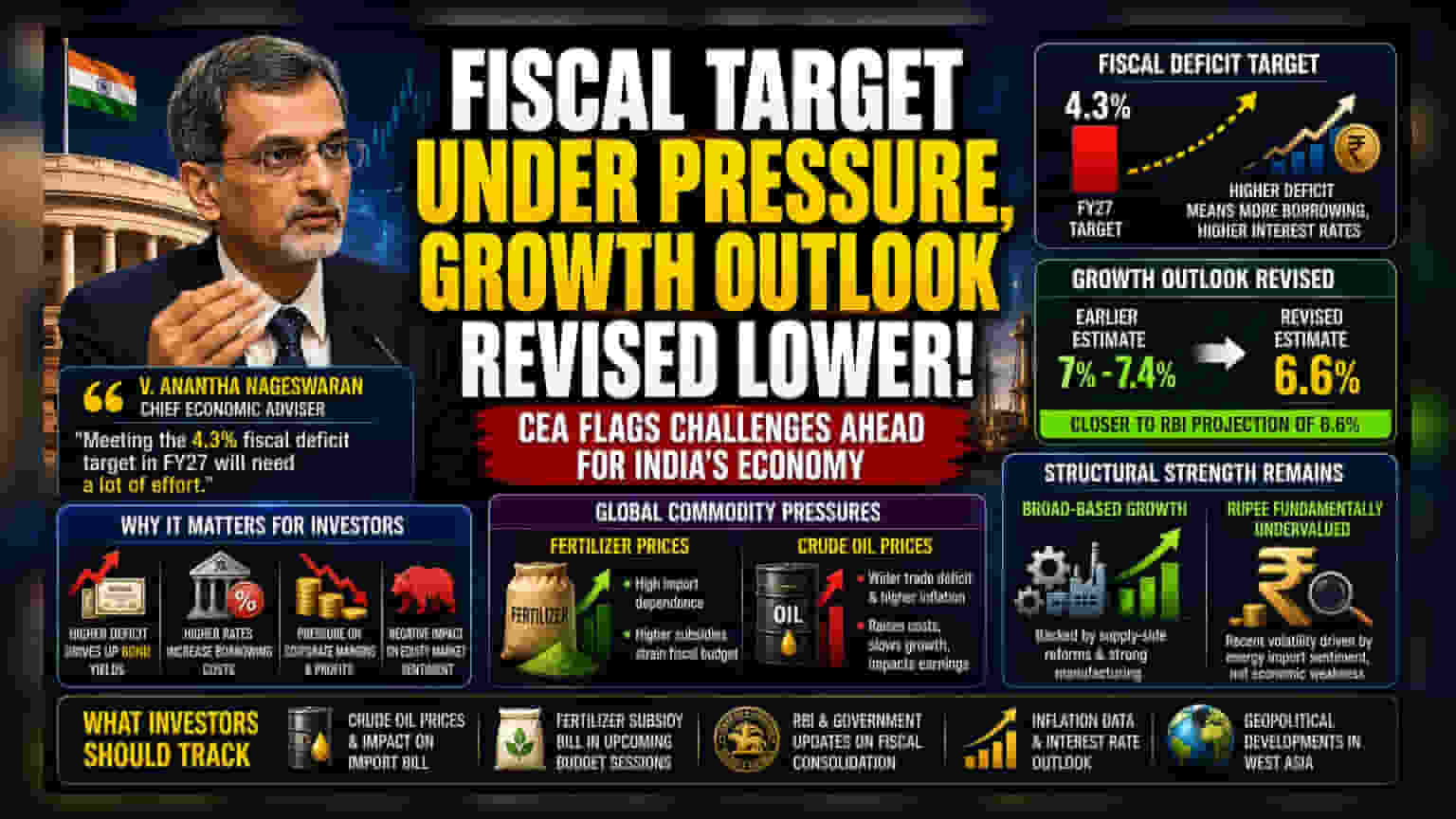


What Happened
Chief Economic Adviser V. Anantha Nageswaran recently addressed the outlook for India’s economy, highlighting significant challenges in meeting the government’s fiscal deficit target of 4.3% for the 2026-27 financial year. While the government remains committed to fiscal consolidation, the CEA acknowledged that achieving this specific goal will require substantial effort. Alongside this, the official growth projection has been revised, moving closer to the Reserve Bank of India’s estimate of 6.6%, down from earlier, more optimistic expectations of 7% to 7.4%. These revisions are primarily attributed to heightened global uncertainty and the persistent influence of external economic variables.
Why This Matters For Investors
The fiscal deficit—the gap between what the government earns and what it spends—is a crucial number for the stock market. When the government spends more than its revenue, it must borrow to bridge the difference. For investors, a higher-than-expected deficit can signal increased government borrowing, which often drives up bond yields. Higher bond yields can lead to a rise in interest rates across the economy, potentially increasing the cost of borrowing for companies and individuals. This can squeeze profit margins for businesses and shift sentiment in the equity markets. Understanding this balance is essential for assessing the overall cost of capital in the Indian market.
Impact of Global Commodities
Two specific variables were identified as key sources of pressure: fertilizer and crude oil prices. Fertilizer subsidies represent a massive component of government expenditure. India’s heavy reliance on imported components for fertilizer production makes the budget highly sensitive to global price fluctuations. When global prices spike, the government is often required to increase its subsidy support to keep costs stable for farmers, which in turn stretches the fiscal budget.
Similarly, crude oil prices continue to be a dual risk. As a major importer of crude oil, India’s trade deficit and inflation levels are directly influenced by global energy prices. Higher oil prices raise transportation and production costs, which can fuel inflation and dampen consumer spending power. This, in turn, can slow down broader economic growth and weigh on corporate earnings, particularly in oil-sensitive sectors.
Structural Strength and Currency Dynamics
Despite these short-term headwinds, the government maintains a positive long-term view of India’s economic structure. The growth seen in FY26 was described as broad-based and supported by years of supply-side reforms and a strong manufacturing performance. On the currency front, while the Indian rupee has faced downward pressure, the CEA indicated that fundamental economic indicators suggest the currency is undervalued. The recent volatility in the rupee is largely attributed to market sentiment regarding India’s position as a major energy importer, rather than internal economic weakness.
What Investors Should Track
Moving forward, investors may monitor several indicators to gauge the potential impact on the economy. First, any further updates on oil prices and their effect on the import bill will be vital, as this directly impacts the fiscal position and inflation. Second, updates on the fertilizer subsidy bill, especially during the upcoming budget sessions, will clarify the extent of the fiscal burden. Finally, tracking the Reserve Bank of India’s commentary and any government statements on fiscal consolidation will provide clues into how policy might adjust to changing global conditions. Keeping an eye on inflation data and global geopolitical developments in West Asia will also help in understanding the broader trend of economic stability.