 Whalesbook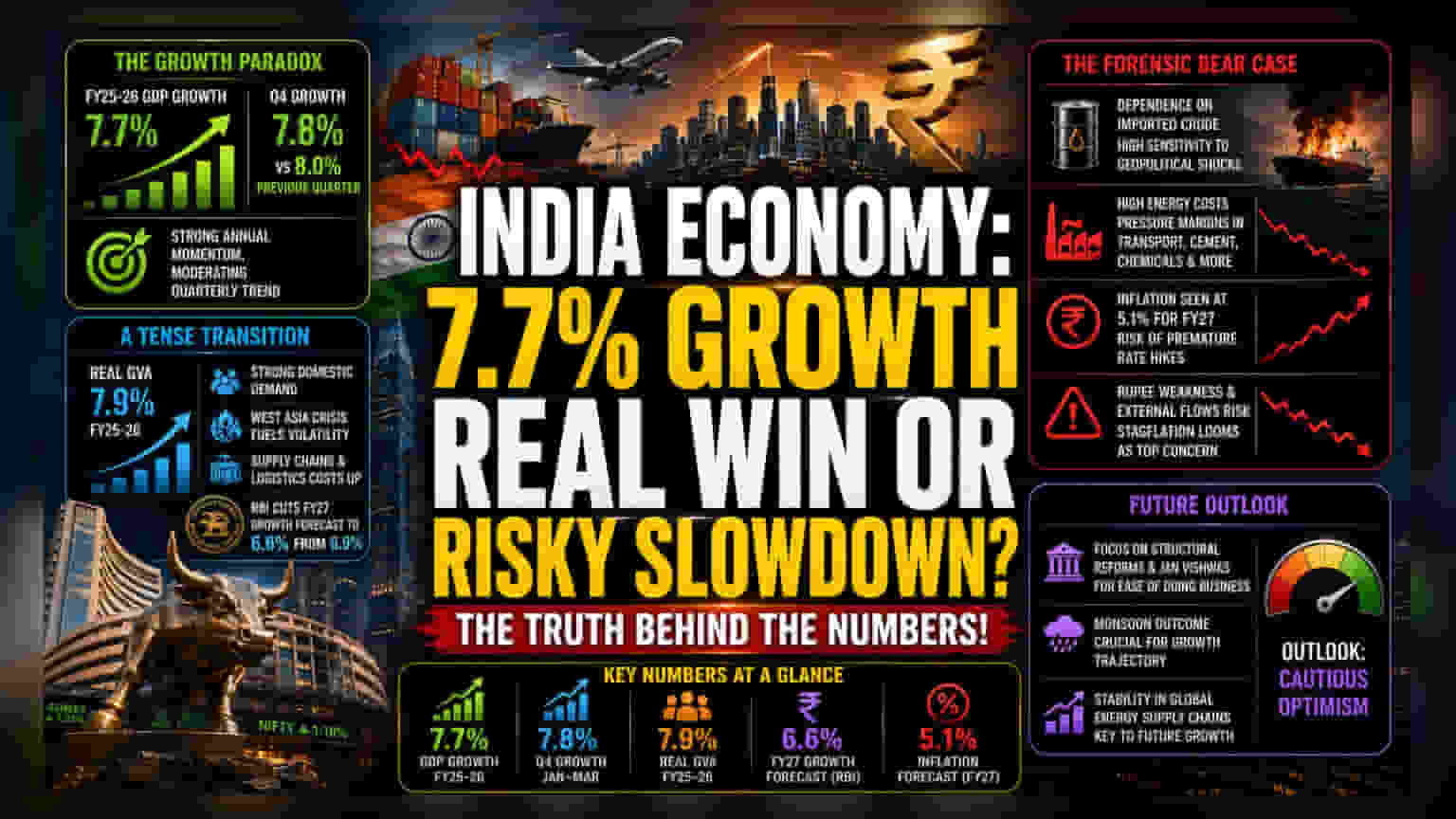


The Growth Paradox
While the 7.7% annual GDP expansion for fiscal year 2025-26 signals robust domestic momentum, the headline figure masks a nuanced deceleration. Official data shows the economy grew by 7.8% in the January-March quarter, a modest retreat from the previous quarter's upwardly revised 8.0%. This performance, while resilient, arrives at a moment of significant macro friction. The divergence between annual strength and quarterly moderation is increasingly capturing the attention of institutional analysts who are pivoting from celebratory narratives toward a more guarded outlook.
The Analytical Deep Dive: A Tense Transition
The current economic environment is defined by a clash between strong internal demand and external vulnerability. Real Gross Value Added (GVA) clocked in at 7.9% for the full year, a notable improvement over the previous year, yet the secondary and tertiary sectors are now bracing for the spillover effects of regional conflicts. The West Asia crisis has injected volatility into energy markets and global supply chains, pushing logistical costs higher. Consequently, the Reserve Bank of India (RBI) has adopted a hawkish stance, recently slashing its FY27 growth projection to 6.6% from 6.9%. This adjustment underscores a broader industry consensus that the era of post-pandemic acceleration is yielding to a period of consolidation and defensive positioning.
The Forensic Bear Case: Structural Weaknesses
Despite official optimism, the bear case is anchored in structural risks that cannot be easily mitigated by fiscal policy. India’s heavy reliance on imported crude oil makes it disproportionately sensitive to geopolitical shocks, such as the ongoing instability in the Strait of Hormuz. Elevated energy prices threaten to squeeze corporate profitability, particularly in transport, cement, and chemical sectors, which are already grappling with rising input costs. Furthermore, persistent inflation—pegged at 5.1% for FY27 by the central bank—could force a premature interest rate hike cycle. Unlike more insulated markets, India’s dependence on external capital flows and commodity imports leaves it exposed should the rupee weaken further, a trend already showing signs of acceleration. The risk of stagflation—where growth moderates while inflation remains sticky—is the primary concern currently dampening institutional appetite.
The Future Outlook
Moving into the new fiscal year, the government’s focus remains on deepening structural reforms, including the Jan Vishwas framework to improve the ease of doing business. However, the market is discounting these long-term gains in favor of short-term liquidity concerns. Consensus sentiment suggests that while the economy remains a bright spot in the global context, future growth will be heavily contingent on monsoon outcomes and the stability of global energy supply chains. Investors should expect continued volatility as the RBI balances the need for liquidity with the mandate of inflation control.