 Whalesbook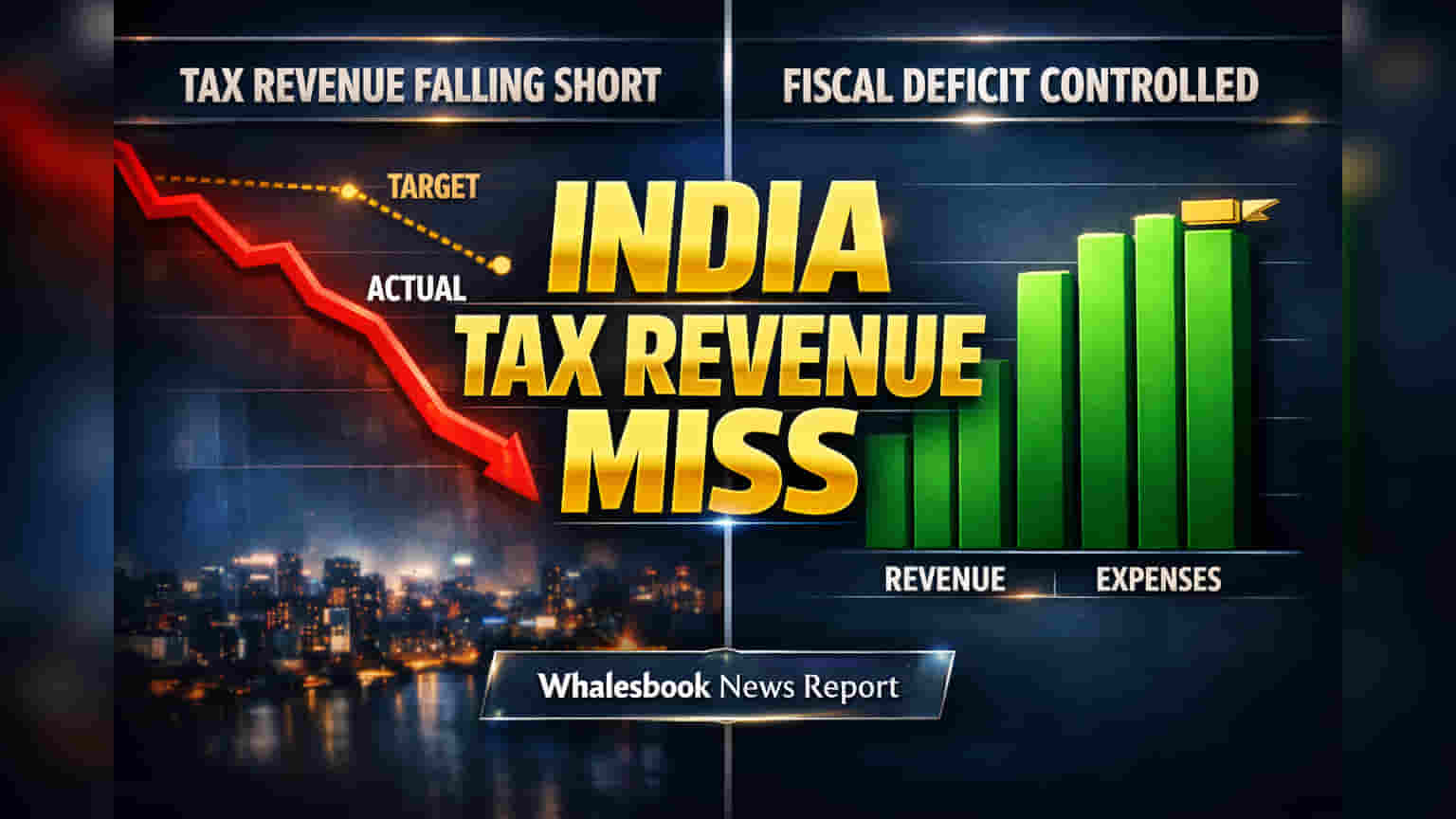


Revenue Collections Narrowly Miss Target
The Union government is set to narrowly miss its revised gross tax revenue (GTR) target for fiscal year 2026. Provisional data shows Rs 34.19 lakh crore collected by the end of February 2026, against a target of Rs 40.77 lakh crore, leaving a Rs 6.58 lakh crore gap to be bridged in March. Meeting the full-year estimate requires March collections to surge 11.38% year-on-year, a rate considerably faster than the 6.7% seen from April-February and the 2.8% growth in March FY25. Despite the revenue gap, the fiscal deficit target of 4.4% of GDP for FY26 is still expected to be met. This is largely due to expected spending cuts across ministries and strong indirect tax receipts. The government's strong cash position, shown by the cancellation of a recent Treasury Bill auction, also supports its fiscal management.
Direct vs. Indirect Tax Performance Diverges
The main shortfall in revenue is in direct taxes, particularly personal income tax (PIT). Gross direct tax collections rose 4.86% year-on-year to Rs 27.15 lakh crore by March 17, 2026. However, net collections after refunds grew a more modest 7.19% to Rs 22.80 lakh crore, below the revised estimate's 9% growth target. Corporate tax collections were stronger, with net amounts increasing about 13% year-on-year to Rs 10.92 lakh crore, surpassing the revised target. Personal income tax collections, however, slowed significantly, growing just 2.7% to Rs 11.32 lakh crore, against a revised target of Rs 13.12 lakh crore. This slowdown is partly due to tax relief measures in the Union Budget that made annual taxable income up to Rs 12 lakh tax-free under the new regime. Lower tax refunds, down 18.82% from the prior year, helped boost net direct tax collections somewhat.
Indirect Taxes Provide Critical Support
Indirect tax collections have significantly exceeded expectations, reaching 101.2% of the revised FY26 target. The combined total from customs duties, excise duties, and the Centre's share of Goods and Services Tax (GST) surpassed the Rs 15.53 lakh crore revised estimate. Customs duties hit 102% of their target, excise duties reached 101%, and Central GST (CGST) collections were at 100.8% of their respective revised targets. This strong performance indicates resilient economic activity and compliance, providing a vital buffer against the direct tax shortfall.
Concerns Over Future Fiscal Health
While the 4.4% of GDP fiscal deficit target for FY26 is projected to be met, this outcome relies on indirect taxes offsetting shortfalls in direct taxes. The reliance on indirect taxes, which are closely tied to consumption, to cover gaps in personal income tax collections suggests that while corporate profits remain robust, household income growth and consumer spending power may be facing challenges. The tax relief aimed at boosting consumption has directly affected PIT collections, highlighting a balance between policy goals and revenue targets. External factors, such as geopolitical tensions, could increase energy prices, raising subsidy costs for fuel and fertilizers. This could impact corporate profitability and, consequently, corporate tax collections and dividend receipts in FY27. Rating agency ICRA forecasts potential risks to the FY27 fiscal deficit target of 4.5% (budgeted at 4.3%) if energy prices remain high. A shortfall in disinvestment targets could also strain non-tax revenues, similar to projections in FY25.
Looking Ahead: Fiscal Goals for FY27
Looking ahead, the Union Budget for FY27 aims for a fiscal deficit of 4.3% of GDP, a slight reduction from FY26's 4.4%. Gross tax revenue is projected to grow 8% to Rs 44.04 lakh crore in FY27, led by an anticipated 11.4% rise in direct taxes, while indirect tax growth is expected to slow to around 3%. The government plans to maintain capital expenditure at approximately Rs 12.2 lakh crore, signaling continued focus on infrastructure development. The debt-to-GDP ratio is forecast to drop from an estimated 56.1% in FY26 to 55.6% in FY27, moving toward a long-term goal of 50% by 2031.