

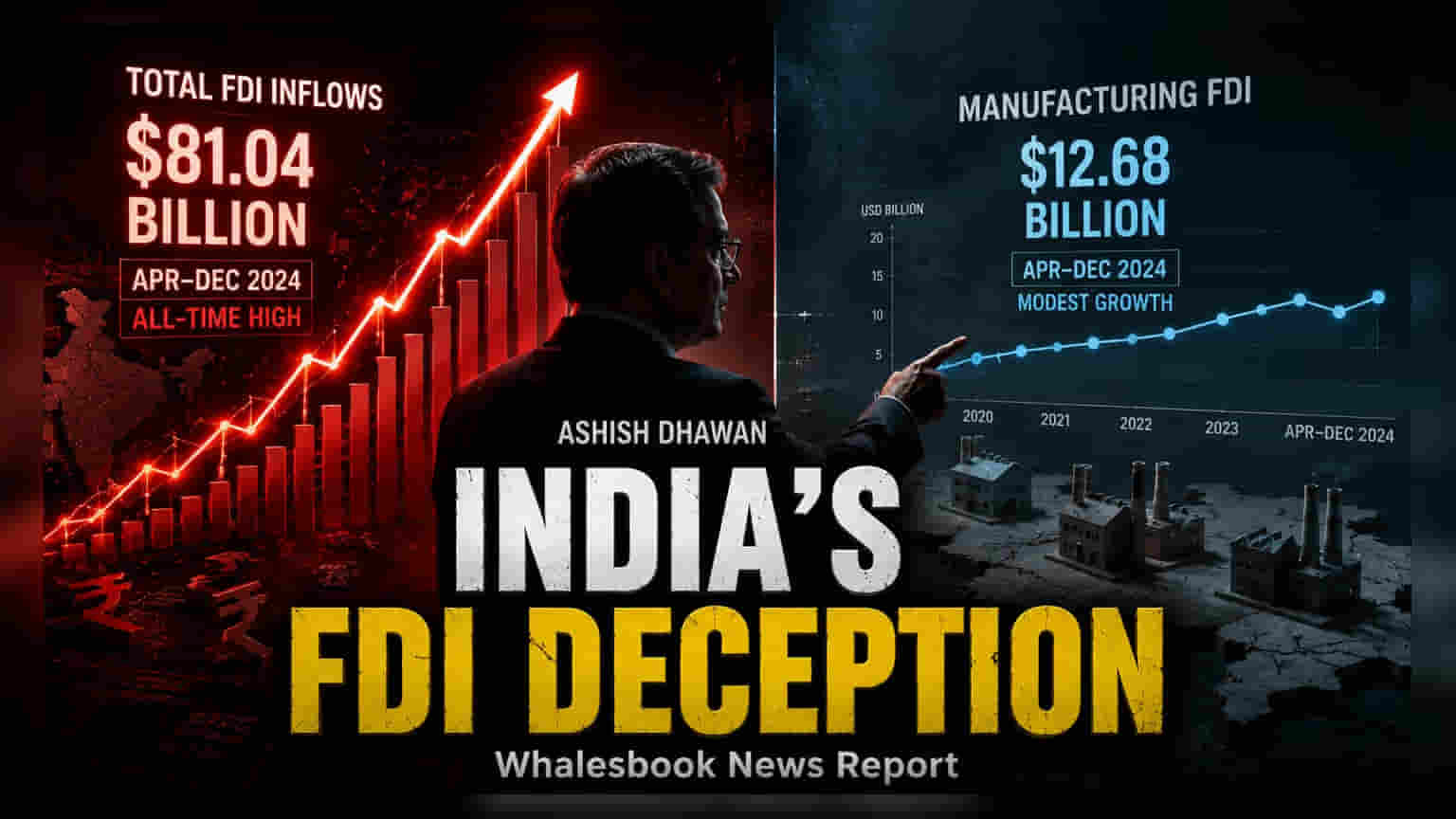
India recorded $58.84 billion in equity FDI in fiscal year 2025-26, led by a surge in US investments. However, experts warn that only $20–22 billion went into manufacturing, raising concerns about the pace of job creation. Understanding the difference between total investment and productive manufacturing capital is vital for assessing India's long-term export and economic growth targets.
India reported an 18% rise in equity Foreign Direct Investment (FDI) to $58.84 billion for the fiscal year 2025-26, signaling strong interest from global markets. Notably, investments from the United States more than doubled to reach $11.17 billion, reflecting a significant shift in trade and investment relations. While the headline growth in total equity inflows presents a positive picture, market analysts are urging investors to look deeper at where this money is actually going.
Ashish Dhawan, founder of ChrysCapital, has cautioned that the headline figures may mask a critical shortfall in manufacturing investment. He pointed out that actual FDI directed toward the manufacturing sector stands at approximately $20–22 billion. This distinction is vital because manufacturing is the primary engine for creating the 40–50 million jobs required for India's growing workforce and for scaling exports to the ambitious $2 trillion target.
Investors should also understand the difference between gross and net FDI figures, which can significantly alter the assessment of capital quality. While gross FDI inflows for the year were reported in the range of $94.53 to $94.84 billion, the net FDI figure, which accounts for factors like repatriation, disinvestment, and outward FDI by Indian firms, was significantly lower at roughly $7.65 billion. This suggests that a substantial portion of global capital flowing into India is volatile or being cycled out, rather than staying as permanent, productive assets in factories and infrastructure.
Despite these concerns, the environment for setting up factories has improved noticeably over the past decade. Improvements in logistics, faster turnaround times at ports, and the development of dedicated industrial parks have created a more favorable landscape for long-term investment. Furthermore, the global shift in trade dynamics, with Western nations seeking to diversify supply chains away from China, provides a strategic opportunity for India to capture a larger share of global manufacturing exports through its existing and upcoming Free Trade Agreements.
For investors, the key monitorable is not just the total FDI inflow number, which can be influenced by financial flows and private equity deals. Instead, the focus should be on tracking actual capital spending by companies in the manufacturing sector. Success in reaching India’s economic goals will likely depend on whether this surge in global interest can be converted into long-term, stable investments in building production capacity, rather than just short-term capital allocations.