

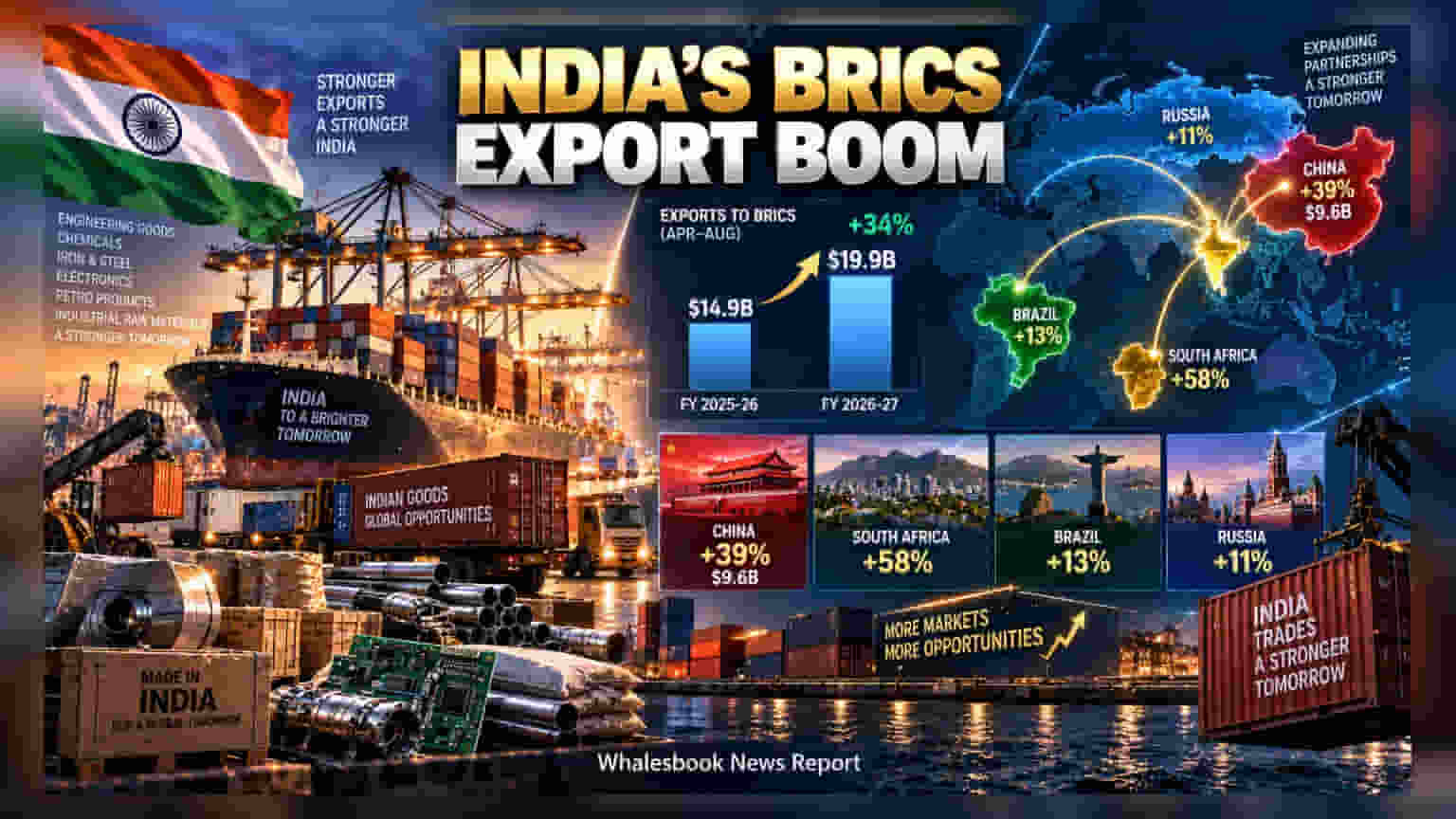
Indian exports to China, South Africa, Brazil, and Russia grew 34% to $19.9 billion between April and August 2026. Increased shipments of industrial raw materials and electronics helped improve India's export share in these markets. This growth signals potential benefits for export-oriented manufacturing, engineering, and logistics companies as trade diversification reduces dependency on single-market demand.
India’s trade momentum gathered pace in the first five months of the 2026-27 financial year, with exports to key BRICS partners—China, South Africa, Brazil, and Russia—climbing by 34% to $19.9 billion. This is a notable increase from the $14.9 billion recorded during the same period in the previous fiscal year, reflecting broader trade activity across these regions.
China remained the largest contributor among the group, with Indian shipments rising 39% to $9.6 billion. South Africa posted the fastest growth among the four nations, with export volumes expanding by 58%. Meanwhile, trade with Brazil and Russia grew by 13% and 11%, respectively. The collective share of these four economies in India’s total export basket rose to 9.2%, up from 8.1% a year earlier. This shift toward a broader trade mix is useful for the domestic economy as it reduces concentration risk and dependence on any single export destination.
Export strength also extended beyond the BRICS bloc. Indian suppliers saw increased demand from several large Asian and European economies. Exports to Japan increased by 43% to $3.43 billion, supported by higher shipments of mineral fuels, electronics, and aluminium. Italy recorded a 30% rise, with exports reaching $3.92 billion, while shipments to South Korea grew by 22% to $3.21 billion. The categories driving this increase include industrial raw materials, intermediate goods, chemicals, and iron and steel, which are essential to the manufacturing sectors of these importing nations.
For investors, these export trends are relevant when analyzing companies in the manufacturing, commodity processing, engineering, and logistics sectors. Many such firms rely on overseas demand to maintain revenue growth and order book levels. While the data shows a strong start to the fiscal year, the final impact on corporate earnings will depend on whether this acceleration in demand continues through the remainder of the year. Investors may track future quarterly results and management commentary for insights on export sustainability, pricing power, and the effect of these trade flows on profit margins for companies with high exposure to overseas markets.