 Whalesbook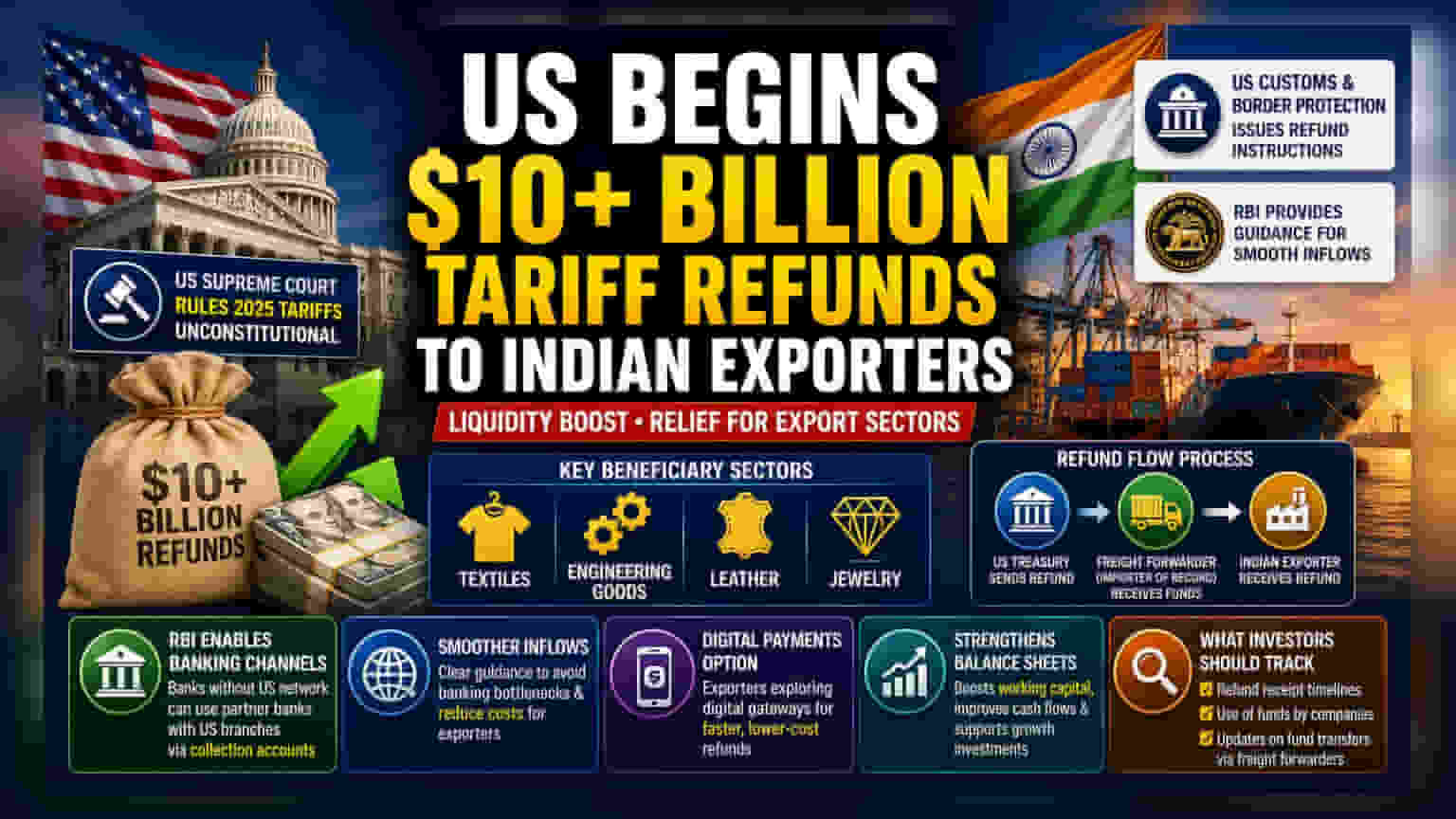


Over $10 billion in US tariff refunds are flowing back to Indian exporters following a 2026 Supreme Court ruling. This liquidity boost affects sectors like textiles, engineering, and jewelry. Investors should monitor how companies manage the logistics of these payments, particularly when freight forwarders are involved, and whether this capital helps improve corporate balance sheets.
What Happened
United States authorities have begun the process of repatriating over $10 billion in reciprocal tariffs to Indian exporters. This development comes after the US Supreme Court ruled in February 2026 that the trade penalties imposed in 2025 were unconstitutional. US Customs and Border Protection has issued the necessary administrative instructions to start the refund process, while the Reserve Bank of India (RBI) has provided regulatory guidance to help Indian banks handle these inflows efficiently. This marks a significant step in resolving trade enforcement actions that had previously impacted various sectors.
Why This Matters For Investors
The arrival of these refunds serves as a substantial one-time liquidity boost for export-focused industries. Sectors that faced heavy duties under the 2025 policies—most notably textiles, engineering goods, leather, and jewelry—are the primary beneficiaries. Many of these companies had previously absorbed high tariff costs or offered steep discounts to remain competitive in the US market, which pressured their profit margins. While the refund provides relief, the process is expected to be gradual rather than immediate. For investors, the return of this capital could help improve the working capital position and financial health of affected export-heavy firms.
The Payment Mechanics
The process of reclaiming these funds involves some procedural complexity, particularly for exporters who used freight forwarders. In many trade transactions, the freight forwarder acted as the legal "importer of record" in the United States. Under administrative rules, the refund is directed to the entity listed as the importer of record. Consequently, these forwarders will receive the refunds from the US Treasury first and must then distribute the funds to the actual Indian exporters. Companies and their partners are currently working through the specific logistics of these transfers, which may differ on a case-by-case basis.
RBI's Role and Banking Channels
To prevent banking bottlenecks, the Reserve Bank of India has clarified the procedures for receiving these international remittances. Some Indian banks do not have a direct US correspondent network, which could have complicated the refund process. The RBI has clarified that these banks can set up specialized collection accounts through partner banks that have operational US branches. This guidance aims to ensure that exporters can receive their funds without the need to open separate foreign bank accounts, potentially reducing the cost of recovery. Some exporters are also exploring the use of digital payment gateways, which may offer a lower-cost alternative to traditional banking channels.
What Investors Should Track
Investors should closely observe how these refunds impact the balance sheets and operational cash flows of export-oriented companies in the coming quarters. Key monitorables include the timeline for the actual receipt of funds, as the process is expected to be gradual. Furthermore, management commentary will be important to understand whether these inflows will be used to reduce debt, boost capital spending, or support operations. Finally, stakeholders should watch for any updates on how efficiently the funds are distributed in cases involving third-party freight forwarders, as this remains a critical link in the recovery chain.