

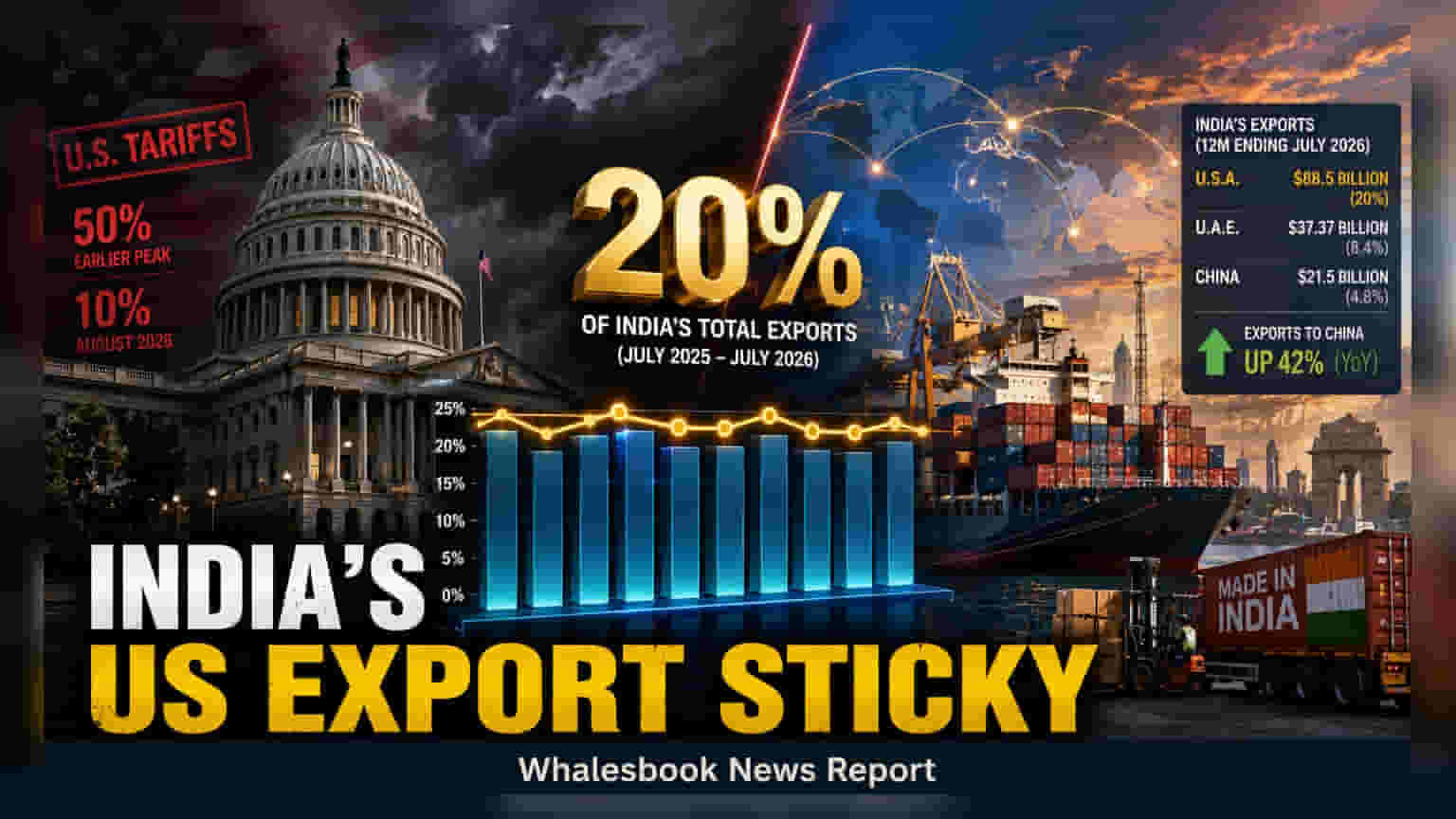
India’s exports to the United States reached $88.5 billion over the 12 months ending July 2026, maintaining a 20% share of total exports despite recent tariff volatility. While duties have settled at 10% after peaking at 50%, trade dependence remains high. Investors should note that meaningful diversification into new trade corridors is expected to take two to three years.
India's trade relationship with the United States has shown notable resilience, with the U.S. absorbing approximately 20% of India's total exports. This figure, calculated for the 12 months ending in July 2026, reflects a shift from the 17.4% share recorded in the 2022-23 fiscal year. This sustained dependence comes despite significant volatility in trade policy, where U.S. tariffs on Indian goods briefly reached 50% before stabilizing at 10% as of August 2026.
Total exports to the U.S. reached $88.5 billion during this period, keeping the country firmly positioned as India's primary export market. For investors, this data clarifies that despite high-profile trade tensions, the U.S. remains the most lucrative destination for Indian businesses. By comparison, exports to the United Arab Emirates stood at $37.37 billion, while shipments to China totaled $21.5 billion. Notably, India's export growth to China saw a 42% increase, suggesting that while the U.S. remains the dominant partner, efforts to expand trade volumes with other nations are producing measurable results.
To de-risk the export strategy, India has expanded its portfolio by adding roughly 500 new product lines, specifically targeting sectors like electronics, engineering goods, marine products, and pharmaceuticals. This expansion is central to the government's long-term goal of reducing the concentration risk associated with the U.S. market. However, industry analysis suggests that the full impact of these diversification efforts will likely take two to three years to materialize. Until then, the U.S. is expected to remain the primary source of revenue for many Indian exporters.
The strategic focus has now shifted toward finalizing and implementing new trade agreements. A deal with the United Kingdom became active in July 2026, and ongoing negotiations with the European Union, Oman, and New Zealand are being closely followed. These deals are intended to open new avenues for Indian manufacturers, reducing the immediate need to rely heavily on a single market.
For investors, the primary risks involve the potential for future shifts in U.S. trade policy and the time required to establish stable trade volumes in alternative regions. While the current 10% tariff rate is more manageable than earlier peaks, the geopolitical environment requires businesses to maintain flexible supply chains. The next important updates will be the progression of these ongoing trade negotiations and whether sectors like electronics and pharmaceuticals can maintain their current export growth rates in the face of evolving global trade rules.