 Whalesbook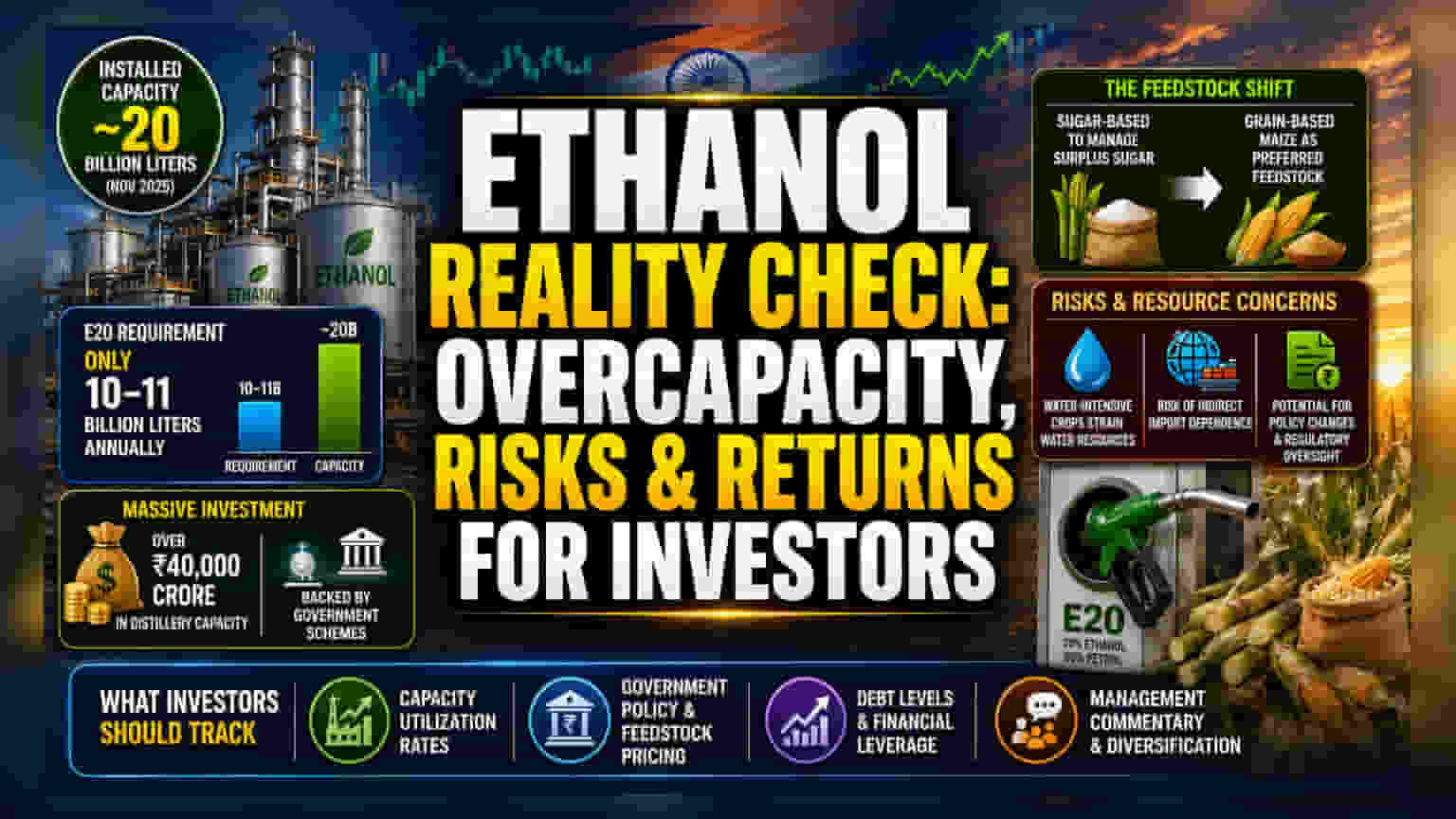


India’s ethanol production capacity has significantly outpaced demand, reaching nearly 20 billion liters against an E20 blending requirement of 10-11 billion. This creates potential financial pressure for companies that invested heavily in new distilleries, as low capacity utilization can weigh on profit margins and asset returns.
What Happened
India’s ambitious drive to blend ethanol with petrol is hitting a significant economic reality check. While the government's push to lower crude oil imports and support the rupee led to rapid infrastructure growth, the country’s ethanol production capacity has now far exceeded the actual demand required for blending targets. Official data and industry reports indicate that installed production capacity reached nearly 20 billion liters by November 2025. In contrast, the requirement to meet the E20 (20% ethanol blending) goals is estimated at only 10-11 billion liters annually. This creates a situation where less than half of the current infrastructure is being utilized for the primary blending mandate.
Why This Matters For Investors
For investors, this capacity mismatch shifts the focus from growth to operational efficiency. Over the past few years, the sector saw massive investment, with over ₹40,000 crore poured into new distillery capacity, supported by government interest subvention schemes and soft loans. When companies spend significant money on expansion, they expect high utilization rates to pay back those investments.
However, when capacity stands idle or underutilized, fixed costs—such as interest payments on debt and plant maintenance—remain high, while revenue remains lower than expected. This can put pressure on profit margins. Investors should be aware that the financial viability of companies in this sector now depends less on building new plants and more on whether existing plants can run at full capacity.
The Feedstock Shift
Government policy initially favored sugar-based distilleries to help manage surplus sugar production. As sugar supplies tightened, the policy focus pivoted toward grain-based distilleries, with maize becoming a preferred feedstock due to administered pricing. This creates a complex environment for companies, as they must navigate shifting government incentives. Companies that pivoted quickly to grain-based distillation have navigated this differently than those solely dependent on sugar. The result is that blending targets are now being driven as much by the need to utilize existing distillery capacity as by pure energy security goals.
Risks And Resource Concerns
Beyond financial metrics, the ethanol program faces increasing scrutiny regarding resource usage. Scaling production requires massive inputs of sugarcane, maize, and rice. The cultivation of these crops is water-intensive. Government and independent studies highlight that producing ethanol from grain and sugar sources requires significant water volumes. Regions already facing water stress may struggle to support further expansion of grain-based distilleries.
Additionally, there is the risk of indirect import dependence. If land is diverted from essential crops like oilseeds or pulses to produce ethanol feedstock, India may simply trade a dependency on imported crude oil for a dependency on imported fertilizers, edible oils, or natural gas used in the production chain. These factors create a complex web of environmental and resource costs that could eventually lead to policy adjustments or stricter regulatory oversight.
What Investors Should Track
Investors looking at companies in the sugar, distillery, or ethanol equipment sectors should monitor several key indicators. First, track capacity utilization rates in quarterly results; low utilization is a red flag for profitability. Second, watch for any shifts in government policy regarding feedstock pricing or ethanol procurement, as these directly dictate revenue. Third, keep an eye on debt levels, as the heavy investment made in the last few years means that companies with high leverage are more vulnerable if utilization remains low. Finally, observe management commentary on product diversification beyond ethanol to ensure the business is not overly dependent on a single policy-driven revenue stream.