 Whalesbook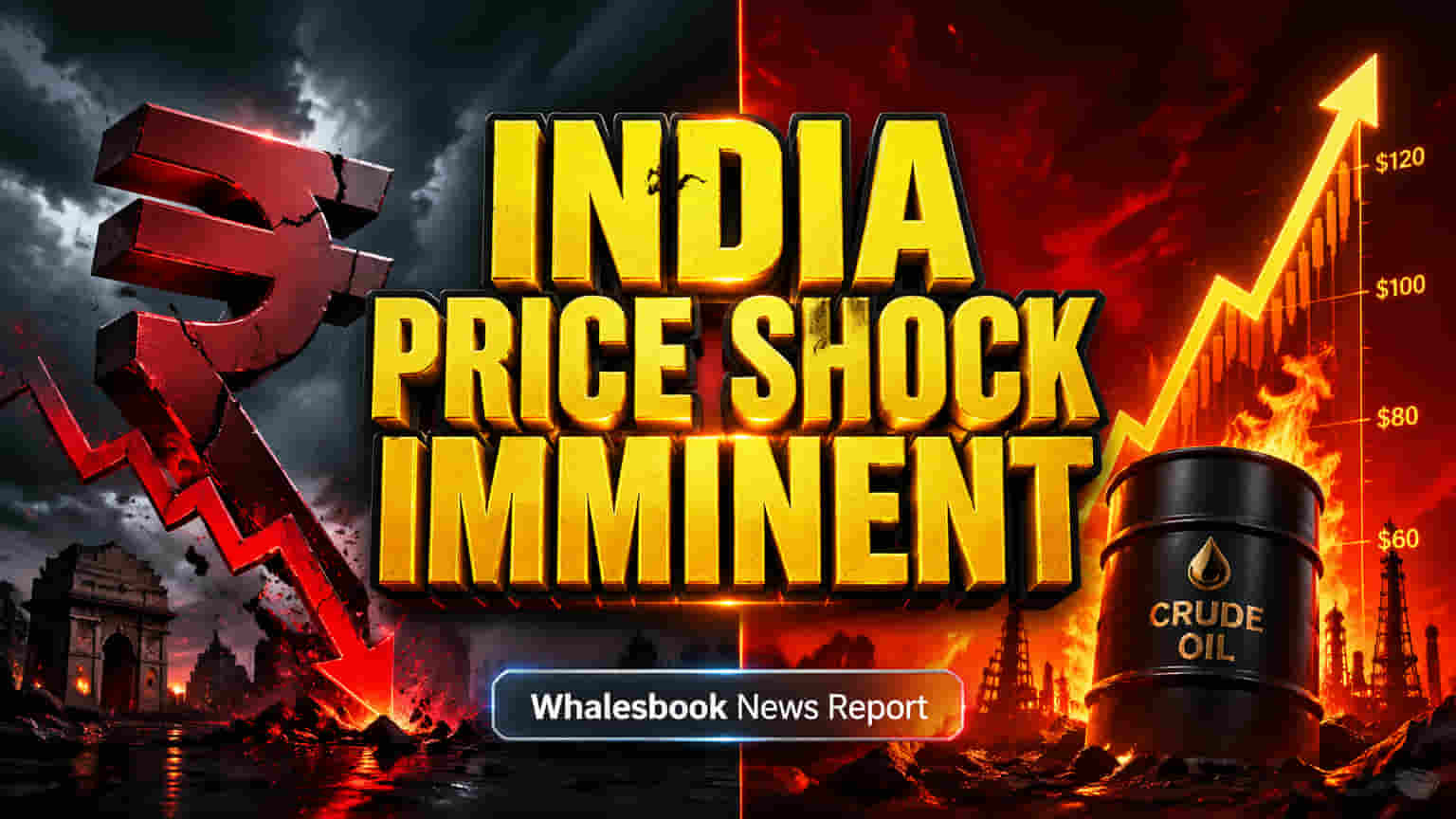


External Pressures Mount
The Indian economy is currently dealing with a combination of external shocks: a weakening rupee against the US dollar and sharply rising global energy prices. As of May 1, 2026, the Indian Rupee is trading around 0.0105 to the US dollar, having depreciated over the past year. This currency drop is worsened by the surge in crude oil prices, with Brent crude futures nearing $111.59 per barrel, reflecting ongoing geopolitical tensions that have pushed prices to four-year highs. This combination increases imported inflation, widens the current account deficit (CAD), and strains government finances. The benchmark indices, Nifty 50 and BSE Sensex, have shown this concern, with the Nifty 50 posting a 1-year return of -0.31% and the Sensex a year-on-year decline of -3.06%. The Sensex's Price-to-Earnings ratio is 21.1, and the Nifty 50's is 20.9, suggesting valuations that may face challenges.
Policymakers' Difficult Choices
For policymakers, the current economic situation presents complex trade-offs, making decisive action a delicate balancing act. The Reserve Bank of India (RBI) must manage inflation without hindering economic growth. Raising interest rates, a common way to control inflation, risks slowing down investment and consumption, which are key to India's expansion. At the same time, the government faces fiscal pressures. Efforts to help consumers with rising fuel prices through tax cuts and subsidies, while politically necessary, stretch public finances, which already show a deficit around 4.4%. Supporting the rupee by intervening in the market uses up foreign exchange reserves, a limited resource. These factors mean solutions to one problem can worsen another, leaving little room for easy answers and requiring carefully planned actions.
Risk of Stagflation Grows
A significant concern from this scenario is the risk of mild stagflation – a period of rising inflation alongside slowing economic growth. Higher oil prices directly raise transportation and production costs, which then lead to higher prices for many goods and services. This inflation is made worse by the weakening rupee, making all imports more expensive. Furthermore, forecasts for the Southwest Monsoon in 2026 suggest 'below normal' rainfall, potentially reducing agricultural supplies and further pushing up food prices, a major part of India's inflation. While economists forecast GDP growth to remain relatively strong, between 6.4% and 7.1% for 2026, the rising inflation risks are concerning. This mix of persistent price pressures and moderating growth creates an environment where people's real income could stop growing.
Consumer Squeeze Builds Slowly
While consumers have been partly protected from direct price rises in petrol and domestic LPG, the effects are starting to show indirectly. Energy costs, a large part of household spending, affect transportation, food, and service expenses. As fuel prices climb, so do logistics costs, ultimately leading to higher retail prices for everyday items like vegetables and packaged goods. Economists expect a gradual but noticeable squeeze on household disposable income, potentially leading to cuts in non-essential spending and a shift to cheaper alternatives. This is not a sudden crisis but a slow erosion of buying power, typical of the complex economic challenges India is facing.
Key Economic Risks
Despite India's strong economic fundamentals like robust domestic demand and a growing investment rate, vulnerabilities remain. The current account deficit, projected to average around 1.5% of GDP over the next five years, is a main concern, especially as it is heavily influenced by oil and fertilizer import costs. The rupee's depreciation is increasingly seen not just as a shock absorber but as a way imported inflation enters the country. Reports indicate the rupee's fall has occurred despite India's strong macro fundamentals, suggesting market speculation and foreign institutional investor (FII) outflows, which reached $6.4 billion between April 2025 and February 2026, have contributed significantly. Relying on energy imports, with India importing about 86% of its energy needs, leaves it very sensitive to global price swings. While the government has buffers, including foreign exchange reserves and fiscal policy flexibility, these are not unlimited, and the room for error is shrinking considerably.
Growth Outlook and Buffers
Looking ahead, analysts expect continued, though slower, growth for India in 2026. Goldman Sachs forecasts real GDP growth at 6.9%, while others predict rates around 6.4%. Inflation is expected to stay within the RBI's target range of 2-6% over the medium term, with forecasts from 4.5% to 5.1% for the year. India's economy retains significant strengths, including strong domestic demand, increasing government spending on infrastructure, and a generally stable financial system. However, how external shocks – currency depreciation, energy price volatility, and geopolitical instability – are linked presents a complex challenge requiring careful policy management. With no easy solutions, the path forward requires careful management to protect growth while keeping inflation expectations stable.