 Whalesbook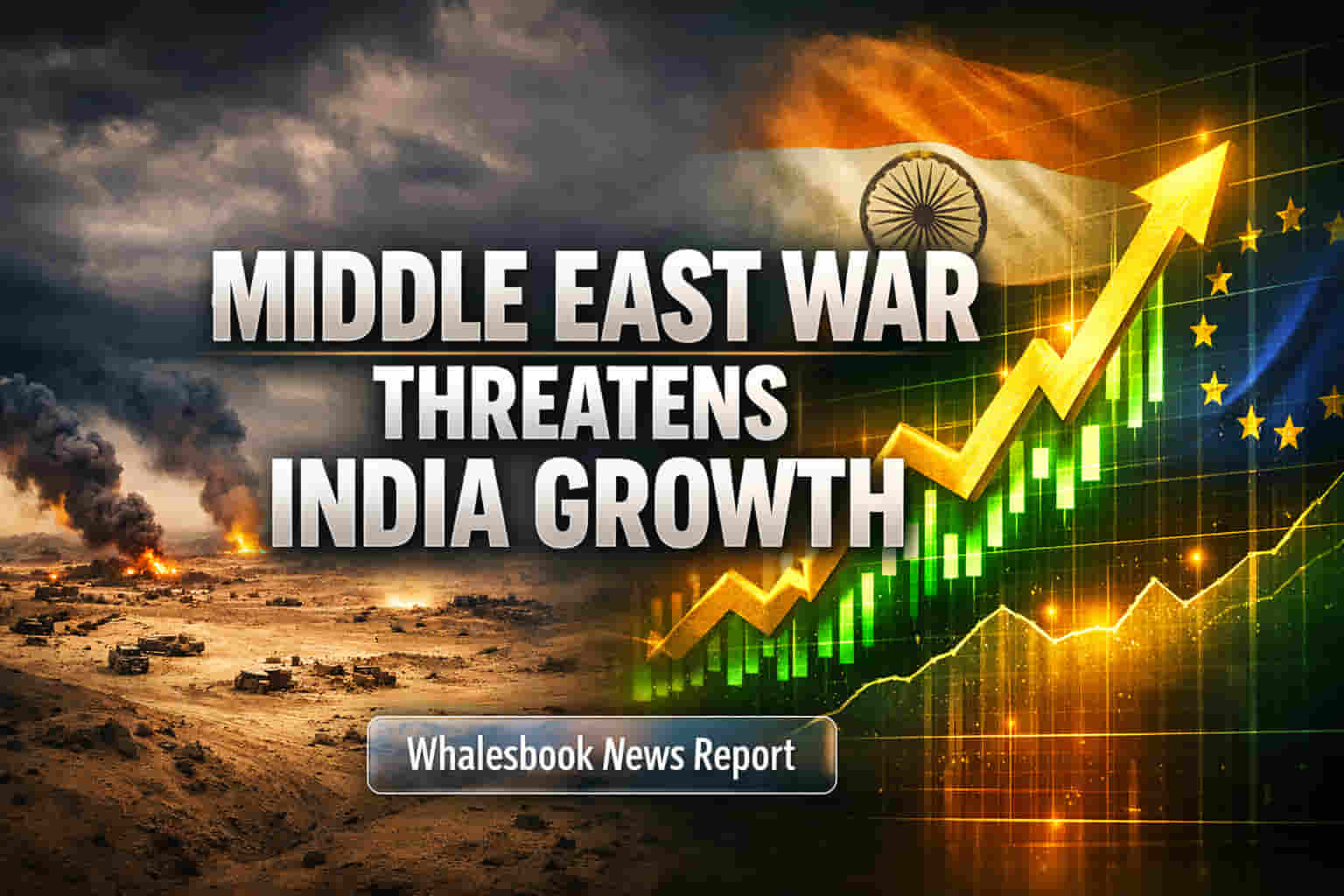


India's Economic Tightrope: Trade Aspirations Meet Geopolitical Reality
The Indian economy finds itself at a critical juncture, navigating a delicate balance between the substantial economic uplift promised by strategic trade agreements and the considerable downside risks emanating from escalating geopolitical tensions in the Middle East. Forecasts for fiscal year 2026/27 reflect this duality, with institutions offering divergent outlooks that hinge on the resolution of external volatilities.
The Geopolitical Shockwave
The ongoing conflict, fueled by reciprocal strikes between Iran, the US, and Israel, has introduced significant uncertainty. The Strait of Hormuz, a vital transit point for approximately 20% of global oil supply, faces substantial disruption. Concerns over potential blockades have already driven Brent crude oil prices to surge, reaching $79.53 per barrel on March 3, 2026. This volatility directly threatens India's energy security, given its reliance on imports for roughly 88% of its crude oil needs [cite: News1]. Analysts warn that prolonged disruption could push oil prices above $100 per barrel. Such a scenario would not only swell India's import bill but also fuel inflationary pressures, with projections indicating retail inflation could climb to 4.3% in FY27 from an estimated 2.5% in FY26. The Reserve Bank of India (RBI) has projected inflation at 4% for Q1 FY27 and 4.2% for Q2 FY27, but these figures do not fully account for the immediate impact of Middle Eastern conflict. The Indian Rupee has also shown weakness, trading at 91.9240 against the US Dollar on March 3, 2026, down 5.41% over the past year. This inflationary environment and currency depreciation risk higher borrowing costs and dampen consumer confidence.
Trade Pacts: A Potential Counterbalance?
Offsetting some of these headwinds are significant trade agreements. India has finalized a Free Trade Agreement (FTA) with the European Union, expected to double bilateral trade and offer substantial tariff reductions on goods such as engineering products and marine exports. Separately, an interim trade deal framework with the United States, effective by March 2026, lowers US tariffs on Indian goods to 18% and includes India's commitment to purchase $500 billion in US products over five years. This deal aims to de-escalate trade tensions and facilitate increased market access for Indian textiles, pharmaceuticals, and steel. While these agreements are designed to boost exports and domestic manufacturing, their full impact is subject to ratification processes and implementation timelines, with some analysts estimating a limited GDP impact of 0.15-0.3% from the US deal.
The Forensics Bear Case (The Hedge Fund View)
The confluence of geopolitical instability and trade uncertainties creates a complex risk profile. While BMI projects 7% GDP growth for FY2026/27, other agencies offer a more nuanced view. The IMF, for instance, forecasts 7.3% for FY26 and 6.4% for FY27, noting India's growth is driven by a "balancing of divergent forces". A primary concern is the potential for an inflationary spiral, where rising energy prices, coupled with supply chain disruptions, could erode purchasing power and strain fiscal budgets through increased subsidy outlays for essentials like LPG. Foreign investment, a crucial engine for India's growth, may falter amid heightened geopolitical risk and investor hesitancy. Furthermore, the US trade deal remains provisional, and the US has demonstrated a willingness to offer competitive terms to other regional partners like Bangladesh, potentially undercutting India's negotiated advantages. The dependence on imported fossil fuels, estimated at 88% of crude oil needs, exposes India to significant external shocks, a structural vulnerability that clean energy transition initiatives must contend with.
The Future Outlook
India's economic trajectory for FY2026/27 will be heavily influenced by the duration and severity of the Middle East conflict and the successful integration of its new trade partnerships. Projections from the IMF, World Bank, and RBI suggest a strong growth outlook, but these are predicated on a relatively stable global environment. The near-term inflation outlook, with projections by Crisil and the RBI pointing to an increase in FY27, suggests that policymakers will face challenging trade-offs between growth and price stability. The coming months will be critical in determining whether the momentum from trade deals can override the disruptive potential of regional conflict, or if emerging market headwinds will temper India's expansionist ambitions.