 Whalesbook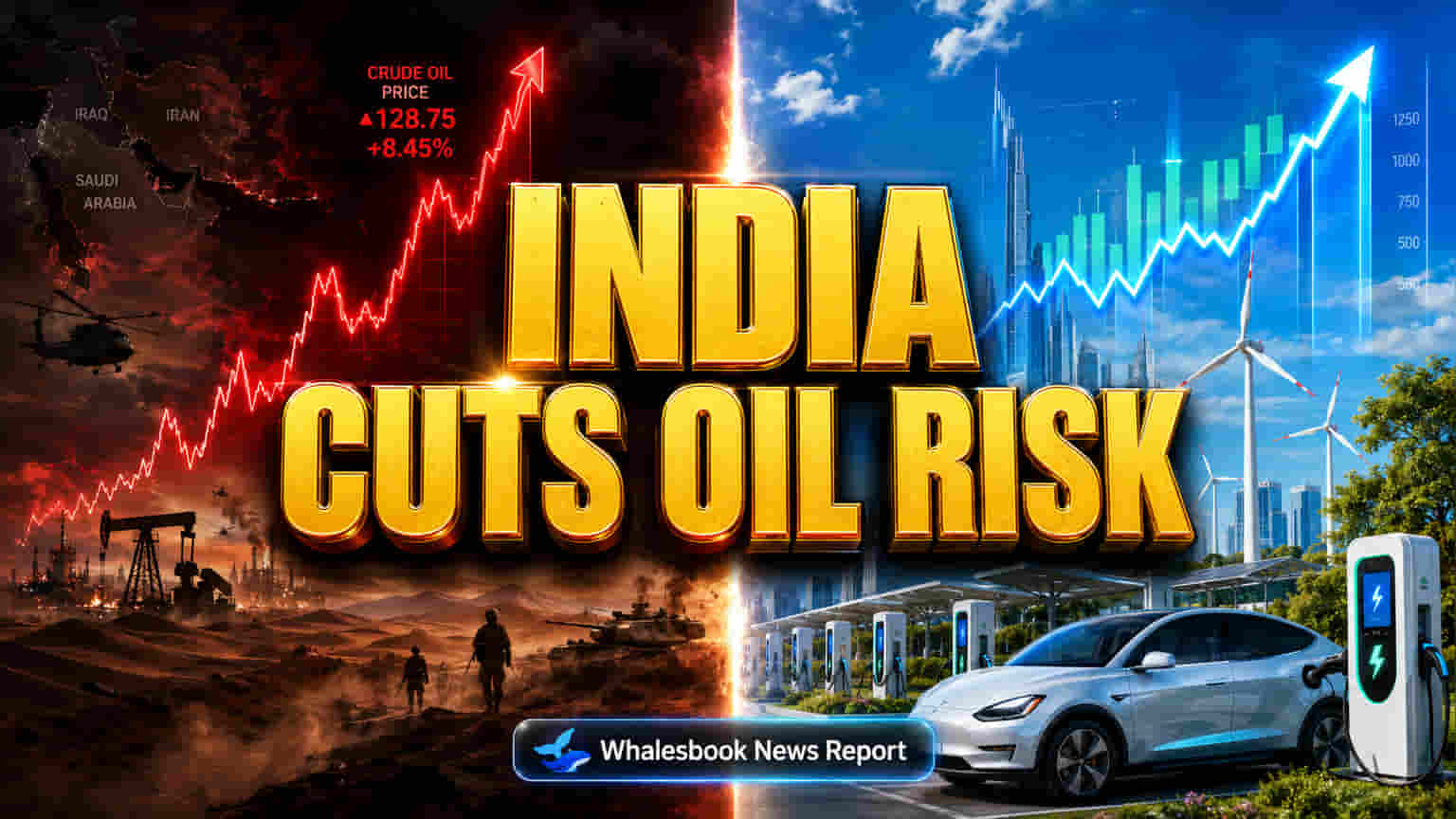


Geopolitical Tensions Threaten India's Energy Security
India is at a critical point in its energy security, balancing a push for electric vehicles (EVs) and renewable energy with immediate financial needs. Rising geopolitical tensions in West Asia, a major source of its oil, pose a significant risk. With India relying on imports for over 88% of its crude oil, sustained prices above $100 a barrel directly threaten its current account deficit and currency. While renewable energy capacity is growing – expected to be 20.2% of the power mix in FY25 and 40% of installed capacity by late 2025 – a major challenge remains bridging the gap in EV adoption and achieving energy self-sufficiency.
Macroeconomic Pressures Mount as Oil Prices Rise
The automotive sector's high valuation, with a Price-to-Earnings (P/E) ratio around 30.3x, adds to the pressure. This, combined with rising crude oil prices (Brent crude is trading around $103.06 a barrel), is straining the Indian Rupee (INR), which has fallen 12.03% in the past year to reach 95.1760 against the US dollar as of May 11, 2026. Although India's economy is in a better position than during the 2013 taper tantrum, complacency is not an option. If oil prices stay above $100 a barrel for an extended period, the current account deficit could widen significantly, which is a greater concern for policymakers than a slower economic growth rate. Government strategies to counter this include promoting EVs, renewables, and public transport. However, EV adoption, at about 8% of sales last year, lags far behind the global average of 25%.
Long-Term Reforms vs. Short-Term Fixes
This situation highlights a split between necessary long-term structural changes and immediate policy actions. While expanding public transport, encouraging remote work, and investing in alternative fuels are vital for cutting the energy import bill, their effects take time. Short-term actions, like limiting gold imports or adjusting remittance rules, might offer minor help but are not enough on their own. The Reserve Bank of India (RBI) is reportedly looking into a special dollar window for oil companies to ease pressure on the rupee, a move seen in other countries. However, attracting large foreign investments through methods like FCNR deposits could be difficult, as global interest rates are much higher now than in 2013.
India's EV and Renewables Progress: A Closer Look
India's renewable energy capacity is growing significantly. Non-fossil fuels accounted for 29.2% of total generation in 2025-26, with total installed capacity from these sources reaching 283.46 GW by March 2026. Solar power alone met 9.4% of India's demand in 2025, positioning the country as the third-largest solar generator worldwide. Despite this, EV penetration in passenger cars was only 3.66% in the first half of 2025, much lower than Germany's 17.7% or Belgium's 32.8%. Government policies are adapting, with updated EV incentives emphasizing performance and efficiency. Subsidies for electric two- and three-wheelers have been extended until July 2026 and March 2028, respectively. The Nifty Auto index P/E ratio hovers around 30.0, indicating investor confidence but also potential risks in valuations.
Key Risks: Oil Dependence and EV Adoption Hurdles
India's main risk is its heavy reliance on imported crude oil, covering about 88% of its needs. Geopolitical instability in West Asia, which supplied over 54% of India's oil imports before recent conflicts, is a direct threat. Any extended disruption through the Strait of Hormuz, a key global transit route for oil and LNG, could trigger severe price surges, possibly over $200 a barrel, and further weaken the rupee. While India's renewable energy capacity is growing fast, it doesn't meet immediate oil demands for transport and industry. Doubts are also rising about the effectiveness of EV subsidies. Experts believe widespread adoption needs strong charging infrastructure and affordability, which remain significant challenges. Delhi's policy to phase out internal combustion engine vehicle registrations by 2027 shows regulatory intent but also the long path to wider adoption outside major cities. India's energy demand is rising, projected to grow from 5.5 million barrels daily to 8.5-10.5 million by 2050. Attracting foreign investment in the oil and gas sector is difficult due to higher global interest rates, suggesting a need for more open policies, according to industry figures. Higher domestic fuel prices, while helping curb consumption, could also increase borrowing costs across the economy.
Navigating India's Energy Future
The path ahead requires careful balance. Analysts agree that while structural reforms are crucial for long-term energy security, immediate financial management and smart policy choices are vital to navigating the current geopolitical climate. The RBI's potential use of a special dollar window could provide some relief for the rupee, but it's not a complete solution. India's resilience against external energy shocks will depend on its continued efforts to boost renewable capacity and EV adoption, along with potential policy changes like adjusting domestic fuel prices. The main focus must be on reducing import dependence by diversifying the energy mix and developing local production, rather than relying only on quick policy fixes.