 Whalesbook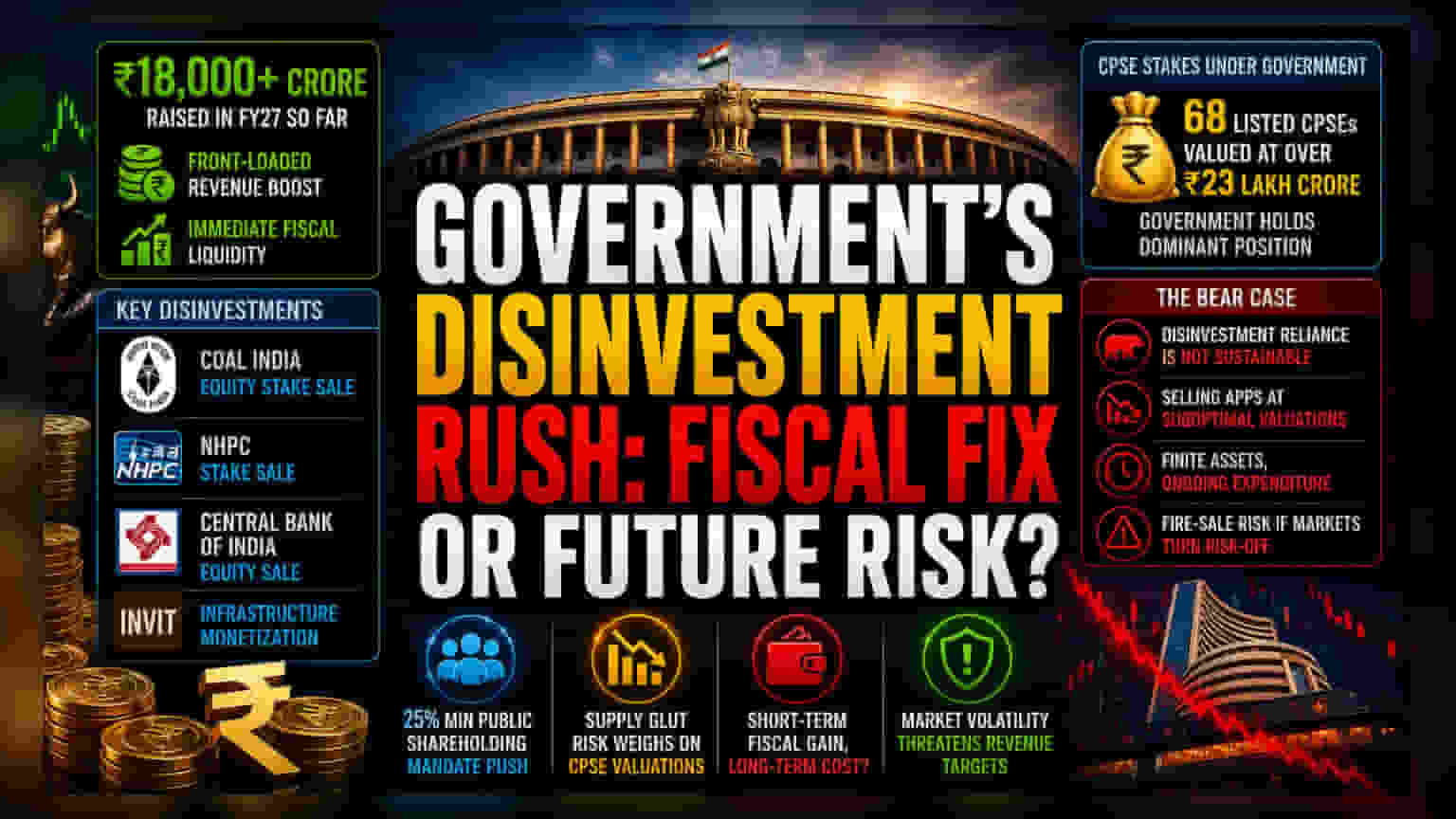


The Illusion of Fiscal Momentum
The rapid execution of disinvestment programs early in fiscal year 2027 suggests a government prioritizing immediate liquidity over long-term strategic ownership. By capturing over ₹18,000 crore through equity stake sales in entities like Coal India, NHPC, and Central Bank of India alongside InvIT-based monetization, the administration has front-loaded revenue to offset anticipated tax shortfalls. While this move provides a temporary cushion against rising subsidy burdens and global inflationary pressures, it exposes the underlying fragility of a budget that increasingly leans on capital receipts to fund recurrent revenue expenditure.
Market Dynamics and Public Shareholding Pressure
The aggressive pace of Offer for Sale events serves a dual purpose beyond mere revenue collection, as regulators push for stricter compliance with the 25% minimum public shareholding mandate. With government equity in 68 listed Central Public Sector Enterprises valued north of ₹23 lakh crore, the state occupies a dominant market position that often keeps equity prices suppressed due to the persistent threat of supply-side gluts. Institutional investors are watching closely to see if this accelerated divestment pace triggers a sustained correction in CPSE valuations, especially as the market absorbs these large-block liquidity events without the benefit of fundamental operational improvements in the underlying companies.
The Forensic Bear Case
Reliance on disinvestment to fill the fiscal deficit is a cyclical trap that leaves the government vulnerable to capital market volatility. Unlike tax-based revenue, which scales with GDP growth, disinvestment proceeds are finite and often divest the state of high-performing, dividend-paying assets that provide steady long-term income. History shows that when the government prioritizes rapid divestment, it frequently does so at suboptimal valuations during periods of high market demand, essentially selling off long-term value for short-term fiscal optics. Furthermore, should global liquidity tighten or domestic equity interest wane, the government may find itself unable to meet the remaining 77% of its target without resorting to fire-sale tactics that could rattle investor confidence in the public sector index.
Future Outlook and Budgetary Risks
The focus on non-tax revenue streams highlights a pivot in economic policy aimed at narrowing the fiscal gap, yet the sustainability of this trajectory remains questionable. Analysts indicate that unless the government balances these capital receipts with significant improvements in tax-to-GDP ratios, the budget will continue to face pressure. The current approach offers a tactical victory in the short term, but the strategy hinges on the assumption that market appetite for CPSEs will remain robust throughout the fiscal year, a condition that could change rapidly in the face of shifting macroeconomic sentiment.