

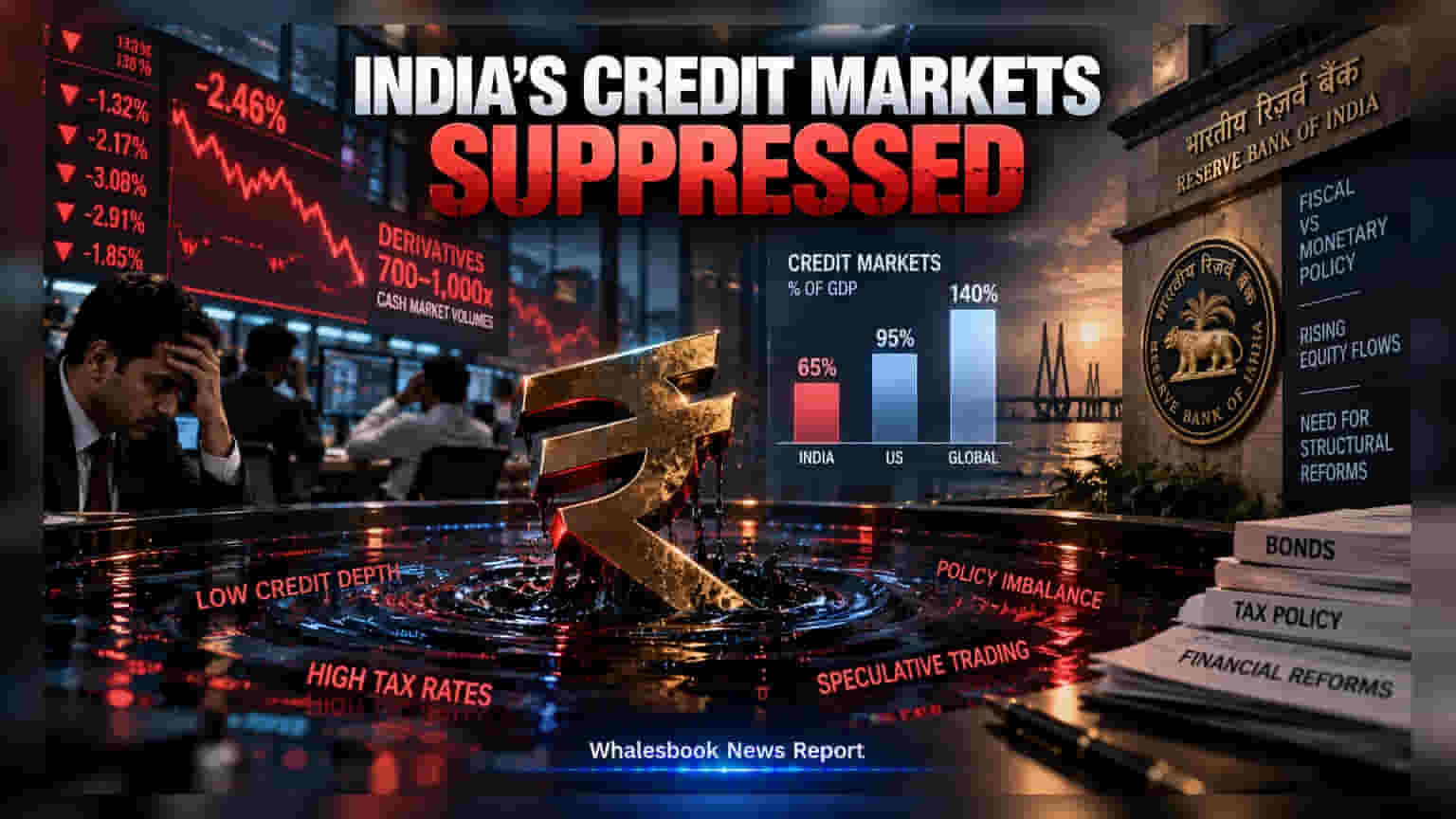
Former SEBI official Ananth Narayan has highlighted that India’s credit market remains small at 65% of GDP compared to the 140% global average. He argues that high tax burdens on fixed income and heavy RBI bond intervention are pushing household savings into risky equity derivatives, raising concerns about retail losses.
At the 13th SBI Banking and Economics Conclave in Mumbai, former SEBI Whole Time Member Ananth Narayan pointed out a structural imbalance in India’s financial sector. He noted that the country’s credit markets currently represent 65% of GDP, which is significantly lower than the 140% global average and the 95% observed in the United States. This indicates that India has a smaller base for debt instruments, forcing more capital into other asset classes.
Narayan identified a conflict between fiscal and monetary policy as a key driver of this imbalance. During FY26, the Reserve Bank of India (RBI) absorbed ₹8.8 lakh crore in government bonds, accounting for roughly 85% of the central government’s net borrowing. When this is combined with high tax rates on fixed deposit interest, traditional savings instruments become less attractive to the average household. As a result, domestic capital is frequently redirected into the equity markets, which can drive up valuations and may deter foreign investors looking for more balanced debt exposure.
This shift toward equity has led to a surge in speculative activity within the derivatives market. Current data shows that 90% of retail participants trading in index options incur losses. Furthermore, 35% of these individuals do not hold any underlying shares, suggesting that many are engaging in pure speculation rather than long-term investment. On peak expiry days, derivative volumes have reached levels 700 to 1,000 times higher than the cash market. Narayan warned that these volumes resemble historical patterns seen in other markets that faced manipulation risks, stressing the need for better evaluation of who is participating in these high-velocity segments.
To address these issues, Narayan proposed several structural reforms. He suggested rebalancing tax incentives for fixed-income products to encourage a more diverse and stable investor base. Additionally, he called for the creation of an independent appellate authority for RBI enforcement actions, similar to the role the Securities Appellate Tribunal (SAT) plays for SEBI. He also encouraged industry organizations like the Indian Banks’ Association to move beyond lobbying and act as proactive watchdogs that identify and report systemic malpractice.
For investors, the key area to monitor will be any shifts in tax policies regarding interest income and potential changes in regulatory oversight for the derivatives segment. The future health of the capital markets may depend on whether policy frameworks can encourage a move back toward balanced debt and equity participation, reducing the current reliance on speculative trading.