 Whalesbook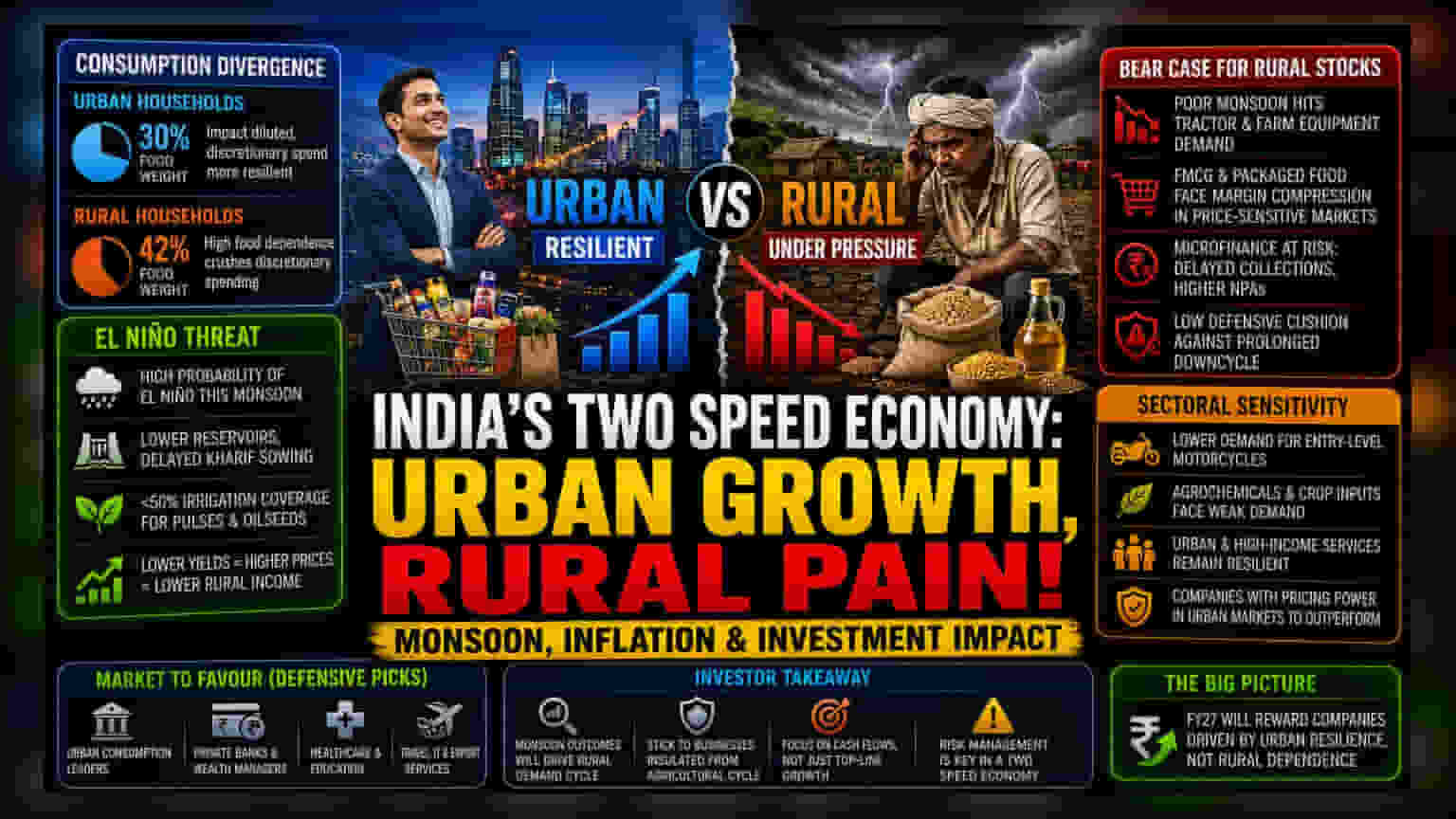


The Consumption Divergence
The Indian economic narrative is shifting toward a bifurcated reality where urban resilience masks deepening rural vulnerability. While the broader market focuses on aggregate growth, the underlying mechanics show a stark separation driven by the disparate weight of food costs within consumer baskets. In urban households, where food represents roughly 30% of expenditures, the impact of price volatility is relatively diluted. Conversely, the 42% weighting in rural baskets acts as a severe drag, effectively functioning as a tax on discretionary spending when inflation spikes. This structural imbalance ensures that any disruption to agricultural output cascades immediately into a contraction of non-essential purchases.
The El Niño Factor and Yield Volatility
Beyond mere price fluctuations, the primary threat to the rural economy remains the high probability of El Niño weather patterns throughout the Southwest Monsoon season. Historical data indicates that persistent El Niño conditions correlate strongly with diminished reservoir levels and delayed kharif sowing. Crucially, the vulnerability of Indian agriculture is exacerbated by insufficient irrigation infrastructure, particularly for pulses and oilseeds, where less than half of the net-sown area receives consistent water coverage. When rainfall falters, these crops—which are central to both farm income and national food security—suffer disproportionately, creating a feedback loop of higher food prices and lower rural disposable income.
The Bear Case for Rural-Centric Equities
Investors exposed to firms with high rural penetration face a period of significant earnings risk. The correlation between monsoon performance and tractor sales is well-documented, but the danger extends deeper into the value chain. Packaged food companies and mass-market FMCG players are facing a dual threat: they are unable to fully pass on rising raw commodity costs to a price-sensitive rural demographic, leading to margin compression. Furthermore, the microfinance sector is increasingly exposed to the risk of collection delays as rural household budgets move into survival mode, potentially increasing non-performing assets. Unlike urban-focused private banks or wealth management firms—which benefit from the compounding effect of accumulated capital—these rural-dependent entities possess little defensive cushioning against a prolonged downcycle.
Sectoral Sensitivity and Future Guidance
Looking ahead, the market is expected to heavily favor companies that provide services to the top income quintile, which remains immune to monsoon fluctuations. Analysts expect a defensive rotation away from entry-level motorcycle manufacturers and agrochemical suppliers, as these sectors will likely see reduced demand for crop protection products and discretionary upgrades. The divergence suggests that FY27 will be a year where top-line growth is insufficient; only companies with pricing power in urban corridors or those insulated from the agricultural cycle are positioned to maintain historical valuation premiums.