 Whalesbook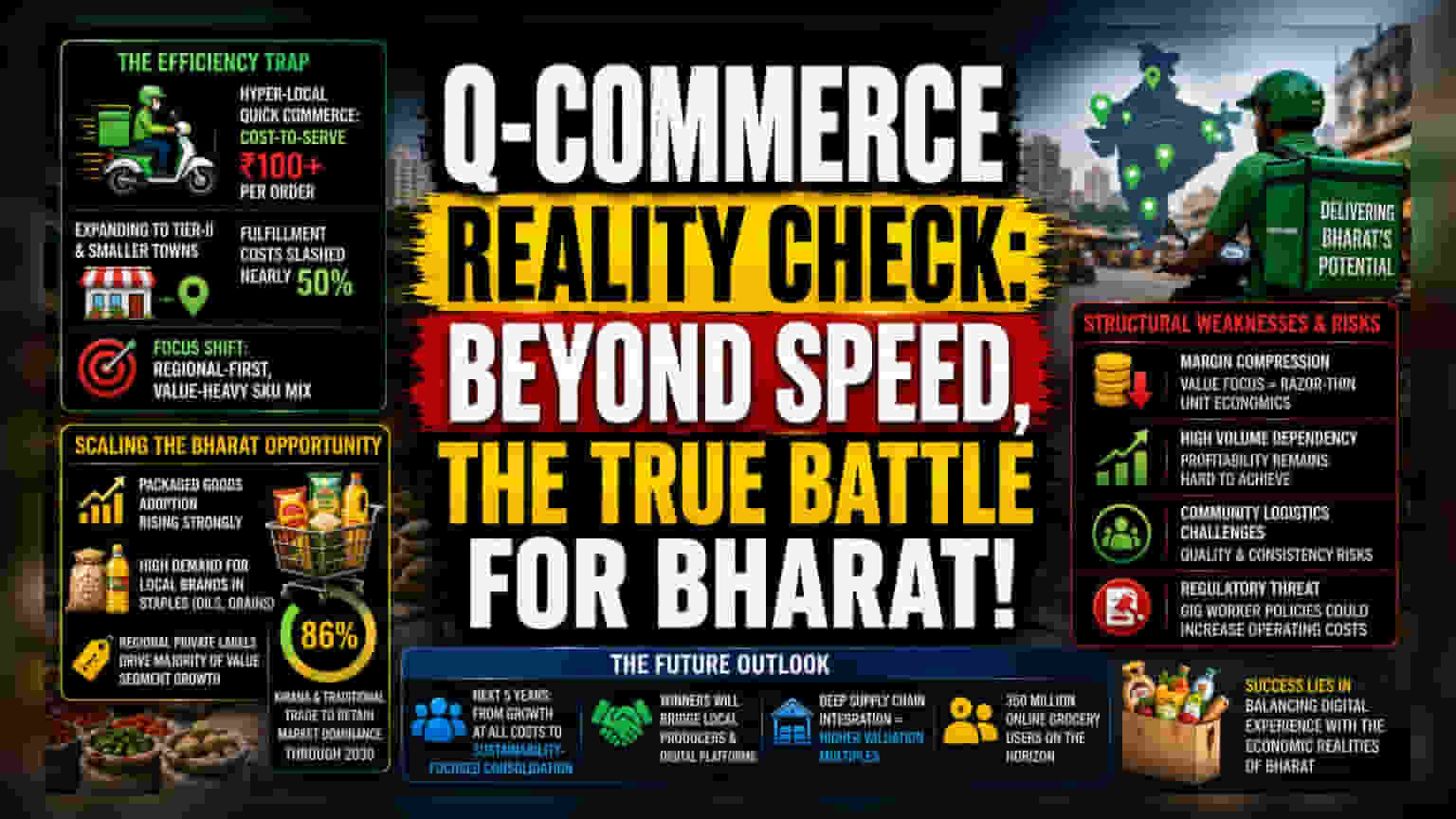


The Efficiency Trap
The obsession with hyper-local quick commerce is increasingly disconnected from the reality of the broader Indian market. While rapid delivery platforms have dominated the conversation in tier-one urban centers, their high cost-to-serve model—often exceeding ₹100 per order—remains a barrier to profitability in secondary markets. As expansion targets shift toward Tier-II and smaller towns, the economic math changes entirely. Sustained growth in these regions relies on lowering fulfillment costs, which are currently being slashed to nearly half through community partner-led distribution networks. Investors are beginning to look past top-line revenue growth, focusing instead on whether platforms can pivot to a regional-first, value-heavy SKU mix without sacrificing their existing logistics infrastructure.
Scaling the Bharat Opportunity
Unlike the hyper-competitive metro hubs where convenience is the primary driver, the 'Bharat' demographic exhibits a distinct pattern of consumption. With packaged goods adoption climbing steadily, particularly in staples like edible oils and grains, the demand for localized brands is at an all-time high. Market analysis suggests that platforms failing to integrate regional private labels—which now account for a significant majority of successful SKU mixes in high-growth value segments—will struggle to retain market share against traditional kirana networks. The resilience of the traditional trade, which is expected to retain 86% market dominance through 2030, serves as a benchmark for how much physical presence and trust matter compared to mere digital speed.
Structural Weaknesses and Risk Factors
Despite the optimistic projections for online grocery penetration, there are profound systemic risks. The primary concern is the margin compression inherent in pivoting to value-focused models. When platforms shift focus to smaller pack sizes and lower-priced regional stock, the unit economics become razor-thin. This creates a dependency on high volume to achieve profitability, a feat that has remained elusive for many Indian e-commerce players. Furthermore, the reliance on community-led logistics introduces quality control and consistency challenges that traditional, centralized warehouse models do not face. There is also the threat of regulatory intervention regarding the treatment of gig workers in these decentralized logistics chains, which could potentially force a rapid restructuring of operational costs.
The Future Outlook
Institutional analysts are recalibrating their expectations for the sector, viewing the next five years as a transition from a 'growth-at-all-costs' phase to a 'sustainability-focused' consolidation. Companies that prioritize deep supply chain integration—specifically those capable of bridging the gap between local producers and the digital storefront—are likely to command higher valuation multiples than those tethered to the quick-commerce paradigm. As the market reaches the anticipated 350-million-user threshold, the winners will likely be the platforms that successfully balance the digital experience with the economic realities of the average Indian household.