

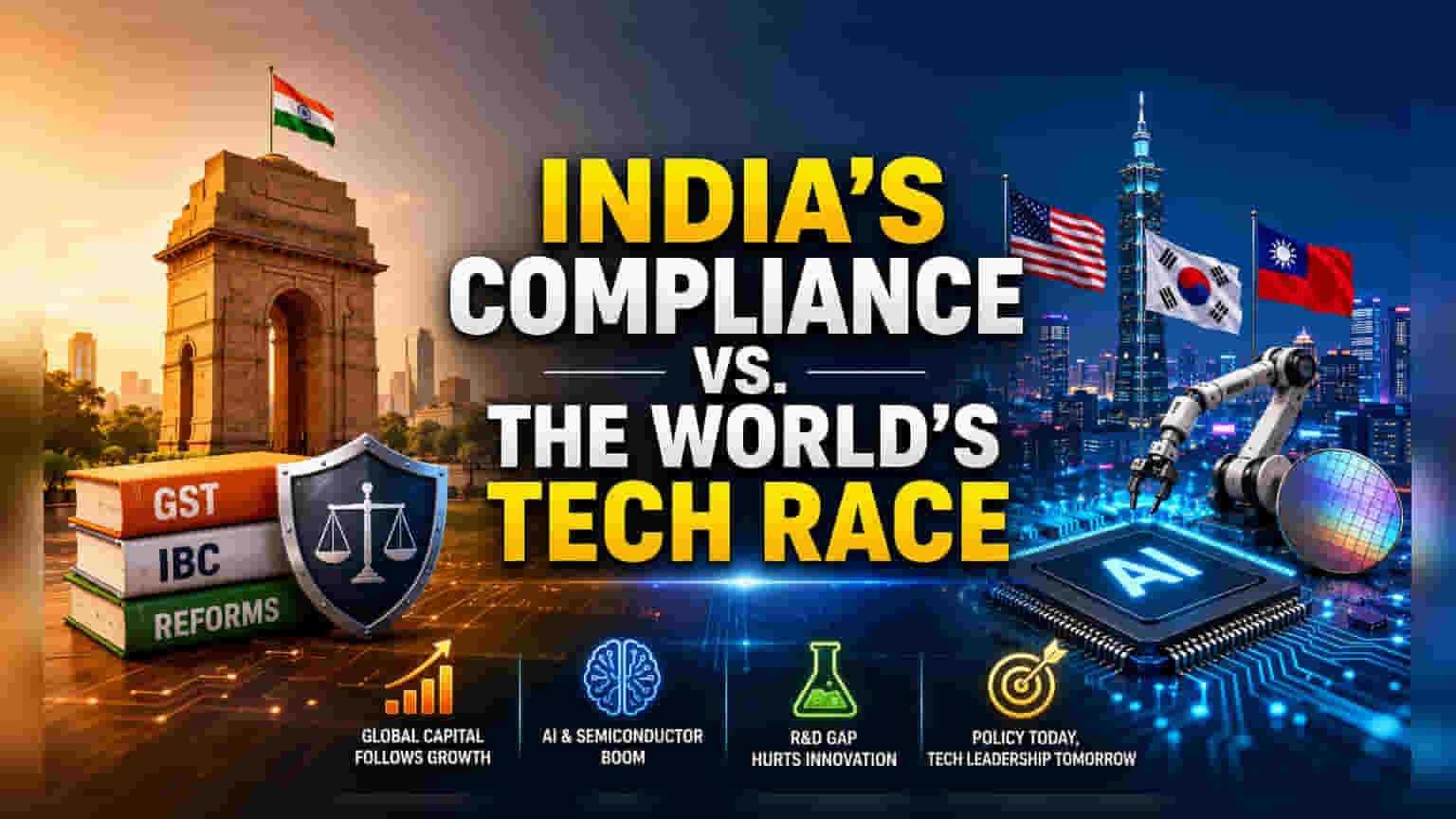
India’s decade of economic formalization has built stability, but global investors are currently prioritizing markets heavily exposed to AI and semiconductors. As capital chases these high-growth sectors, analysts are debating whether India needs to boost its research spending to remain competitive for global investment.
What Happened
Over the past decade, India has focused heavily on structural reforms, such as the Goods and Services Tax (GST) and the Insolvency and Bankruptcy Code. These moves were designed to make the economy more transparent, formal, and easier to navigate for businesses. While India was cleaning up its balance sheets and regulatory framework, developed economies like the United States, along with hubs like Taiwan and South Korea, were aggressively pouring capital into artificial intelligence, semiconductors, and deep technology. This divergence has sparked a debate on whether India’s compliance-first approach has come at the cost of global innovation leadership.
The Capital Flow Trade-Off
Investors operate in a global market where capital flows to the highest growth potential. The current trend shows that global investment is heavily skewed toward markets that provide direct exposure to the AI and semiconductor boom. While India remains a stable growth market, it does not currently offer the same concentration of deep-tech companies that are driving global market valuations. This has caused a shift in how some foreign investors allocate their money, favoring markets with entrenched hardware and advanced tech ecosystems over those primarily focused on software services.
The Innovation Gap
One of the main areas of concern is public and private spending on research and development. According to industry data, India’s Gross Expenditure on Research and Development (GERD) stood at approximately 0.64% of GDP in the 2020-21 period. When compared to global peers—where South Korea spends over 5%, the United States over 3%, and China over 2.5%—the gap becomes clear. Manoranjan Sharma, Chief Economist at Infomerics Ratings, highlighted that India's push for compliance and stability has not been matched by a similar intensity in patent approvals or applied research infrastructure, which are vital for long-term tech competitiveness.
Why Earnings Drive Capital
Not all analysts view this as a failure of policy. Dr. VK Vijayakumar, Chief Investment Strategist at Geojit Investments, points out that global capital is primarily driven by earnings potential. Investors are not necessarily ignoring India; they are chasing the extraordinary profit growth currently found in the AI and chip-making sectors of Taiwan, South Korea, and the US. In this view, the movement of capital is a rational response to where the most significant immediate returns are being generated, rather than a rejection of India’s economic framework.
What Investors Should Track
India’s strength remains its vibrant startup ecosystem and its massive IT services export sector, which continue to attract interest. However, the move toward higher-value hardware is still in early stages. Investors may monitor how the country bridges this gap, specifically watching developments in the government's semiconductor mission and policies designed to incentivize deep-tech research. The key monitorable will be whether India can translate its policy-driven compliance success into an environment that fosters large-scale, globally dominant technology manufacturing.