

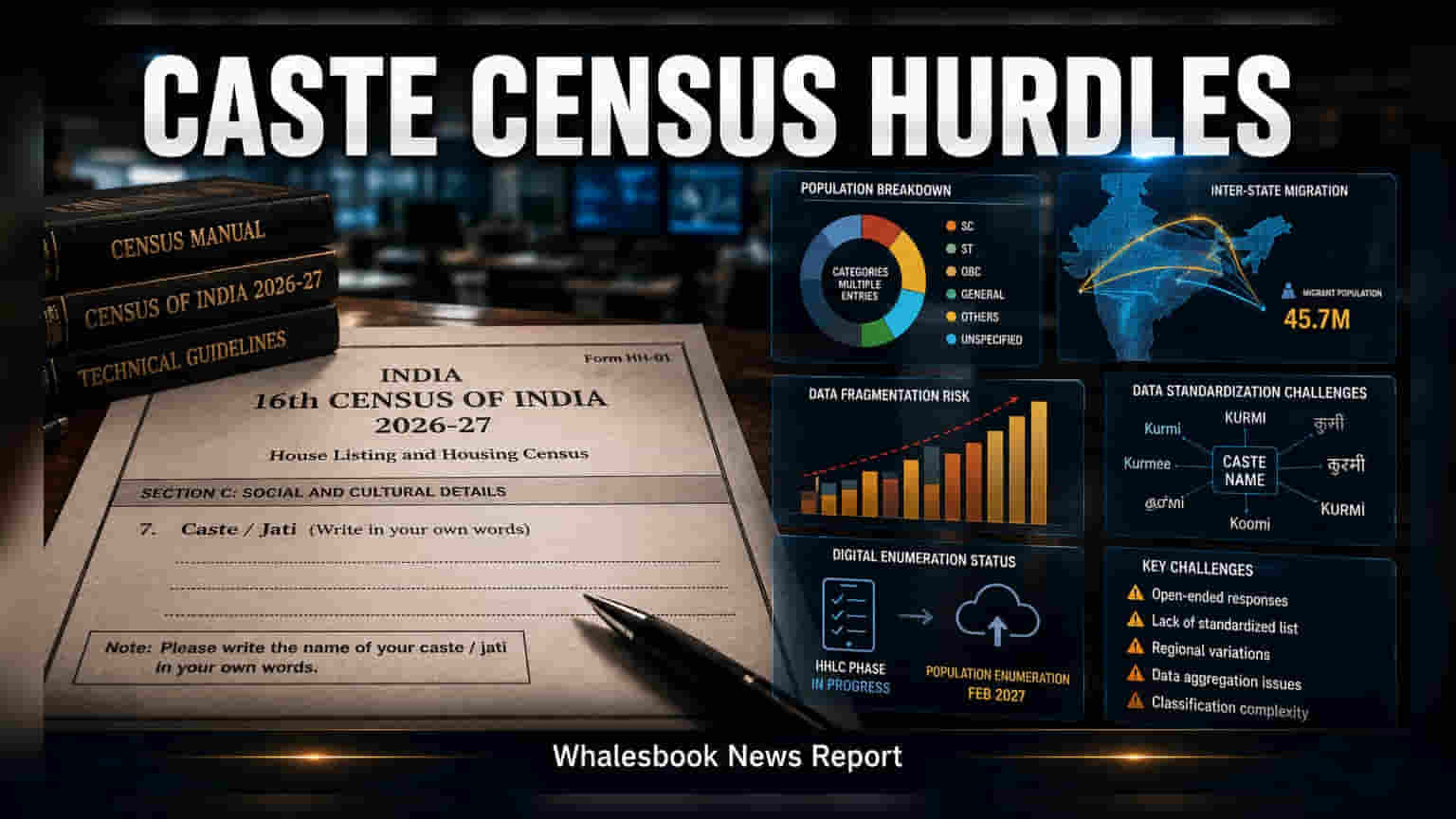
India’s first digital census, currently in its housing enumeration phase, faces technical concerns over the collection of caste data. Experts warn that reliance on open-ended respondent answers, rather than a standardized list, could lead to fragmented and unusable information. This methodology risks repeating historical data challenges, potentially impacting the utility of the census for future policy and resource allocation.
India’s 16th decennial census, which is currently being conducted as the country's first fully digital enumeration, has encountered significant administrative and technical scrutiny regarding its methodology for collecting caste data. With the Houselisting and Housing Census phase already underway and scheduled to conclude in September 2026, the government’s approach to capturing caste-based information has become a central point of debate.
At the core of the issue is the government's decision to use an open-ended question for caste identification. Unlike surveys that utilize a pre-vetted, standardized drop-down menu or master list, this approach relies on respondents to provide their own descriptions. Experts and statisticians have raised concerns that this method may lead to data fragmentation, where varying spellings, local vernacular terms, and inconsistent reporting make it difficult to aggregate the information at a national level. This technical risk draws parallels to the 2011 Socio-Economic and Caste Census (SECC), where a lack of a unified classification framework resulted in millions of entries that were ultimately deemed too difficult to categorize meaningfully.
Beyond the challenge of classification, the census faces complex administrative hurdles stemming from India’s inter-state migration patterns. Because caste categorization often varies by state, a standardized national framework is necessary to ensure accuracy. When respondents report their identity in a state different from their home region, there is a risk that they may be misclassified or relegated to an amorphous 'others' category. Without a robust system to reconcile these regional variations against a national database, the resulting dataset may lose the analytical depth required for effective policy and welfare distribution planning.
These technical challenges are particularly significant given the scale of the exercise, which covers a population of over 1.4 billion people. The transition to a digital format, utilizing the Census Management and Monitoring System (CMMS) portal and mobile applications, is intended to streamline the process. However, the effectiveness of this digital infrastructure depends heavily on how the captured data is processed and standardized during the subsequent Population Enumeration phase, which is slated to begin in February 2027.
For policymakers and stakeholders, the utility of the census data depends on the government's ability to resolve these classification issues before the final data is released. The key monitorable for the coming months will be whether authorities introduce a formal classification mechanism to clean and structure the open-ended responses, or if the data will require extensive post-collection reconciliation. The outcome of this exercise will likely influence how the government approaches future resource allocation, reservation systems, and long-term socio-economic planning.