 Whalesbook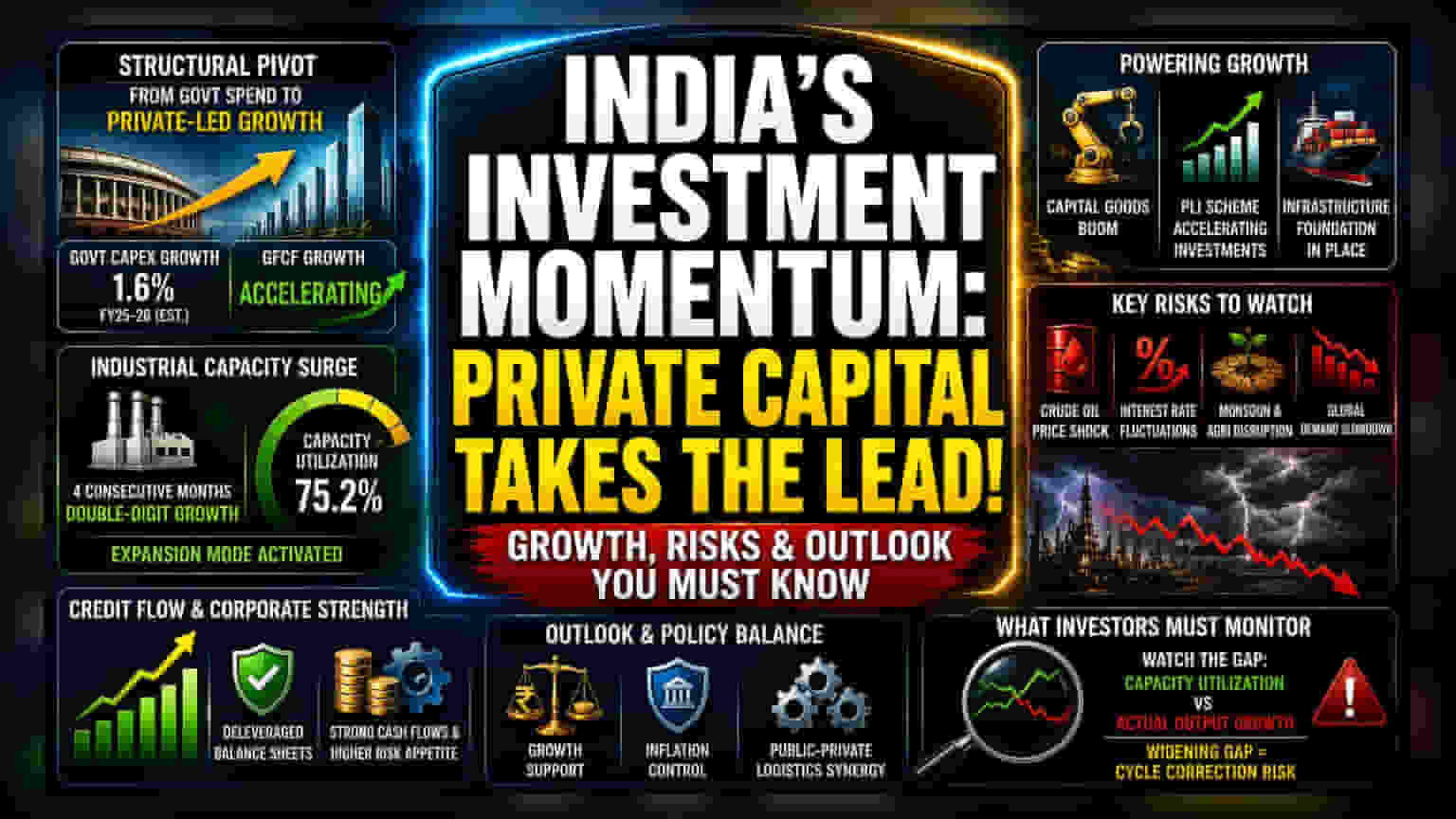


The Structural Pivot in Capital Formation
The trajectory of Indian capital formation is undergoing a fundamental realignment. The fiscal dependency on central government capital outlays, which characterized the immediate post-pandemic recovery, is yielding to a more organic, private-led expansion. While headline government spending growth has decelerated to a projected 1.6% for fiscal year 2025-26, the broader Gross Fixed Capital Formation (GFCF) continues to accelerate, suggesting that corporate balance sheets have finally reached the critical mass necessary to absorb the infrastructure groundwork laid over the last three years.
Industrial Capacity and Credit Dynamics
The surge in capital goods production, evidenced by four consecutive months of double-digit growth in the Index of Industrial Production, reflects a synchronized effort by manufacturers to resolve supply-side constraints. With capacity utilization at 75.2%, industries are nearing the threshold where further output expansion necessitates greenfield projects rather than simple efficiency gains. This trend is bolstered by the Production Linked Incentive (PLI) framework, which has functioned as a de-risking mechanism for long-term commitments. Unlike previous cycles where domestic investment remained defensive, current credit flows indicate a higher risk appetite, fueled by deleveraged corporate balance sheets and improved cash flow visibility across heavy engineering and manufacturing sectors.
The Forensic Bear Case: Vulnerabilities in the Cycle
Despite the optimistic shift, the reliance on private capital introduces new sensitivities to global volatility. The most immediate threat is the fragile equilibrium in West Asia; any escalation leading to a sustained rise in crude oil prices would instantly squeeze corporate operating margins through higher energy and logistics costs. Unlike the government-led phase, which was insulated by sovereign budget allocations, a private-led cycle is highly sensitive to interest rate fluctuations. If persistent inflation forces the Reserve Bank of India to maintain or raise rates, the current momentum in capital goods could evaporate.
Furthermore, the shadow of climate-induced agricultural disruption remains a structural concern. A poor monsoon cycle would suppress rural consumption, narrowing the demand visibility that many firms currently use to justify expansion. There is also the risk of 'mal-investment' if firms scale capacity prematurely, assuming that export demand will compensate for any domestic consumption shortfall. If the global growth outlook cools, this capacity may become a burden on balance sheets rather than an asset.
Future Outlook and Policy Constraints
The central bank remains cautious, balancing the necessity of supporting growth with the mandate of controlling inflation. While credit growth to the industrial sector remains buoyant, future momentum depends on the stability of input costs and the continuation of public-private logistics synergies. Investors should monitor the delta between capacity utilization and actual output growth; should this gap widen without a corresponding rise in end-user demand, the transition from state-led to private-led investment may face a sharp, cyclical correction in the coming fiscal quarters.