

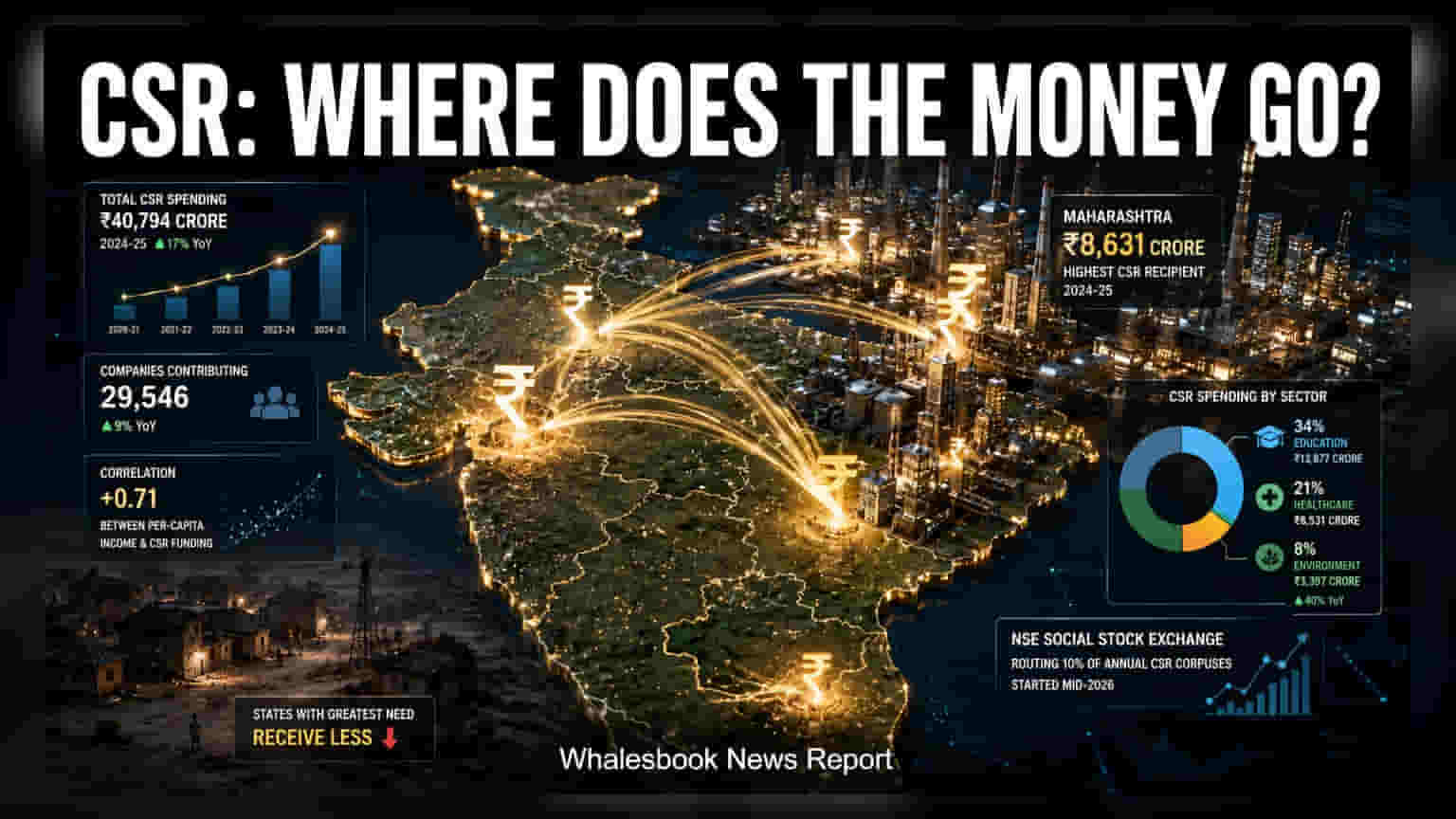
Corporate India’s social responsibility spending rose 17% to a record ₹40,794 crore in FY2024-25, led by education and healthcare investments. However, data reveals a persistent pattern where funds flow toward wealthier states, leaving underdeveloped regions underserved. For investors, this highlights the growing importance of how companies measure social impact, with regulators pushing for better transparency through platforms like the Social Stock Exchange.
Corporate India’s social responsibility spending has reached a new high, with total outlays hitting ₹40,794 crore in the 2024-25 financial year. This 17% increase from the previous year reflects a 9% rise in the number of contributing companies, totaling 29,546. While the absolute increase in funding marks a significant commitment, the geographical distribution of this capital suggests a growing challenge regarding equitable development.
Data from the 2024-25 period shows a strong correlation of +0.71 between a state's per-capita income and the amount of corporate social responsibility (CSR) funding it receives. This indicates that money is consistently flowing to regions that are already economically developed and industrialized. Maharashtra, for instance, topped the list as the largest recipient, securing ₹8,631 crore in CSR funds. In contrast, states with the greatest developmental needs often struggle to attract comparable levels of investment. This pattern arises because many companies prefer to implement projects near their own operational hubs or headquarters, where it is easier to manage, monitor, and report on the impact of their spending.
Sector-wise, education remains the primary focus, accounting for 34% of the total expenditure at ₹13,877 crore. Healthcare followed closely, representing 21% of the total at ₹8,531 crore. Environmental sustainability also saw a notable shift, recording a 40% growth in spending to reach ₹3,397 crore, signaling that corporate efforts are increasingly aligning with global climate goals.
This trend of geographical concentration has prompted a discussion among policymakers about the effectiveness of current spending. Critics argue that the current model, which allows companies to independently choose project locations under Section 135 of the Companies Act, often leads to a mismatch between private capital and the areas of most acute public need. To address these gaps, there is a growing push toward incentive-based frameworks. The government and various advisory bodies are evaluating whether offering tax benefits or streamlined compliance for projects in underdeveloped or 'aspirational' districts could better align private sector resources with national development priorities.
For investors, the focus is shifting beyond simple compliance. The introduction of mechanisms like the NSE Social Stock Exchange, which began operationalizing the routing of 10% of annual CSR corpuses in mid-2026, signals a change in how social impact is measured and reported. As regulatory bodies demand more transparency and geography-tagged impact data, companies will likely face more scrutiny regarding where their CSR funds go and what measurable outcomes they produce. The key update for market participants to track will be whether companies begin to pivot their project locations toward districts with lower development benchmarks, driven by potential policy shifts or increased institutional investor demand for genuine, measurable social impact.