 Whalesbook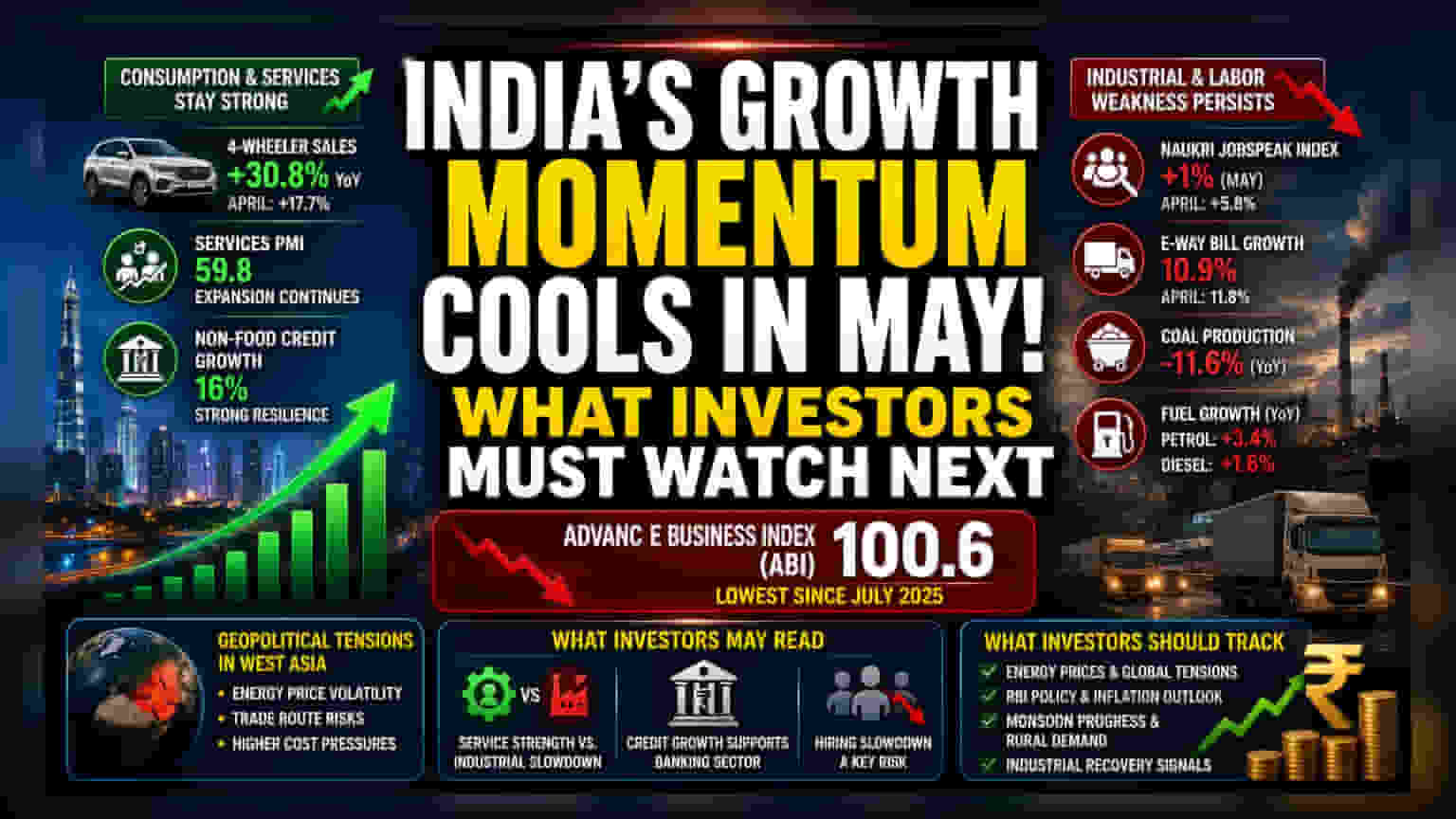


India's Advance Business Index (ABI) dipped to 100.6 in May, its lowest level since July 2025, signaling a moderation in economic momentum. While the index indicates growth remains above trend, diverging patterns have emerged: robust services and urban vehicle demand are being offset by a slowdown in hiring, industrial logistics, and fuel consumption. Investors are weighing these mixed signals amid global geopolitical caution.
What Happened
India's economic momentum showed signs of cooling in May as the Advance Business Index (ABI) fell to 100.6. This is the lowest reading since July 2025, continuing a downward trend from 101.2 in April and 103.0 in March. While the index remains above the 100 mark—which generally separates expansion from contraction—the steady decline suggests the economy is shifting from a period of high-speed growth toward a more moderate pace.
Consumption Strength Versus Industrial Weakness
Data for May paints a tale of two economies. On the positive side, urban consumption remains a reliable engine. Four-wheeler sales grew by 30.8% year-on-year, a significant jump from 17.7% in April, pointing to strong demand in the premium and urban segments. The services sector also continues to perform well, with the Services PMI holding steady at 59.8, indicating continued expansion in areas like banking, IT, and hospitality. Non-food credit growth, which measures lending to businesses and individuals, also showed resilience at 16%.
However, these strengths are being tested by weakness in the industrial and labor markets. Hiring activity has decelerated sharply, with the Naukri JobSpeak Index recording only 1% growth in May, compared to 5.8% the previous month. This suggests companies may be taking a cautious approach to workforce expansion. Industrial logistics, measured by e-way bill generation, also eased to 10.9% from 11.8%. Furthermore, coal production saw a contraction of 11.6%, while fuel consumption—a proxy for industrial and transport activity—saw petrol and diesel growth slow to 3.4% and 1.6%, respectively. This data suggests that while the service-oriented economy is holding up, the industrial and manufacturing sectors are facing increased pressure.
The Geopolitical Impact
Economic sentiment has been weighed down by ongoing geopolitical tensions in West Asia. These conflicts have created uncertainty in global energy markets and raised concerns about trade route disruptions. For India, which relies on energy imports, volatility in energy prices often creates a ripple effect, impacting margins across manufacturing and logistics industries. This external pressure is contributing to a more conservative business environment, as companies navigate the potential for higher operating costs.
How Investors May Read This
Investors often look at these indices to gauge whether the economy is overheating or entering a slowdown. The current moderation suggests that the rapid pace seen in the first quarter of the year is leveling off. For market participants, this dichotomy between strong service-led growth and weaker industrial/hiring signals is important. Companies that are heavily dependent on mass-market consumption or industrial fuel usage may face different headwinds than those focused on premium services. The resilience in credit growth is a positive sign for the banking sector, but the hiring slowdown warrants attention as it could eventually impact consumer sentiment if it persists.
What Investors Should Track Next
Looking ahead, the path of the Indian economy will likely depend on several key factors. Investors may track the trajectory of energy prices, as any sharp increase could put further pressure on profit margins across transport and manufacturing. Additionally, the Reserve Bank of India's (RBI) commentary on growth versus inflation will be a critical monitorable, as interest rate policy remains a key driver for business investment and credit demand. Finally, the performance of the monsoon season and its impact on rural demand will be vital, as this could offset some of the current industrial weakness if rural consumption picks up.