

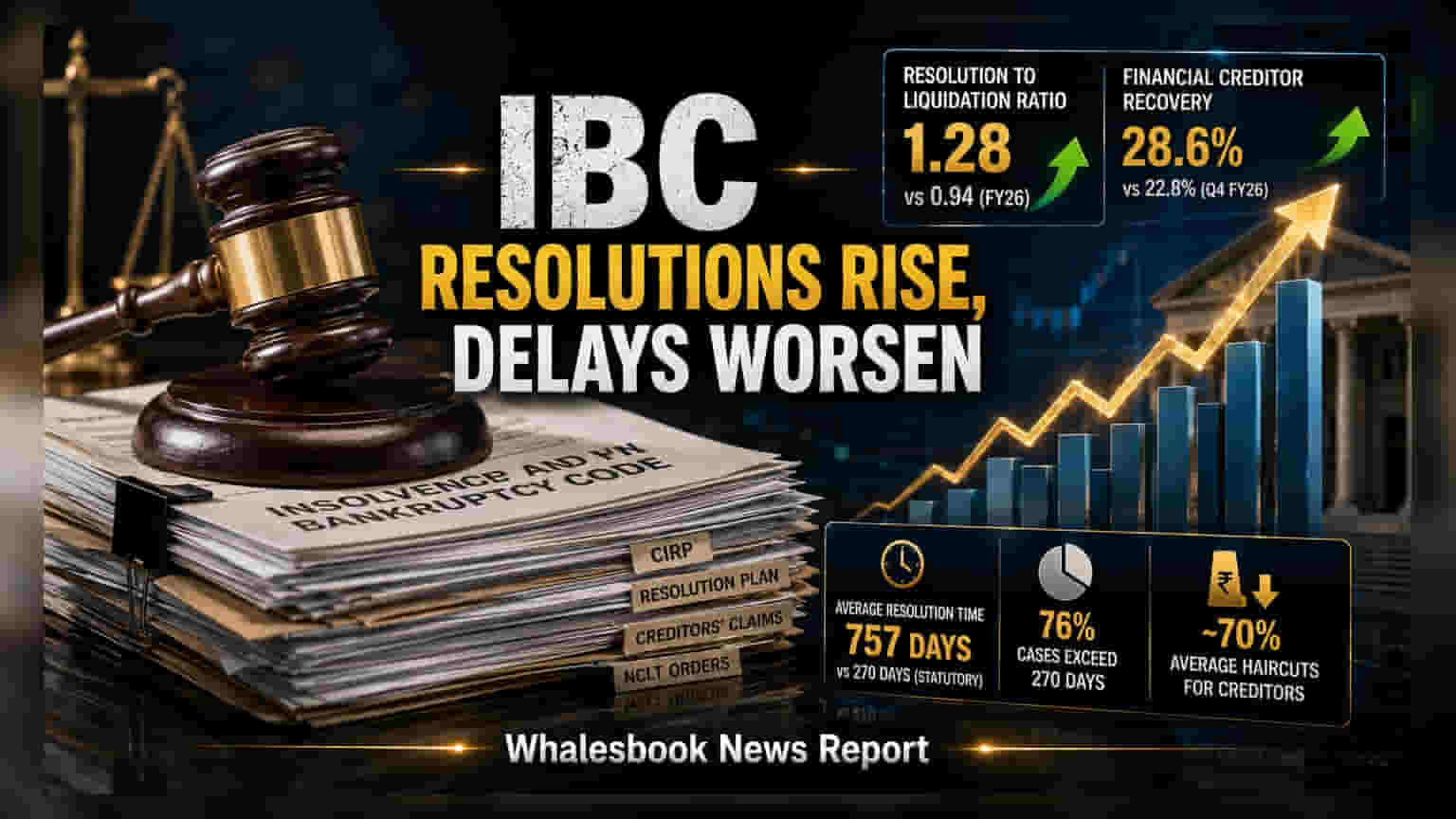
India’s insolvency framework shows improved recovery outcomes in Q1 FY27, with the resolution-to-liquidation ratio climbing to 1.28. However, procedural bottlenecks continue to weigh on the process, as average resolution times hit 757 days.
The Indian insolvency framework is showing signs of improved efficiency, with data for the first quarter of FY27 revealing a positive shift in recovery outcomes. The resolution-to-liquidation ratio has climbed to 1.28, up from 0.94 at the end of FY26. This trend indicates that more companies are being rescued through restructuring plans rather than being sent for liquidation, which is generally a more value-destructive outcome for creditors.
Financial creditors saw a recovery of 28.6 percent of admitted claims in Q1 FY27, a measurable improvement from the 22.8 percent seen in the final quarter of FY26. This suggests that the quality of resolution plans reaching judicial approval is improving, which is a critical signal for the banking sector where asset quality is closely tied to these outcomes. Despite these gains, the cumulative recovery since the inception of the code remains a point of concern, with creditors still facing average haircuts—or loss of value on their claims—of around 70 percent.
While the resolution outcomes are showing promise, the time taken to achieve them remains a persistent drag. The statutory mandate for the Corporate Insolvency Resolution Process (CIRP) is 270 days, yet the average resolution time has stretched to 757 days as of June 2026. Data shows that nearly 76 percent of ongoing cases have crossed the 270-day threshold, illustrating the significant administrative and judicial pressure on the National Company Law Tribunal.
The impact of these delays is direct: when a resolution process drags on for two years or more, the value of the underlying assets often depreciates significantly. This asset erosion makes high haircuts inevitable, leaving financial creditors with less value than they might have recovered in a faster process. Furthermore, about half of all resolution plans still result in recoveries of less than 20 percent of admitted claims, highlighting that while the framework works, it remains difficult to turn around deeply distressed assets efficiently.
To address these hurdles, the Insolvency and Bankruptcy Code (Amendment) Act, 2026, was introduced with a focus on streamlining procedures, enhancing creditor oversight, and reducing the backlog at the tribunal level. The key monitorable for investors and stakeholders in the coming quarters will be the implementation of these amendments and whether they can effectively lower the average resolution time. Reducing this duration is essential to preserving asset value and ensuring that the bankruptcy framework functions as a tool for economic health rather than a site of value erosion.