 Whalesbook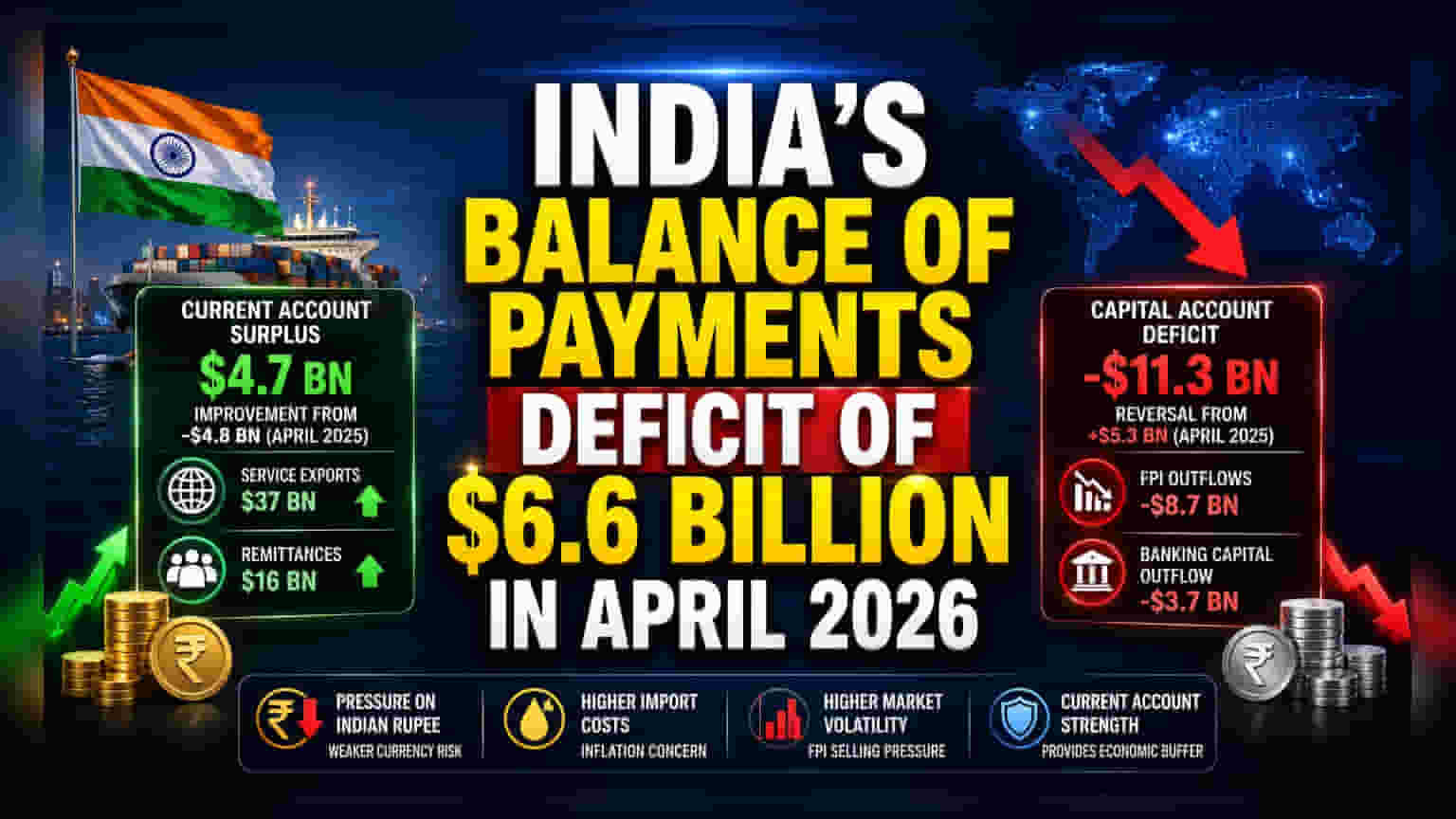


India reported a $6.6 billion balance of payments deficit in April 2026, driven by a sharp rise in foreign investor selling. Despite a resilient current account surplus fueled by services and remittances, heavy outflows from the capital account weighed on the overall economic position.
What Happened
India’s balance of payments, which acts as the official scorecard for all money transactions between the country and the rest of the world, shifted to a deficit of $6.6 billion in April 2026. This is a sharp reversal from the $0.5 billion surplus recorded during the same period in 2025. This change means that, during the month, the total amount of money leaving the country through various investment and banking channels was higher than the money entering it, despite strong earnings from trade and remittances.
The Tug-of-War: Current vs Capital Account
The overall deficit was a result of two conflicting trends. On one side, the 'current account'—which tracks day-to-day trade in goods, services, and money transfers—remained healthy. In fact, it posted a surplus of $4.7 billion, a significant improvement from the $4.8 billion deficit seen a year earlier. This stability was supported by a robust rise in service exports, which hit $37 billion, and a surge in worker remittances, which reached $16 billion. These inflows are often linked to global economic factors and currency movements, providing a cushion for the economy.
However, this strength was overwhelmed by a deterioration in the 'capital account,' which tracks investments like stocks, bonds, and banking transactions. This account swung from a $5.3 billion surplus in April 2025 to a deficit of $11.3 billion in April 2026. The primary driver was a massive increase in foreign portfolio investor (FPI) outflows, which totaled $8.7 billion, significantly higher than the $2.1 billion seen the previous year. Additionally, banking capital saw an outflow of $3.7 billion, further adding to the pressure.
Why This Matters For Investors
For investors, a balance of payments deficit is a key indicator to track because it influences the stability of the Indian Rupee. When more money leaves the country than enters it, there is natural downward pressure on the local currency. A weakening Rupee can lead to higher import costs, particularly for commodities like crude oil, which can then fuel inflation and potentially prompt the central bank to keep interest rates higher for longer.
Additionally, the sharp rise in FPI outflows indicates that foreign investors were selling off Indian assets during this period. When institutional selling pressure increases, it can lead to higher volatility in equity and debt markets. Understanding this flow of funds helps investors gauge whether the selling is part of a broad global trend or specific to local market conditions.
How Investors May Read This
Investors often view such data as a signal of shifting global liquidity. While the current account surplus highlights the resilience of India's services and remittance income, the capital account deficit highlights vulnerability to global risk sentiment. If FPIs continue to pull money out of the market, liquidity could tighten, affecting the performance of larger, FPI-heavy stocks. Conversely, if the current account continues to show strength, it provides a fundamental buffer that limits how much the overall balance of payments can worsen.
What Investors Should Track
The most important factor for investors to monitor going forward is the trend in FPI flows. Whether this $8.7 billion outflow is a temporary adjustment or the beginning of a longer selling trend will likely dictate market sentiment in the coming months. Investors should also watch for updates from the Reserve Bank of India regarding currency management and any impact of these flows on domestic interest rate policies. Additionally, keeping an eye on service export growth will be important, as this sector remains a key contributor to maintaining the current account surplus.