

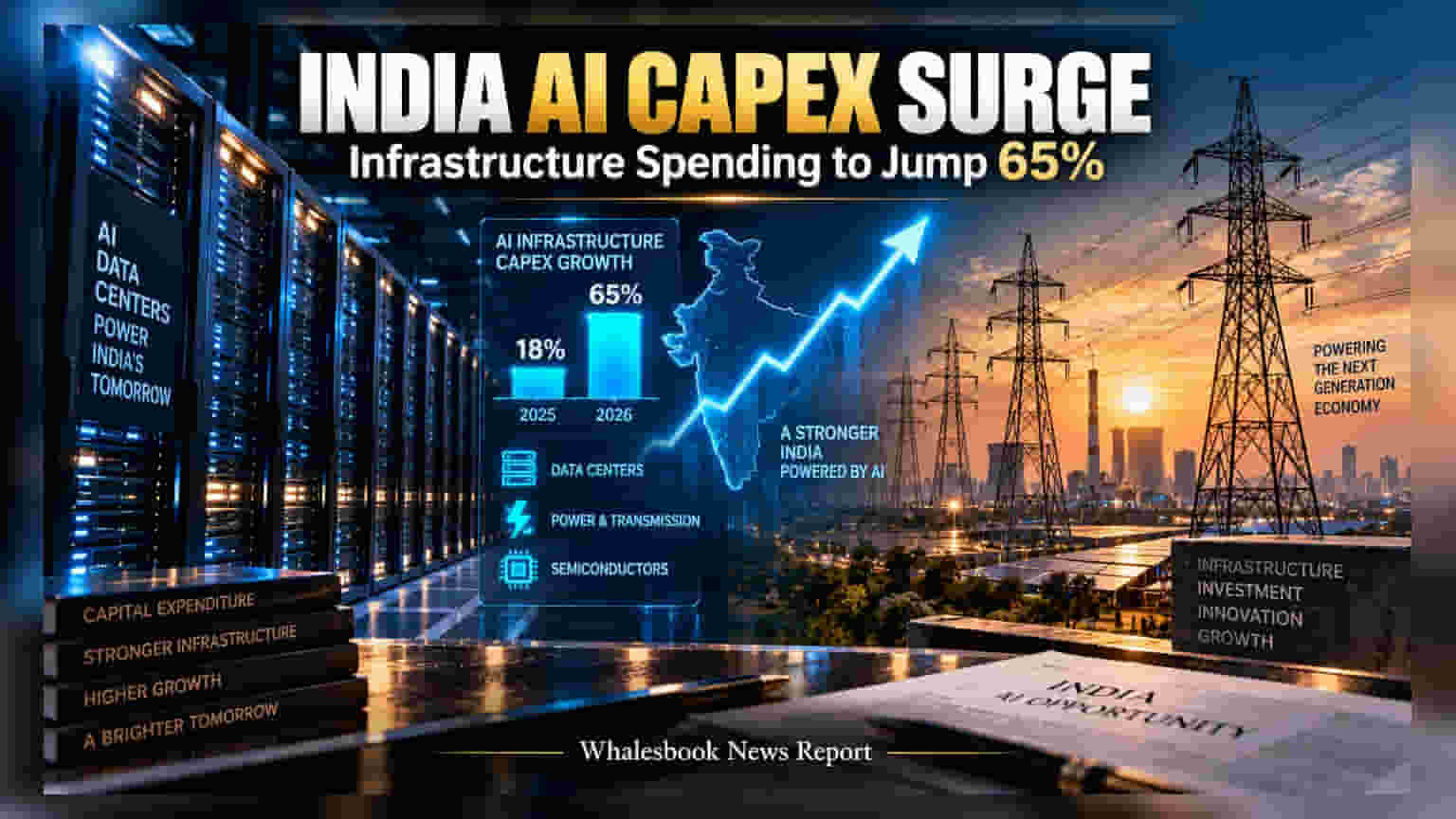
A new report projects a 65% jump in capital spending for 42 Indian firms building the physical foundation for AI. While this signals a major push into power, data centers, and semiconductors, investors should remain aware of the high valuations and execution risks involved in this heavy industrial cycle.
The narrative surrounding Artificial Intelligence in India is shifting from software and IT services to heavy industrial infrastructure. A recent report by Goldman Sachs suggests that the next phase of India’s AI growth will be driven by the physical building blocks of technology. The study identifies 42 Indian companies that act as the backbone for this AI shift, projecting a 65% increase in their total capital spending for the calendar year 2026.
This significant jump in investment, up from 18% growth in 2025, highlights a transition toward building the physical assets required for AI functionality. The primary drivers of this spending spree include the power generation and transmission sectors, data-center operators, and semiconductor assembly and testing units. Collectively, these sectors are expected to contribute six percentage points to the aggregate capital spending growth of the Nifty 500 index.
A Focus on Physical Infrastructure
While the market often focuses on software developers, this new wave of spending is directed toward the essential hardware of the AI era. Power is the most critical component, accounting for nearly half of the total incremental AI-related investment. As AI models require immense computing power, the demand for reliable electricity and specialized data-center infrastructure has intensified. Semiconductor assembly is another key area, reflecting a broader attempt to build local hardware capabilities.
Valuation and Risk Dynamics
For investors, this shift toward high-growth industrial assets comes with a premium price. The basket of 42 companies identified in the report currently trades at 36 times forward earnings, which is roughly 85% higher than the broader MSCI India index. This valuation premium suggests that the market has already priced in strong future growth.
However, the report also notes that the Price-to-Earnings-to-Growth (PEG) ratio—a metric used to evaluate a company's price relative to its earnings growth—stands at 1.3. This is slightly more attractive than the MSCI India index’s PEG ratio of 1.4, suggesting that while the stocks are expensive, their projected earnings growth is higher than that of the broader market.
Despite these projections, investors should keep a close watch on potential risks. Large-scale industrial and infrastructure projects often come with execution risks, such as project delays, cost overruns, and supply chain disruptions. Furthermore, these companies must remain cash-flow positive while maintaining high spending levels. The sustainability of this growth will depend on how efficiently these firms can translate their massive capital spending into actual operating profits.
The key for investors will be monitoring the commissioning timelines of these power and data-center projects, alongside management commentary on how they plan to fund this expansion without straining their balance sheets. As the sector moves through this capital-intensive phase, the ability to manage demand fluctuations and operational costs will be as important as the initial expansion plans.