 Whalesbook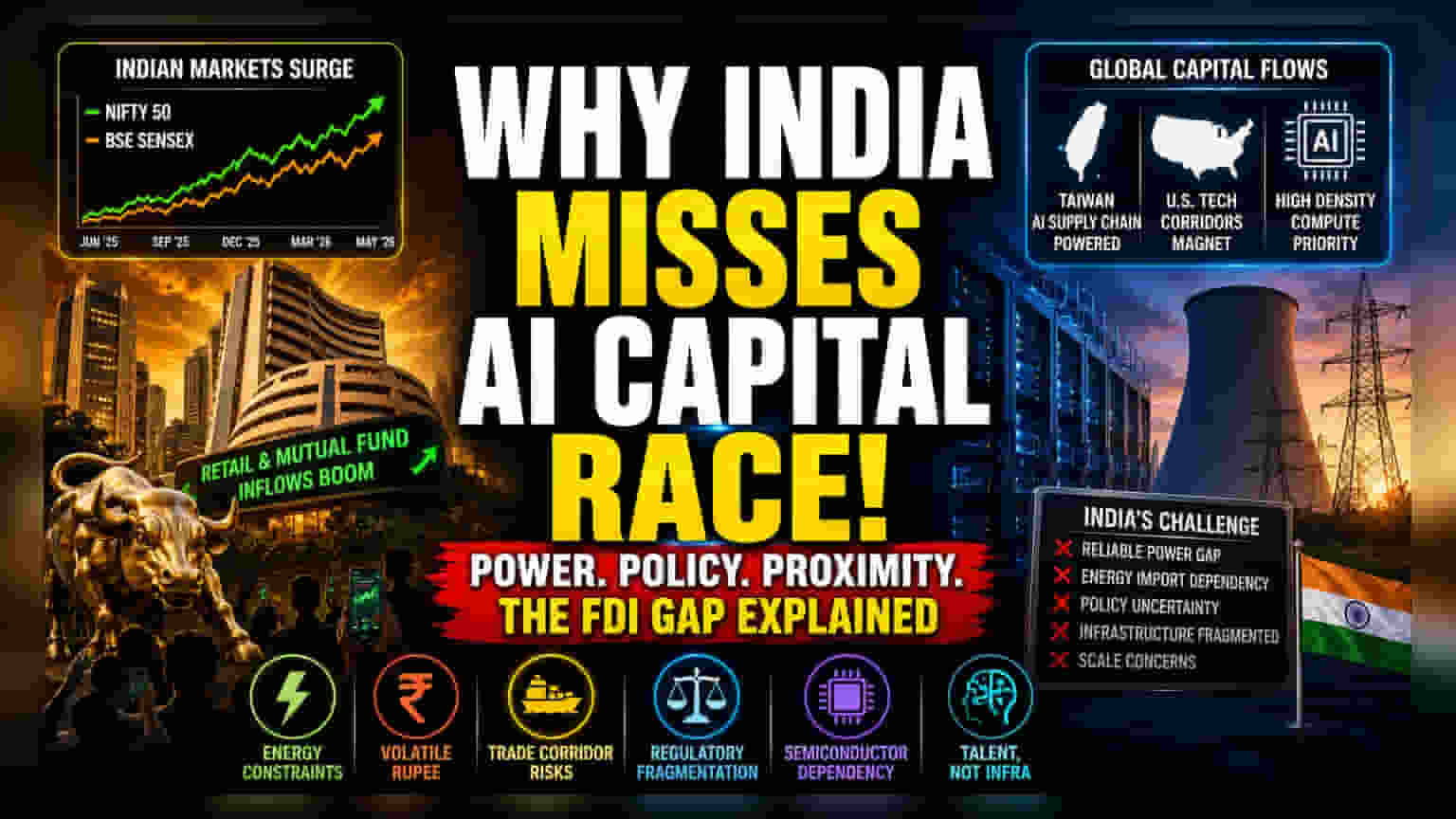


The Capital Allocation Divergence
The disconnect between India’s robust domestic equity performance and sluggish foreign direct investment (FDI) signals a broader trend in how institutional capital evaluates growth. While the Nifty and BSE indices have benefited from a surge in retail participation and local mutual fund inflows, global institutional investors are hyper-focused on one primary metric: the ability to scale AI compute power. This has created a bifurcated global market where capital flows aggressively toward regions offering immediate, reliable access to high-density electricity and cooling infrastructure, such as Taiwan and the U.S. domestic tech corridors.
The Compute-Energy Paradox
India’s strategic ambition to transition into a global compute hub faces a fundamental structural challenge: the energy-to-chip ratio. The massive capital expenditure required to support large language model (LLM) training and inference is not merely a software play but a heavy infrastructure demand. Unlike traditional outsourcing models where labor costs were the primary differentiator, the current AI arms race prioritizes access to power grids and water. Investors remain wary of India’s continued reliance on energy imports, viewing it as a drag on operational scalability. The concern is that until India can demonstrate a clear, policy-backed pathway to providing reliable, low-cost power for high-density compute facilities, it will struggle to attract the scale of FDI seen in nations with more stable energy profiles.
The Valuation of Intellectual Proximity
While semiconductor fabrication is often cited as the ultimate goal for industrial self-sufficiency, it remains a multi-year, capital-intensive endeavor with high execution risk. There is a strong counter-narrative, however, that India’s immediate value proposition lies in the layer above the wafer: design, architecture, and deployment. By leveraging a deep reservoir of technical talent that currently powers the global tech ecosystem, India possesses the potential to lower the cost-per-compute unit significantly below Western benchmarks. This shift would require a pivot from the traditional BPO-style service narrative to a high-end, compute-integrated infrastructure model that foreign capital currently characterizes as aspirational rather than operational.
The Forensic Bear Case: Structural Vulnerabilities
Risk-averse capital often points to the volatility of the Indian Rupee and the unpredictability of trade corridors as major barriers. The reliance on external trade for essential tech hardware creates a vulnerability that becomes magnified during periods of global supply chain tension. Furthermore, the regulatory environment surrounding digital infrastructure remains fragmented compared to regional competitors. For international banks like Citi, the challenge is navigating these corridors while managing the balance sheet risks associated with emerging market currency fluctuations. If the government fails to synchronize energy policy with digital infrastructure goals, the risk remains that India will continue to miss out on the current wave of AI-driven capital deployment, relegated to a talent pool rather than a core node in the global compute architecture.