

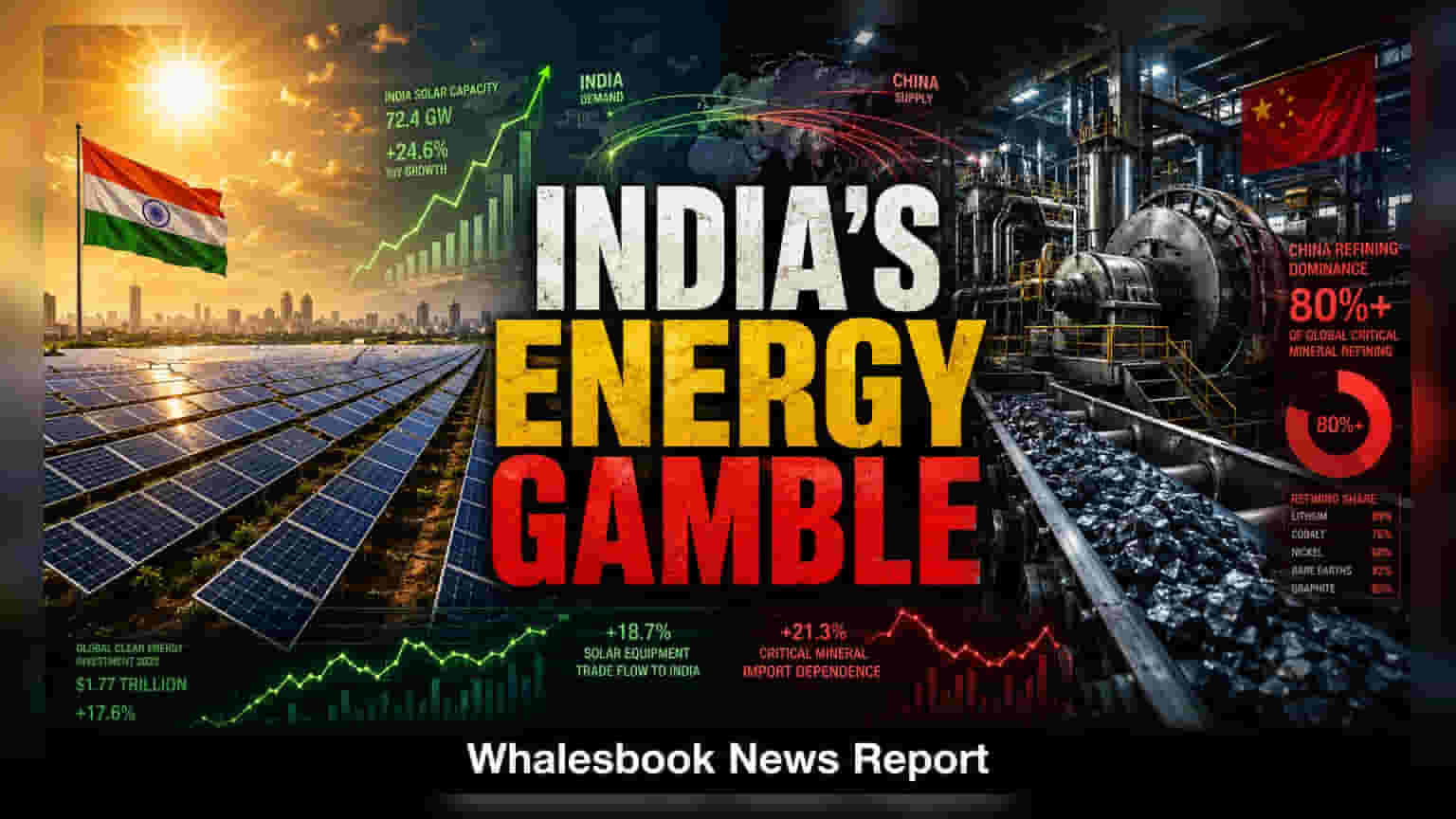
India has achieved 300 GW of non-fossil power capacity, covering over half of its total electricity generation. However, the rapid energy transition is fueling a rise in critical mineral imports, creating new supply chain risks. Investors may track how companies and policymakers prioritize domestic refining and recycling to reduce reliance on external suppliers like China.
India recently reached a major milestone in its green energy transition, with non-fossil fuel-based installed capacity surpassing 300 GW. This figure now accounts for over 54% of the country's total power capacity, bringing the nation closer to its ambitious 500 GW goal for 2030. While this expansion marks significant progress in electricity generation, it has exposed a growing vulnerability in the supply chain for critical minerals needed to sustain this growth.
The Cost of Import Dependence
Behind the success of the energy transition lies a rising bill for the raw materials required for renewable energy technologies. A joint report by the Confederation of Indian Industry (CII) and EY highlighted that India remains almost entirely dependent on imports for 15 out of 23 critical minerals essential for clean energy, including lithium, cobalt, nickel, and rare earth elements. The financial impact of this reliance is clear: India's import bill for these critical minerals more than doubled in three years, rising from $3.03 billion in 2020-21 to $8.01 billion in 2023-24.
This dependence poses a strategic challenge because the global supply chain for these materials is highly concentrated. China currently dominates the refining and processing capacities, controlling roughly 93% of graphite, 85% of rare-earth elements, 79% of cobalt, and 70% of lithium processing. For Indian companies involved in battery manufacturing, solar panel production, and electric vehicle components, this reliance on a single region for refined materials creates significant supply chain risks and exposure to price volatility.
Why Investors Are Watching
For investors, the narrative is shifting from merely tracking capacity expansion to assessing the security of the underlying supply chain. Simply sourcing ore is not enough; the ability to refine these materials domestically is becoming a key competitive advantage. If a company depends on imported, refined materials, it remains vulnerable to global trade tensions and supply disruptions.
Investors may watch for a shift in corporate and government strategy toward building domestic refining and processing facilities. This requires significant capital spending and technological expertise. Companies that are investing in local refining, battery chemistry, and recycling infrastructure may be better positioned to navigate these headwinds than those entirely dependent on global supply chains. Furthermore, the development of robust e-waste and battery recycling pipelines could offer a way to recover materials domestically, potentially reducing long-term import needs.
The next important update for shareholders and market analysts will be policy developments regarding incentives for domestic mineral processing and manufacturing. Track announcements regarding state or central government support for companies entering the refining and recycling space, as these could influence the competitive position of renewable energy firms in the coming years.