

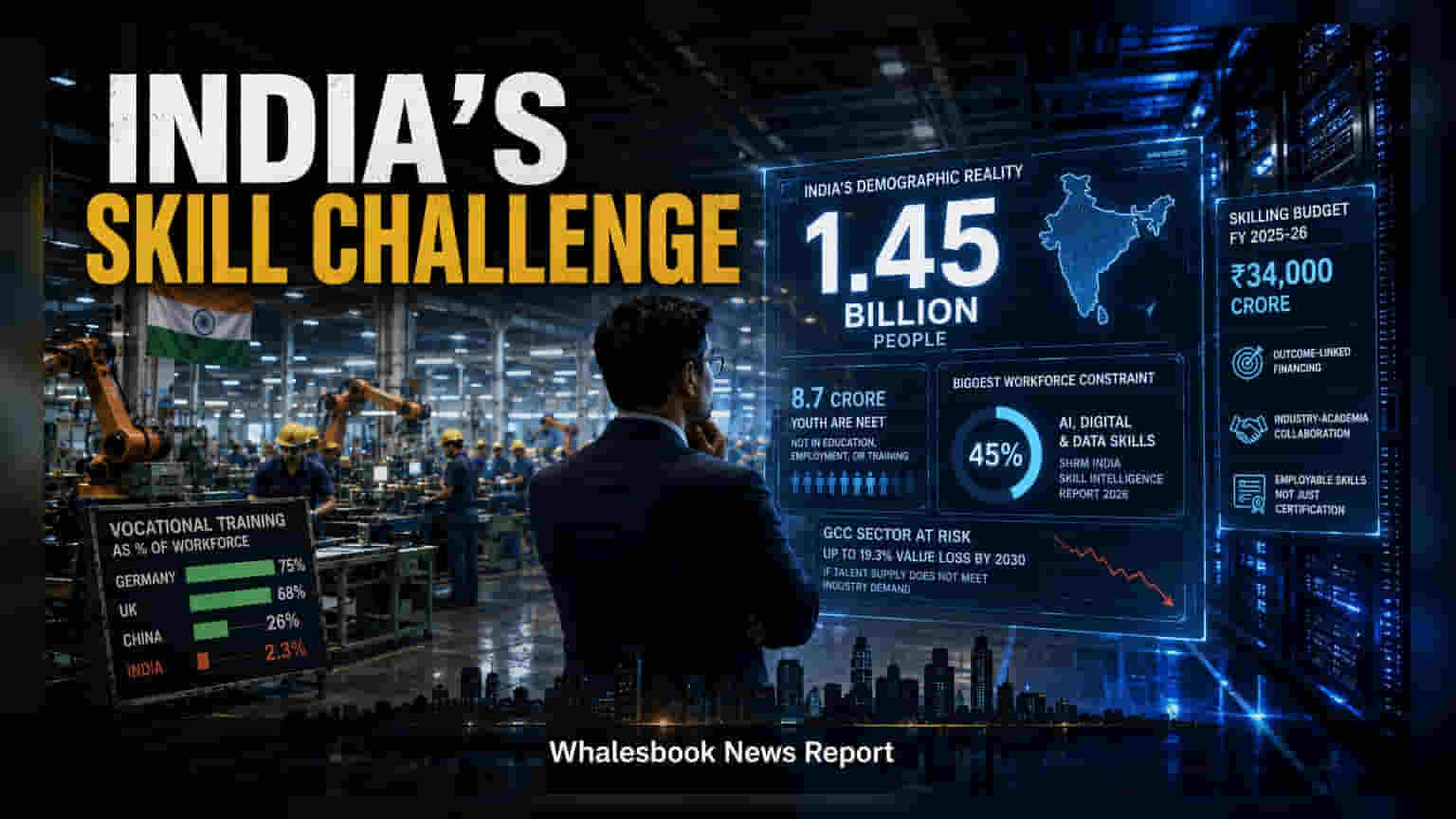
India’s large workforce faces a severe structural skill gap, with only 2.3% of workers receiving formal training. This mismatch forces companies to spend heavily on internal training, creating a hidden tax on business productivity. As AI disrupts traditional roles, the government and industry are pivoting to outcome-linked financing to avoid the demographic dividend becoming a socioeconomic burden.
India is currently facing a critical economic challenge as it attempts to integrate a 1.45 billion-strong population into a modern, digital-first economy. While the country’s demographic dividend is often cited as a growth engine, current data reveals a persistent mismatch between academic qualifications and industry requirements. Only about 2.3% of the Indian workforce receives formal vocational training, a figure that pales in comparison to global benchmarks like Germany at 75% or the UK at 68%. This structural deficit has turned into a primary bottleneck for growth, threatening to dampen long-term productivity and GDP expansion if left unaddressed.
The Hidden Tax on Business
The impact of this talent shortage is most visible in the rising operational costs for companies. Employers across technology, manufacturing, and healthcare sectors report that traditional education pipelines are failing to produce graduates ready for complex, technology-driven roles. To fill this void, major Indian IT firms, including industry leaders like TCS, Infosys, and Wipro, have been forced to implement extensive internal training programs. This is not just a cost of doing business; it acts as a hidden tax that diverts resources away from potential capital spending and expansion efforts. According to the 2026 SHRM India Skill Intelligence Report, approximately 45% of organizations identify AI, digital, and data skills as their biggest workforce constraint, forcing them to prioritize internal retraining over business innovation.
Economic Risks and the GCC Challenge
The risks associated with this skill gap are substantial. A recent NITI Aayog report, 'Reimagining Skilling for Viksit Bharat@2047,' highlights that approximately 8.7 crore youth currently fall into the NEET category—Not in Education, Employment, or Training. If these individuals are not integrated into the formal economy, the demographic dividend risks transforming into a significant socioeconomic burden. Furthermore, the Global Capability Centre (GCC) sector in India—a major employer of high-skilled talent—could face up to 19.3% in future value loss by 2030 if the talent supply does not align with the industry's rapidly evolving needs. The rapid adoption of AI has shortened the shelf life of existing skills, making traditional four-year degrees increasingly inadequate for the demands of modern employment.
Policy Shift Toward Outcome-Linked Financing
Recognizing the urgency, the government has intensified its focus on skilling initiatives. The Union Budget for FY 2025-26 allocated ₹34,000 crore specifically for skilling, signaling a strategic shift away from simple enrollment-based funding toward outcome-linked financing. This approach aims to ensure that training programs lead directly to employable skills rather than just certification. For investors, the effectiveness of these policies and the ability of private enterprises to collaborate with academic institutions to standardize vocational training will be critical monitorables. The next important updates will likely focus on the success of these public-private partnerships and their impact on reducing recruitment costs and bridging the productivity gap for the country’s largest employers.