

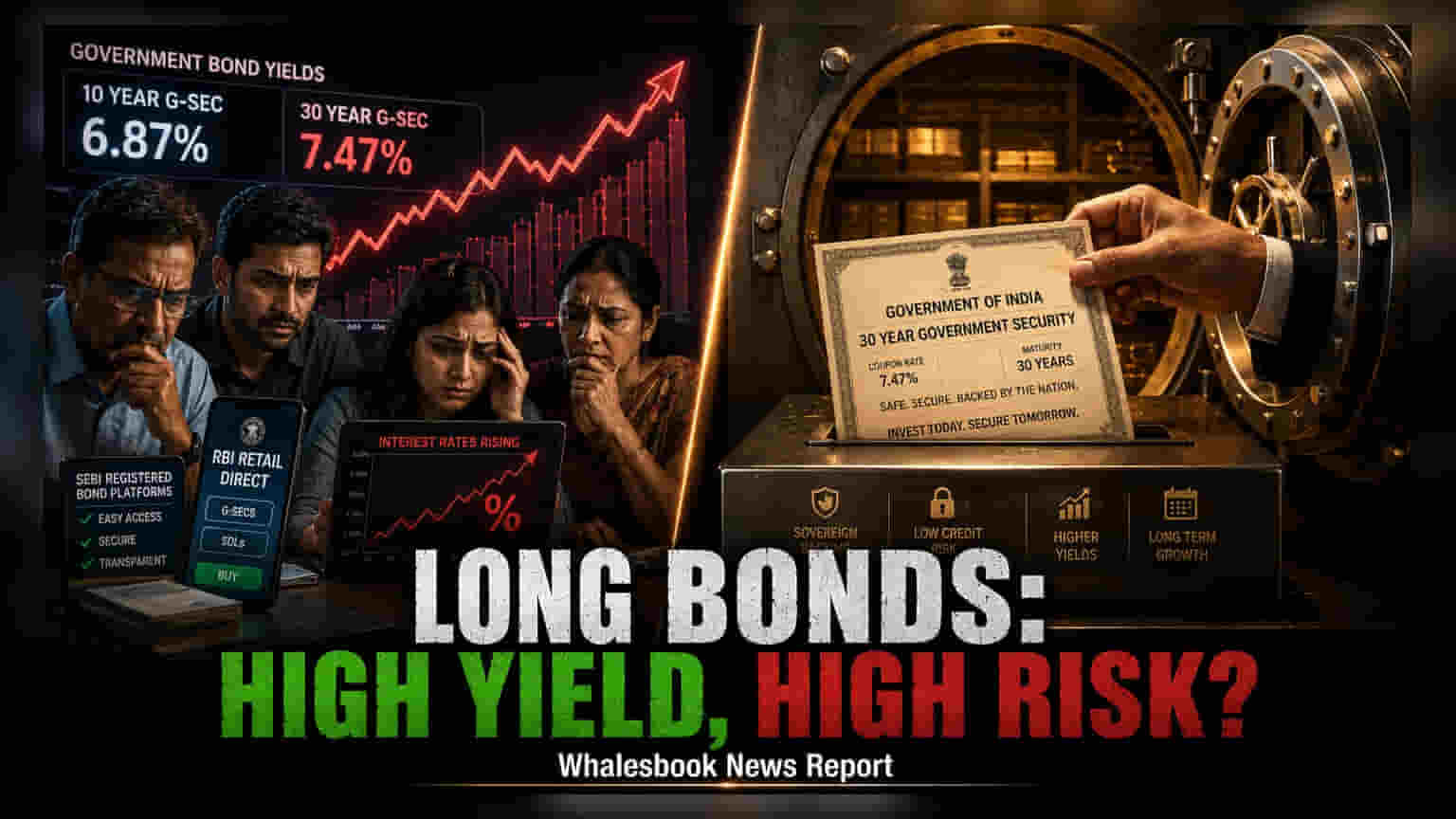
Indian retail investors are increasingly buying long-term government bonds to capture a 60-basis-point yield premium over the 10-year benchmark. While these securities offer higher fixed returns, they carry significant interest-rate sensitivity that can impact market value. Retail investors are using platforms like RBI Retail Direct, but experts advise careful assessment of price risks versus holding horizons.
Indian retail investors are increasingly moving beyond the traditional 10-year government securities to purchase longer-dated bonds, aiming to lock in higher yields. As of August 21, 2026, the 10-year benchmark G-sec was yielding approximately 6.87%, while 30-year government securities were trading at around 7.47%. This yield pick-up of roughly 60 basis points has attracted investors looking for better returns in the fixed-income space.
This shift has been made easier by the RBI Retail Direct platform and various SEBI-registered online bond platforms, which have simplified the process for individuals to buy Central government securities (G-secs) and State Development Loans (SDLs) directly. While these assets are backed by the government, meaning they have almost no credit risk, they are not risk-free investments.
Understanding Price and Interest Rate Risk
The most important factor for investors to understand with long-dated bonds is interest-rate risk. The market price of a bond moves in the opposite direction to interest rates. When market interest rates rise, the value of existing bonds falls. This impact is much stronger on bonds with longer maturities, such as 20- or 30-year instruments, compared to shorter-term bonds. If an investor decides to sell these long-duration bonds before their maturity date, a rise in interest rates could lead to a loss on their initial investment, often referred to as a mark-to-market loss.
Additionally, investors face reinvestment risk. These long-term bonds pay interest coupons semi-annually. If market interest rates fall in the future, investors may find it difficult to reinvest these coupon payments at the same attractive yields they are receiving today.
Strategic Considerations for Investors
For those interested in adding long-dated bonds to their portfolio, managing the holding period is critical. Financial experts often suggest that investors should match the bond's maturity with their specific investment horizon. A common strategy to navigate these risks is bond laddering, where an investor splits their capital across bonds with different maturity dates—such as 5-year, 10-year, and 20-year securities. This approach helps reduce the impact of interest-rate changes and ensures some liquidity, as shorter-term bonds mature sooner.
While long-dated G-secs offer a higher yield today, they are best suited for investors who intend to hold the bond until it matures, thus avoiding the need to sell in a fluctuating market. Investors with a shorter investment horizon or those uncomfortable with price volatility might consider alternatives like shorter-term debt funds, bank deposits, or small savings schemes like the Senior Citizens’ Savings Scheme, which offer defined returns without the same level of interest-rate sensitivity.
The next major factor to monitor will be the future trajectory of interest rates, as set by the Reserve Bank of India. Because these long-term bond prices are highly sensitive to rate changes, any shifts in the central bank’s monetary policy stance will directly impact the market value of these long-dated instruments.