

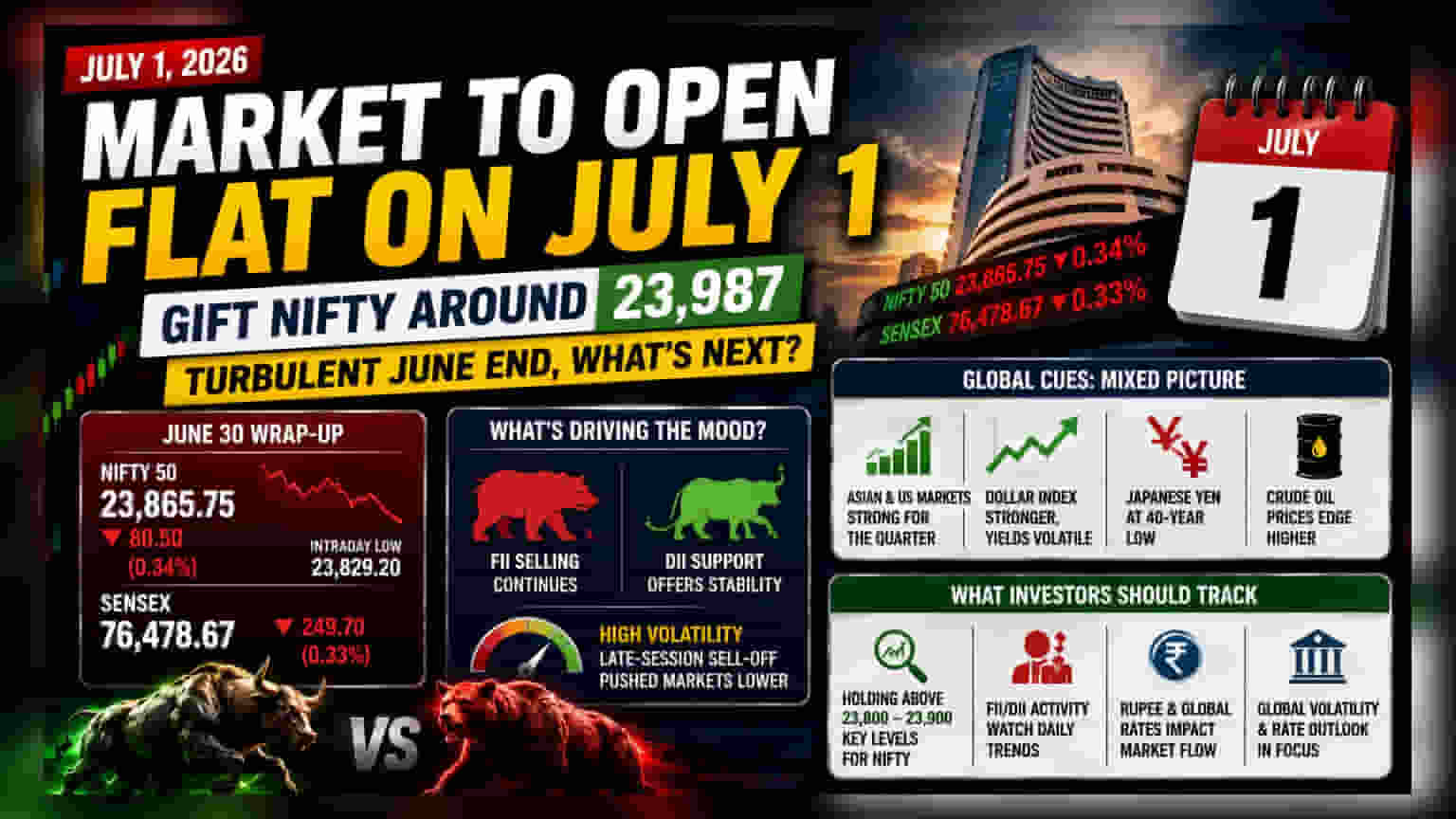
Indian benchmark indices are likely to open flat on July 1, 2026, as the market digests mixed signals from global equities and recent selling pressure. After a volatile close on June 30, investors are balancing positive international sentiment against ongoing selling by foreign institutional investors.
What To Expect On July 1
Indian benchmark indices are expected to begin the trading session on July 1, 2026, with a flat tone. This outlook is based on signals from the GIFT Nifty, which has been trading near the 23,987 level in early morning updates. This muted start follows a turbulent session on June 30, which marked the end of the derivatives expiry period and saw domestic indices finish the day in the red.
Understanding The Recent Market Mood
On June 30, the market experienced a broad sell-off, with the Nifty closing at 23,865.75, down by 80.50 points or 0.34 percent. The Sensex followed a similar trend, ending the session at 76,478.67, a decline of 249.70 points or 0.33 percent.
Investors witnessed a session of high volatility. While the market initially opened on a firm note, gains were quickly wiped out within the first hour. A late-session surge in selling pressure pushed the Nifty to an intraday low of 23,829.20. This trend was largely driven by continued selling from Foreign Institutional Investors (FIIs), though Domestic Institutional Investors (DIIs) have been providing some support to the market.
Global Cues Versus Local Reality
While the Indian market faces short-term pressure, the global environment presents a mix of trends. Asian and US markets have seen a strong performance for the quarter, with major US indices like the Nasdaq and S&P 500 recording significant gains.
However, currency and interest rate dynamics are creating a complex picture for global investors. The US Dollar Index has strengthened as Treasury yields fluctuate, and the Japanese Yen has dropped to a 40-year low. This shift, driven by expectations of US Federal Reserve rate adjustments, often influences risk appetite in emerging markets like India. Additionally, global crude oil prices have edged higher, which can affect import costs and inflation expectations for the Indian economy.
What Investors Should Track
For investors, the immediate focus will be on whether the indices can hold key levels after the recent decline. The Nifty finished below the 23,900 mark on June 30, making the movement around this level a primary point of interest.
Beyond technical levels, investors may monitor the daily trend of FII and DII activity. A persistent trend of FII selling often acts as a hurdle for a sustained market recovery. Additionally, with global markets showing divergent trends—strong equity growth but currency-related volatility—market participants will be watching for signs of stability in the rupee and any impact from changing global borrowing costs.