Indian Markets Sink as Rupee Hits Record Low: What Investors Need to Know Now!

Overview
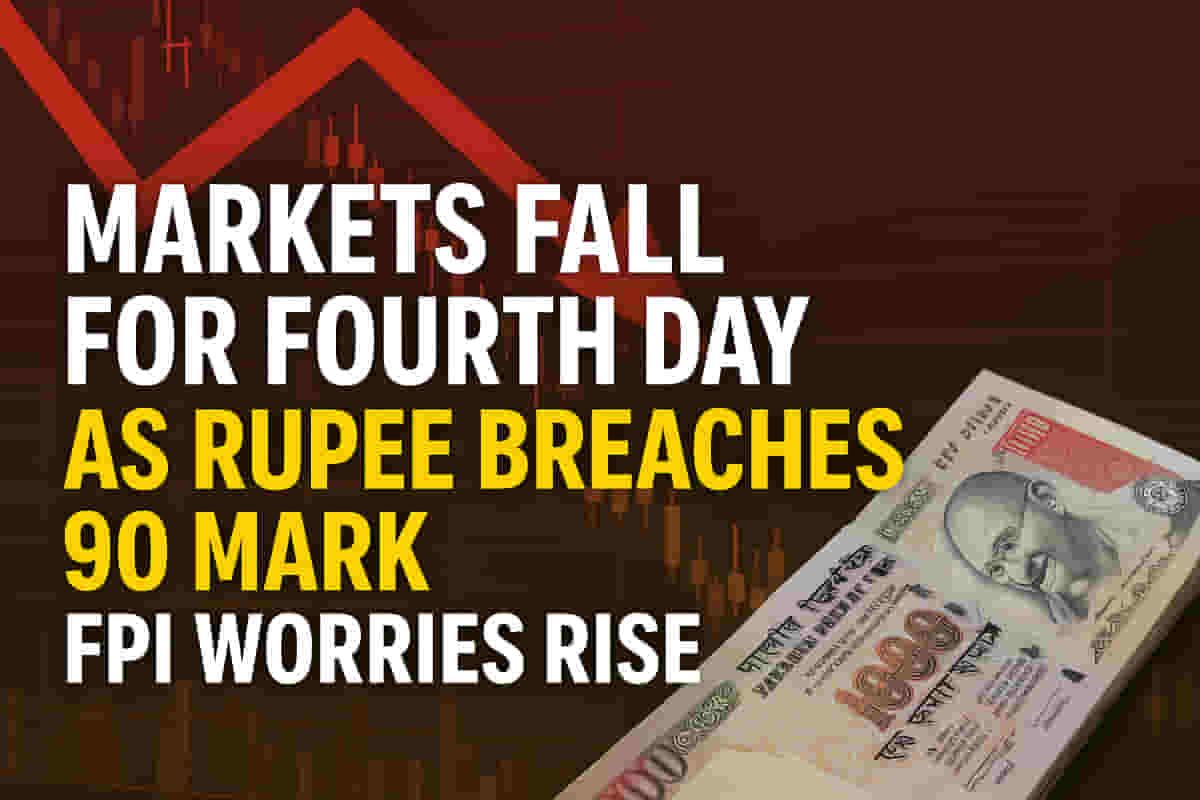
Indian stock markets declined for a fourth consecutive day on Wednesday, with the Sensex falling 31.5 points to 85,107 and the Nifty closing at 25,986, down 46 points. The Indian rupee hit a record low against the US dollar, falling past 90. PSU Bank stocks saw a sharp decline of 3.1%, while IT stocks gained 0.8% due to expected benefits from rupee weakness. Foreign portfolio investor outflows and trade deal delays also impacted sentiment.
Stocks Mentioned
Markets Extend Losses Amidst Rupee Weakness and Trade Deal Delays
Indian stock markets extended their losing streak to a fourth consecutive day on Wednesday, weighed down by a sliding rupee and concerns over potential foreign investor outflows. Delays in a crucial trade deal with the United States further dampened market sentiment.
Market Performance
- The benchmark Sensex closed at 85,107, down 31.5 points (0.04%), after earlier sliding as much as 375 points.
- The Nifty ended at 25,986, a fall of 46 points (0.2%).
- Both indices are now down 0.7% (Sensex) and 0.9% (Nifty) over the past four sessions, following record highs touched on November 27.
Rupee's Record Low
- The Indian rupee weakened significantly, crossing the 90 per US dollar mark for the first time, reaching a new record low on Wednesday.
- This depreciation raises concerns about imported inflation and can deter foreign investment.
Sectoral Movements
- Out of 16 major sectoral indices, 11 ended in the red.
- The Nifty PSU Bank index was the biggest laggard, plummeting 3.1%, its steepest fall in seven months.
- Broader indices like the Nifty Smallcap 100 and Nifty Midcap 100 also experienced declines of approximately 0.7% and 1%, respectively.
- In contrast, the Nifty Information Technology (IT) index managed to gain 0.8%.
Reasons Behind Sectoral Performance
- The sharp fall in PSU Banks occurred after the government indicated it was not considering increasing the foreign direct investment (FDI) limit in the sector to 49%.
- IT stocks benefited from the rupee's weakness, as a weaker rupee typically enhances the revenue earned by Indian IT companies when converted back into rupees. Motilal Oswal noted attractive valuations for the sector and upgraded Infosys, Wipro, and Mphasis.
Market Breadth
- The overall market sentiment was weak, with declining stocks outnumbering advancing ones.
- Out of 4,163 total stocks traded, 1,396 advanced, while 2,767 declined.
Impact
- The continued market decline and rupee depreciation could negatively impact investor sentiment, potentially leading to further foreign portfolio investor (FPI) outflows.
- Sectors like PSU Banks face direct challenges, while IT companies could see improved earnings due to currency advantages.
- Higher imported costs could contribute to inflationary pressures.
- Impact Rating: 8
Difficult Terms Explained
- Sensex: A stock market index representing the weighted average of 30 well-established and financially sound publicly traded companies listed on the Bombay Stock Exchange (BSE).
- Nifty: A benchmark Indian stock market index that represents the weighted average of 50 of the largest Indian companies listed on the National Stock Exchange (NSE).
- Rupee: The official currency of India.
- US Dollar: The official currency of the United States of America.
- FPI (Foreign Portfolio Investor): An investor from one country who invests in securities (stocks, bonds) in another country.
- PSU Bank: Public Sector Undertaking Banks are banks where the majority stake is held by the Government of India.
- FDI (Foreign Direct Investment): An investment made by a company or individual in one country into business interests located in another country, typically involving ownership or control.
- Trade Deal: An agreement between two or more countries regarding the terms of trade between them.
Personal Finance Sector

India's Wealthiest Secret: They're Buying Optionality, Not Just Gold!
Mutual Funds Sector