

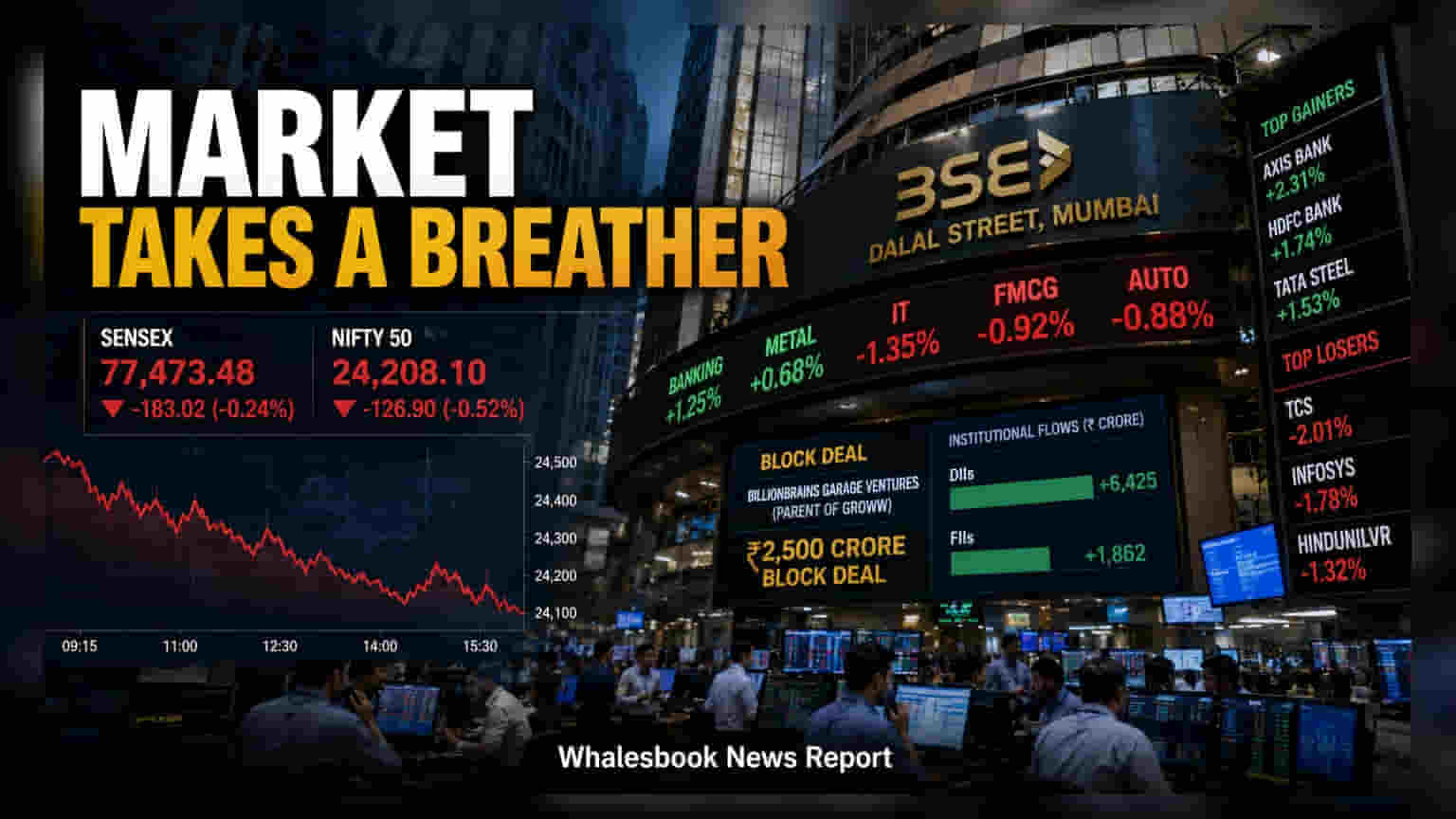
Indian benchmark indices closed lower on Wednesday, with the Sensex falling 183 points to 77,473, as profit-booking and sector-specific weakness offset institutional buying. While foreign and domestic investors remain net buyers, a surge in high-volume block deals is currently testing market liquidity.
Indian equity markets took a breather on Wednesday as profit-booking outweighed positive sentiment in banking and metal sectors. The Sensex shed 183 points to settle at 77,473, while the Nifty slipped 127 points to 24,208. The decline was largely driven by weakness in IT, FMCG, and automotive stocks, reflecting a cautious approach as investors navigate high valuations and global uncertainties.
Institutional Support Amid Selling Pressure
Despite the index-level drop, institutional investors continued to provide a buffer for the market. Domestic Institutional Investors (DIIs) showed strong support with a net inflow of ₹6,425 crore. Meanwhile, Foreign Institutional Investors (FIIs) remained net buyers for the third consecutive session. This contrast between domestic and foreign buying interest against broader selling pressure suggests that while investors are booking profits at current levels, there is still enough demand to absorb large-scale supply.
The Block Deal Liquidity Trend
The market’s secondary liquidity is currently being shaped by a wave of large-scale equity transactions. A notable example today was a ₹2,500 crore block deal involving Billionbrains Garage Ventures, the parent company of the fintech platform Groww. These high-volume deals, where early-stage investors or promoters monetize their holdings, are becoming a recurring theme. For retail investors, this activity is important to watch, as persistent supply through block deals can temporarily pressure share prices, even if the underlying business fundamentals remain intact.
Corporate Strategy and Expansion
Beyond market fluctuations, several large companies are pushing ahead with long-term capital plans. CG Power has outlined an ambitious revenue target for its semiconductor packaging business, aiming for $500 million in annual revenue as its Sanand facility scales production. This signifies a major push into the electronics manufacturing space, though success will depend on operational execution and demand within the semiconductor supply chain.
In the automotive sector, JSW MG Motor India has expanded its product portfolio with the launch of the Hector Tomahawk series. The company is introducing both electric and hybrid variants, reflecting a strategy to capture shifting consumer preferences toward greener mobility. The success of such product launches will be a key monitorable for the company’s market share in the coming quarters.
Investor Monitorables and Sector Risks
Investors are keeping a close watch on specific risks that could influence market direction. The IT sector, in particular, is facing pressure due to uncertainties regarding US visa and immigration policies, which can impact margins and hiring plans. Additionally, global sentiment remains fragile due to geopolitical tensions in the Middle East, which often lead to volatility in energy prices. Moving forward, the key factor for the market will be whether institutional buying power remains strong enough to offset the supply coming from ongoing block deals and whether corporate earnings can justify current valuation levels.