 Whalesbook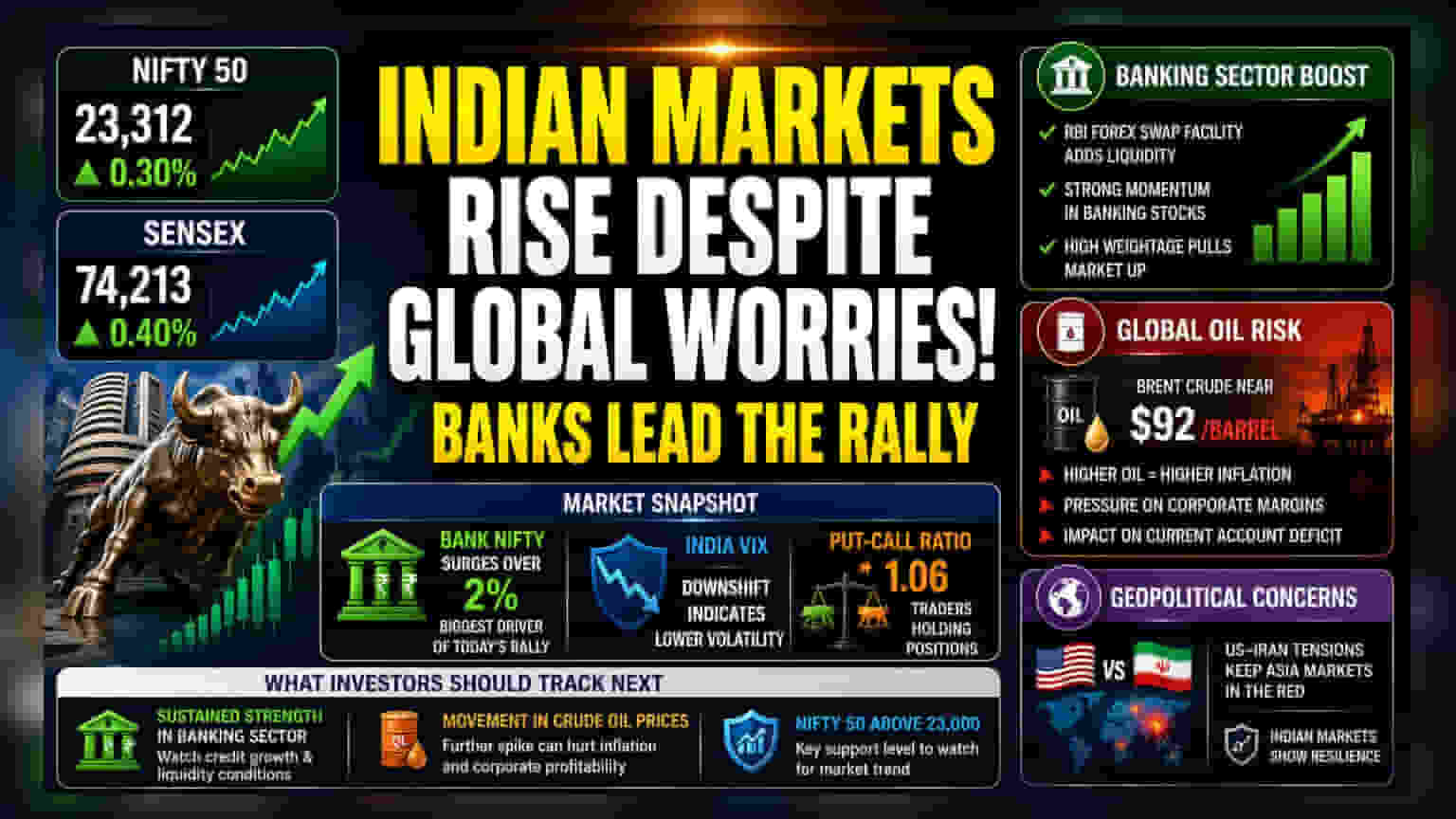


Indian stock markets showed resilience today as the Nifty 50 and BSE Sensex climbed in early trade. The banking sector led the gains, helping to offset worries about rising US-Iran tensions that have dampened global sentiment. Lower volatility and specific liquidity support for banks are providing stability to domestic investors.
What Happened
Indian equity benchmarks, the Nifty 50 and the BSE Sensex, started Wednesday's trading session on a positive note, rising despite weaker global cues. The Nifty 50 climbed 0.30% to 23,312, while the Sensex rose 0.40% to 74,213. This performance stands in contrast to the broader Asia-Pacific region, where markets were trading lower due to ongoing geopolitical concerns involving the US and Iran.
The Banking Sector Boost
The most significant driver of today’s market rise was the banking sector. The Bank Nifty index surged by over 2%, showing much stronger momentum than the broader market. Banking stocks hold high weightage in the main indices, so when this sector performs well, it often pulls the entire market up. Recent moves by the Reserve Bank of India to provide a forex swap facility have acted as a source of liquidity for the banking system, which has likely boosted confidence among institutional investors.
Geopolitical Risks and Oil Prices
While the domestic market is currently ignoring the noise, investors are keeping a close watch on global oil prices. Brent crude is trading near $92 per barrel. For a net oil-importing nation like India, rising oil prices are a significant risk. If global crude prices remain elevated, it can lead to higher domestic inflation and put pressure on the profit margins of Indian companies that rely heavily on energy or imported raw materials. Investors usually monitor this closely because sustained high oil prices can negatively impact India's current account deficit and the overall economy.
Understanding Market Mood
Two key indicators suggest that traders are not panicking despite the headlines. The first is the India VIX, a tool that measures expected market volatility. A sharp drop in the VIX indicates that investors are feeling more confident and less nervous about near-term risks. The second is the Put-Call Ratio (PCR), which measures the balance between bearish and bullish bets in the options market. A ratio of 1.06 suggests that traders are maintaining their positions rather than rushing to sell, which is generally seen as a sign of stabilization.
What Investors Should Track Next
Moving forward, the primary focus for the market will be how long the stability in the banking sector lasts. Any sign of a slowdown in credit growth or a change in liquidity conditions could affect the Bank Nifty. Furthermore, investors may want to watch the movement of crude oil prices; a further sharp increase would be a negative factor for the economy and could limit further market gains. Finally, whether the index can hold above the 23,000 support level will be an important marker for the trend over the coming days.