

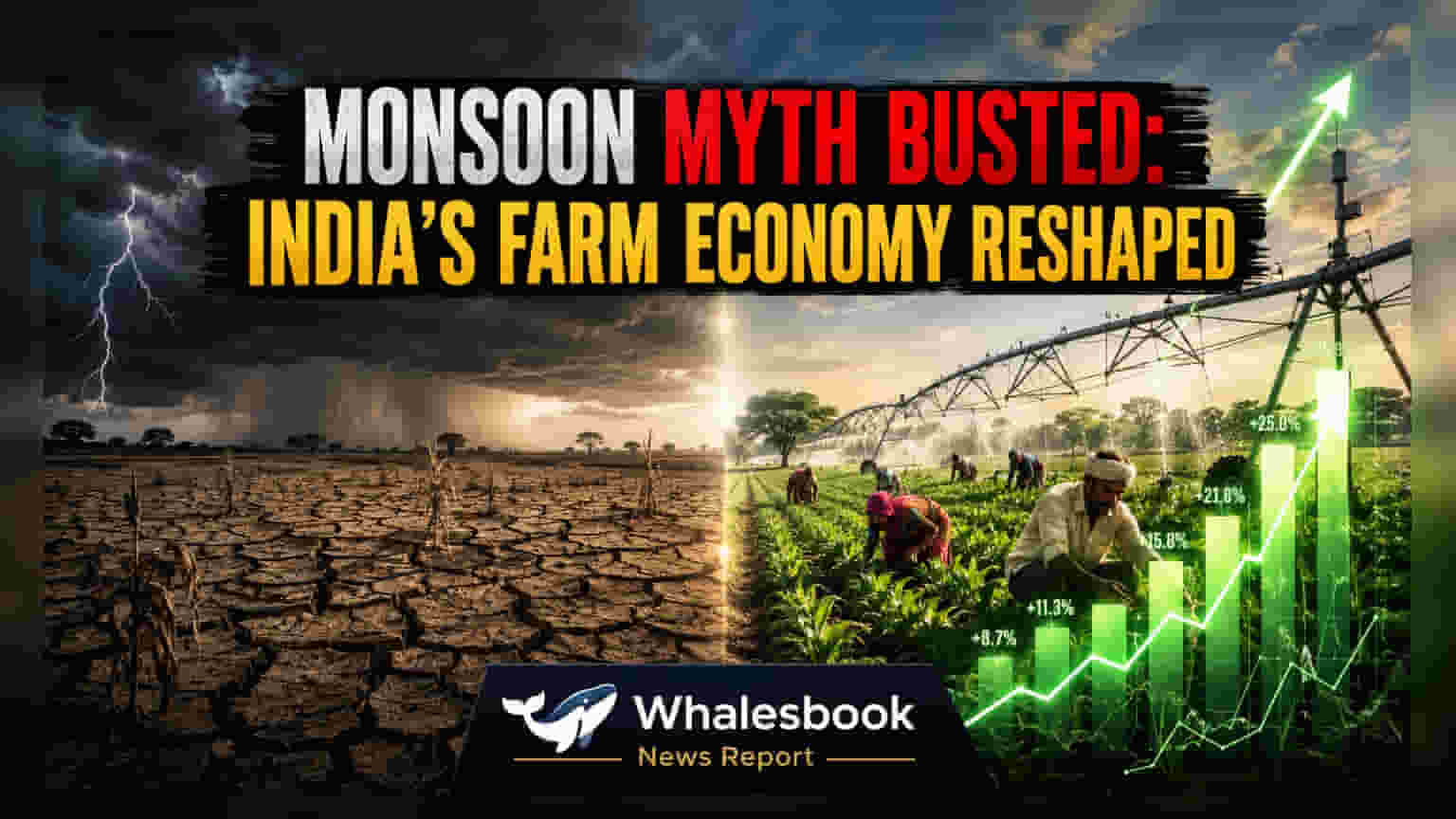
A recent Bernstein report reveals that India's agricultural sector is increasingly resistant to monsoon shifts due to better irrigation and new crop patterns. This structural change offers more stability for the rural economy, reducing the historical risk of production drops during weak rainfall years.
The long-standing belief that India's agricultural growth relies heavily on monsoon rainfall is changing. According to a recent report by brokerage firm Bernstein, the Indian farming sector has undergone a structural reset that makes it more resilient to rainfall fluctuations than in previous decades.
Impact of Irrigation and Crop Diversification
For many years, the Indian economy faced significant pressure whenever monsoon rains were below average. Traditionally, analysts assumed that a large portion of the nation’s farmland was entirely dependent on rainfall. However, Bernstein highlights that the expansion of irrigation networks—such as canals, tube wells, and drip systems—has allowed farmers to manage water usage more effectively even when rainfall is scarce.
Furthermore, farmers are increasingly adopting different crop patterns. By choosing crops that are better suited to available water supplies or that require less water during critical growth stages, the sector has become less vulnerable to rainfall shocks. This shift is helping to protect agricultural output and, by extension, rural disposable incomes, which were once highly sensitive to monsoon-related volatility.
Historical Resilience During Recent Dry Spells
To understand this trend, it is useful to look at historical data. In the past, such as during the 2002 monsoon when rainfall was just 81% of the long-period average, the impact on production and rural earnings was severe. In contrast, the performance over the last ten years shows a different story.
Despite experiencing rainfall that was below normal during periods like 2018-19 and 2023-24, India still managed to see growth in foodgrain production. This consistency serves as evidence that the structural improvements in the sector are working to insulate overall output from the annual variability of the rains.
For investors, this shift suggests that the rural economy may become a more stable contributor to India's GDP. While the monsoon remains an important factor for total water availability, the reduced correlation between rainfall levels and production drops could lead to more predictable outcomes for companies linked to rural consumption, such as those in the consumer goods, fertilizer, and tractor sectors. The next important monitorable will be how these irrigation and cropping improvements continue to scale across different states, further reducing regional disparities in agricultural performance.