

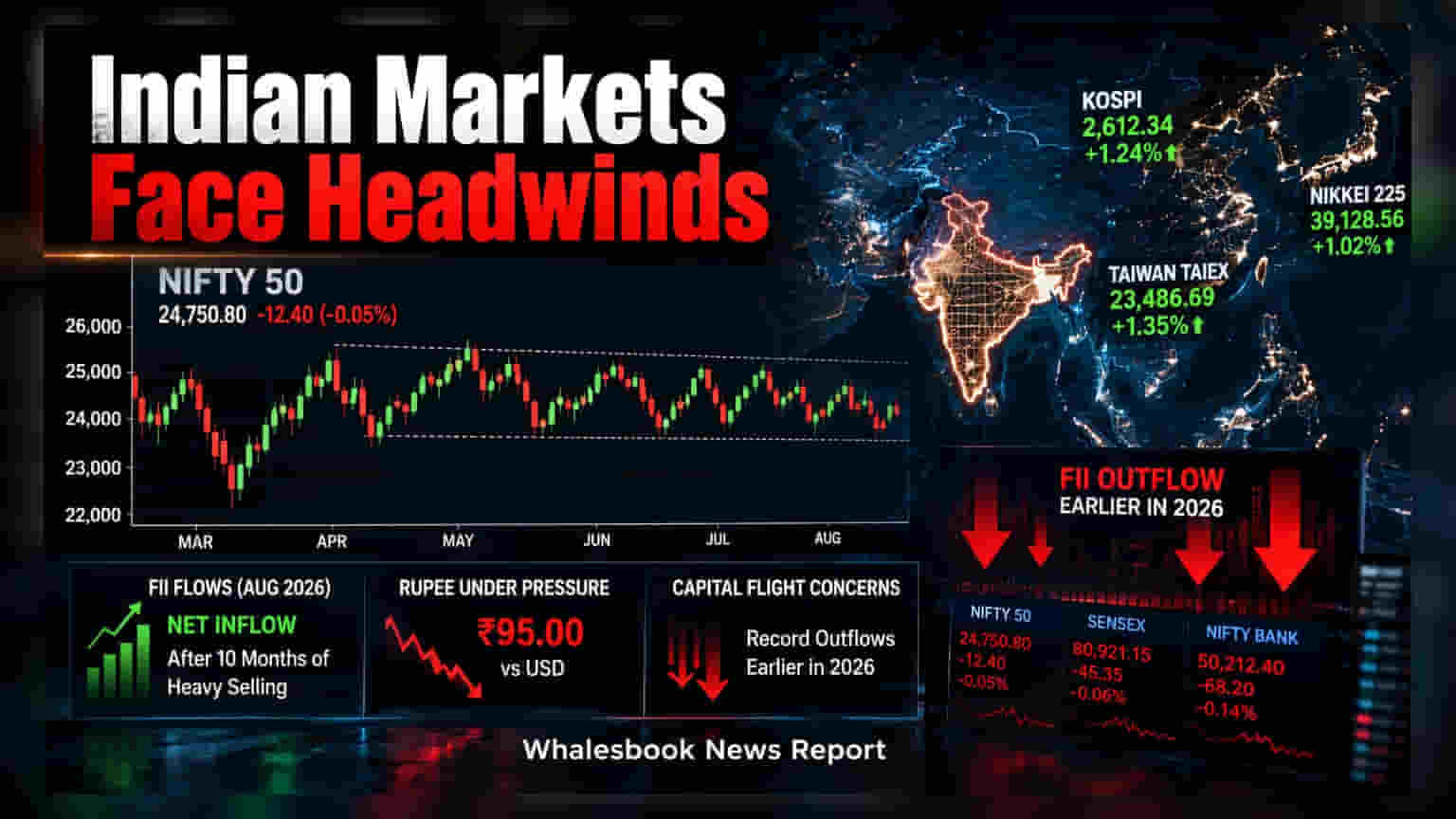
India’s stock market is showing early signs of recovery as foreign investors recorded net inflows in July and August 2026, breaking a long trend of selling. Despite this, investors remain cautious due to a weakened rupee trading around 95 against the U.S. dollar and higher valuations compared to tech-driven Asian peers.
After a year of heavy selling by global investors, the Indian stock market is seeing a subtle shift in sentiment. Data for August 2026 shows net inflows from Foreign Institutional Investors (FIIs), marking a potential second consecutive month of buying following a similar trend in July. This change comes after a prolonged period where record outflows and a struggling rupee created significant pressure on major indices like the Nifty 50 and BSE Sensex throughout early 2026.
While the return of foreign capital is a positive signal, the market environment remains complex. A primary headwind for investors continues to be the Indian rupee, which has faced significant depreciation and is currently trading around 95 against the U.S. dollar. This currency weakness can reduce the effective returns for global investors, making them more selective about where they deploy capital.
India is currently navigating a period of valuation concerns. While corporate earnings have been a point of discussion, some analysts highlight that Indian equities are trading at a premium compared to other emerging markets. This valuation gap, coupled with the high growth seen in tech-heavy Asian indices in Taiwan, South Korea, and Japan, has led some global funds to look toward those regions for exposure to the artificial intelligence and technology sectors. In contrast, the Indian market has had to rely heavily on domestic support to maintain stability.
Domestic retail participation has been the most important stabilizer for the market this year. Regular investments through Systematic Investment Plans (SIPs) have provided a consistent flow of money, acting as a buffer against the volatility caused by foreign selling. Without this steady support from local investors, market indices might have faced a much sharper decline during the months when global sentiment was deeply negative.
Looking ahead, the market's direction will likely depend on a few key factors. Investors are watching for further stabilization in the rupee and clarity on how global interest rate policies might evolve. Regulatory developments also remain on the radar, with SEBI exploring potential trading reforms, such as adjustments to collateral requirements and shorting mechanisms, which aim to improve market depth and make the Indian exchange more attractive to international participants.
The most important monitorable for investors in the coming months will be the consistency of FII inflows. A sustained trend of buying, rather than short-term opportunistic moves, would be a stronger indicator that global confidence in the Indian market is returning. Additionally, the ability of domestic companies to justify their valuations through continued earnings growth will remain a critical factor in how the market performs relative to its regional peers.