 Whalesbook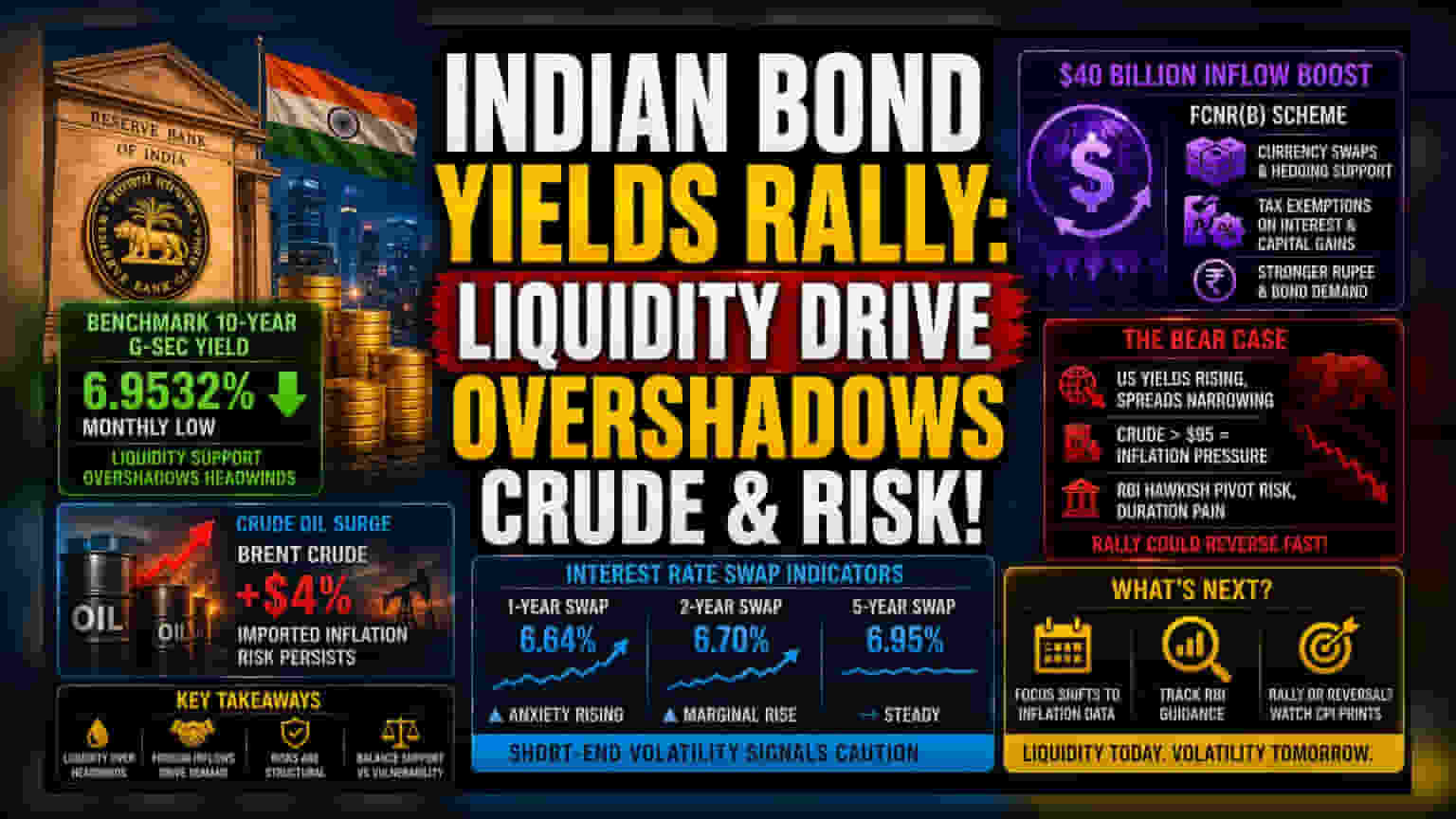


The Liquidity Disconnect
The current price action across the Indian sovereign debt curve suggests that liquidity injections are temporarily overpowering traditional macroeconomic headwinds. While benchmark yields retreated to 6.9532%—a notable monthly floor—this movement remains inversely correlated with the global energy complex. Investors are effectively betting that the Reserve Bank of India's suite of currency swaps and hedging facilities will act as a sufficient buffer against the imported inflation typically associated with a 4% surge in Brent crude. The market is currently prioritizing immediate capital inflow potential over the persistent vulnerability of India’s energy-dependent fiscal deficit.
Structural Reliance on Inflows
Nomura’s projections regarding a $40 billion injection via FCNR(B) schemes highlight the central bank’s transition toward reliance on structured foreign capital to stabilize the rupee and support debt demand. Unlike previous cycles where domestic institutional investors anchored the market, the current appetite is increasingly sensitive to regulatory sweeteners. Removing capital gains and interest income taxes for foreign holders of government securities effectively lowers the hurdle rate for carry trades. However, this creates a synthetic support level for bond prices that may prove brittle if geopolitical tensions in the Middle East cause a sustained, rather than spike-driven, elevation in global shipping costs.
The Forensic Bear Case
Market participants ignoring the current bond rally point to two significant structural risks that could reverse these gains rapidly. First, the yield spread between Indian bonds and US Treasuries is narrowing as the latter tracks higher, potentially diminishing the appeal of the rupee-denominated carry trade. If US Treasury yields climb further, the cost of hedging for foreign investors will increase, regardless of the RBI’s support measures. Second, the energy-price pass-through remains a potent threat to inflation expectations. Historical precedents indicate that when crude exceeds $95, the resulting inflationary pressure eventually forces a hawkish pivot from central banks, regardless of their current accommodative rhetoric. A sudden shift in the RBI’s stance to combat imported inflation would lead to immediate duration risk for long-term bond holders who are currently buying at these lower yields.
Forward Guidance and Volatility
Looking ahead, the stability of the one-year and two-year swap rates will be the primary metric for tracking market confidence. While the five-year swap rate has remained steady, the marginal rise in shorter-term swaps reflects an underlying anxiety that current central bank intervention may not be enough to prevent a structural rise in costs. Institutional focus will likely shift to upcoming consumer price index prints, which will dictate whether this rally has legs or if it represents a liquidity-induced topping pattern before a broader market correction.