

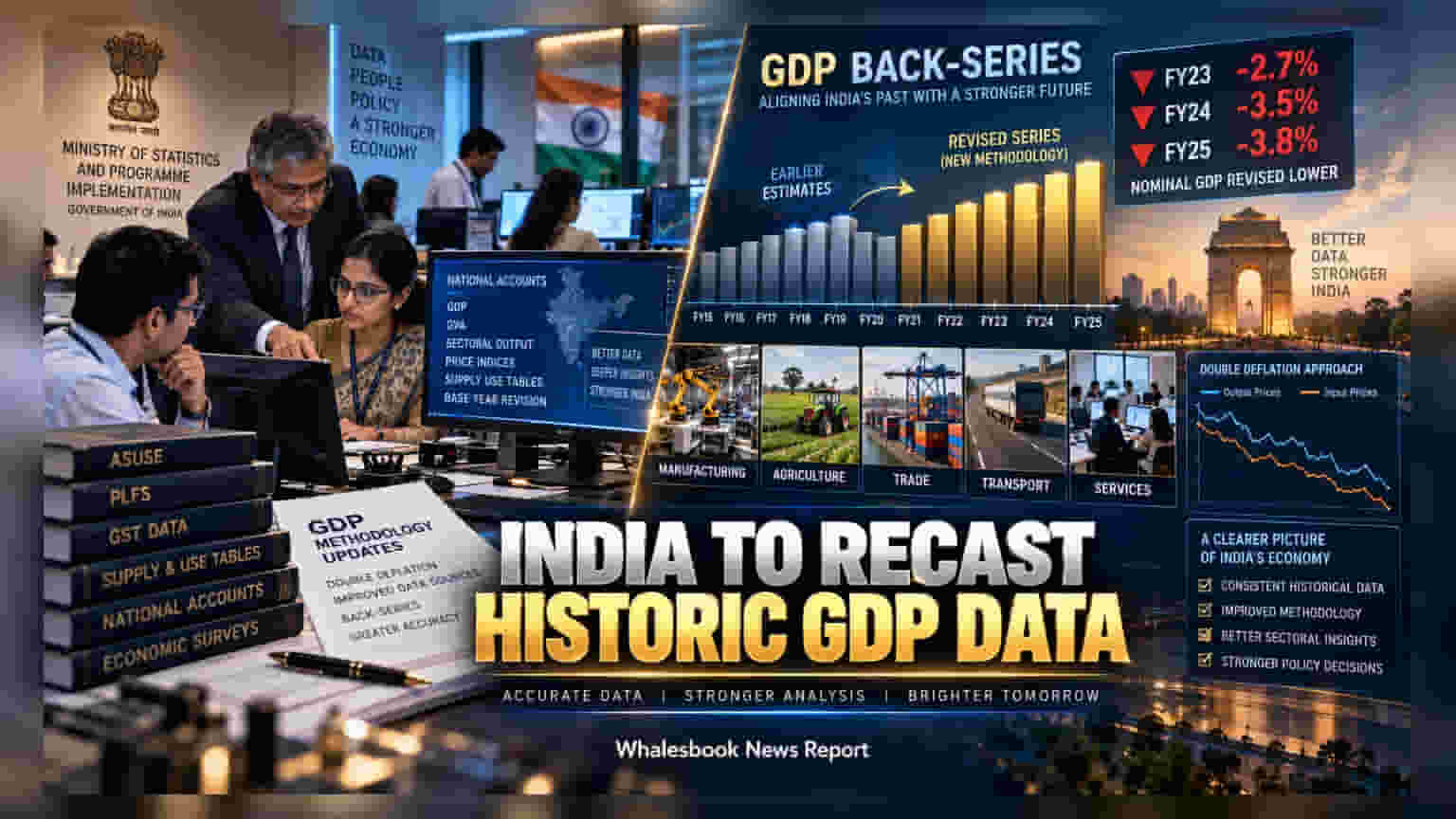
The Ministry of Statistics and Programme Implementation will release GDP back-series for years before FY23 by the end of 2026. This methodology update ensures consistent historical growth data. Investors should note that past revisions lowered nominal GDP, which can mechanically adjust key macro ratios like fiscal deficit-to-GDP and debt-to-GDP.
The Ministry of Statistics and Programme Implementation (MoSPI) has committed to releasing GDP back-series for years prior to the 2022-23 fiscal period by the end of 2026. This project is aimed at aligning historical economic data with the updated national accounts framework currently used to measure India's growth. For market participants and economists, this consistency is essential for analyzing long-term business cycles and growth trends.
Methodology Shifts and Data Accuracy
The upcoming back-series will apply the same advanced measurement techniques used in recent GDP updates. A central change is the move toward double deflation in the manufacturing sector. Previously, a single price index was often used for both production output and intermediate inputs. Under the new approach, output and input prices are tracked and deflated separately, providing a more precise calculation of gross value added.
Additionally, the government is reducing its reliance on older, indirect estimates. Instead, it is using direct datasets such as the Annual Survey of Unincorporated Sector Enterprises (ASUSE), Periodic Labour Force Survey (PLFS), and official GST records. By incorporating these administrative records into a Supply and Use Table framework, the Ministry aims to improve the alignment between production-side data and expenditure-side figures, reducing the need for residual balancing.
Impact on Nominal GDP and Sector Trends
The revised methodology has already influenced recent figures. When applied to the FY23-FY25 period, nominal GDP was adjusted downward by approximately 2.7% to 3.8%. These revisions caused significant changes at the sector level, which investors often use to gauge growth trends.
For example, data for agriculture and financial services was revised upward, while figures for trade, hotels, transport, and storage were lowered. Trade services, in particular, saw a notable downward adjustment. These sector-level shifts demonstrate why a consistent back-series is necessary; without it, historical comparisons between these industries may appear distorted.
Why Investors Monitor the Denominator Effect
For investors, the primary importance of this back-series lies in the denominator effect. Macroeconomic indicators such as the fiscal deficit-to-GDP ratio, debt-to-GDP, and market-capitalization-to-GDP are all calculated using nominal GDP. If the base nominal GDP is revised downward, these ratios may mechanically increase even if the actual government debt or company revenue remains unchanged.
As the back-series is released, the market will likely focus on how these revisions change the perception of India’s long-run productivity, fiscal health, and historical growth path. The next key monitorable will be the release of the updated dataset, which will allow for a clearer view of how structural changes in data collection have impacted the historical economic profile.