

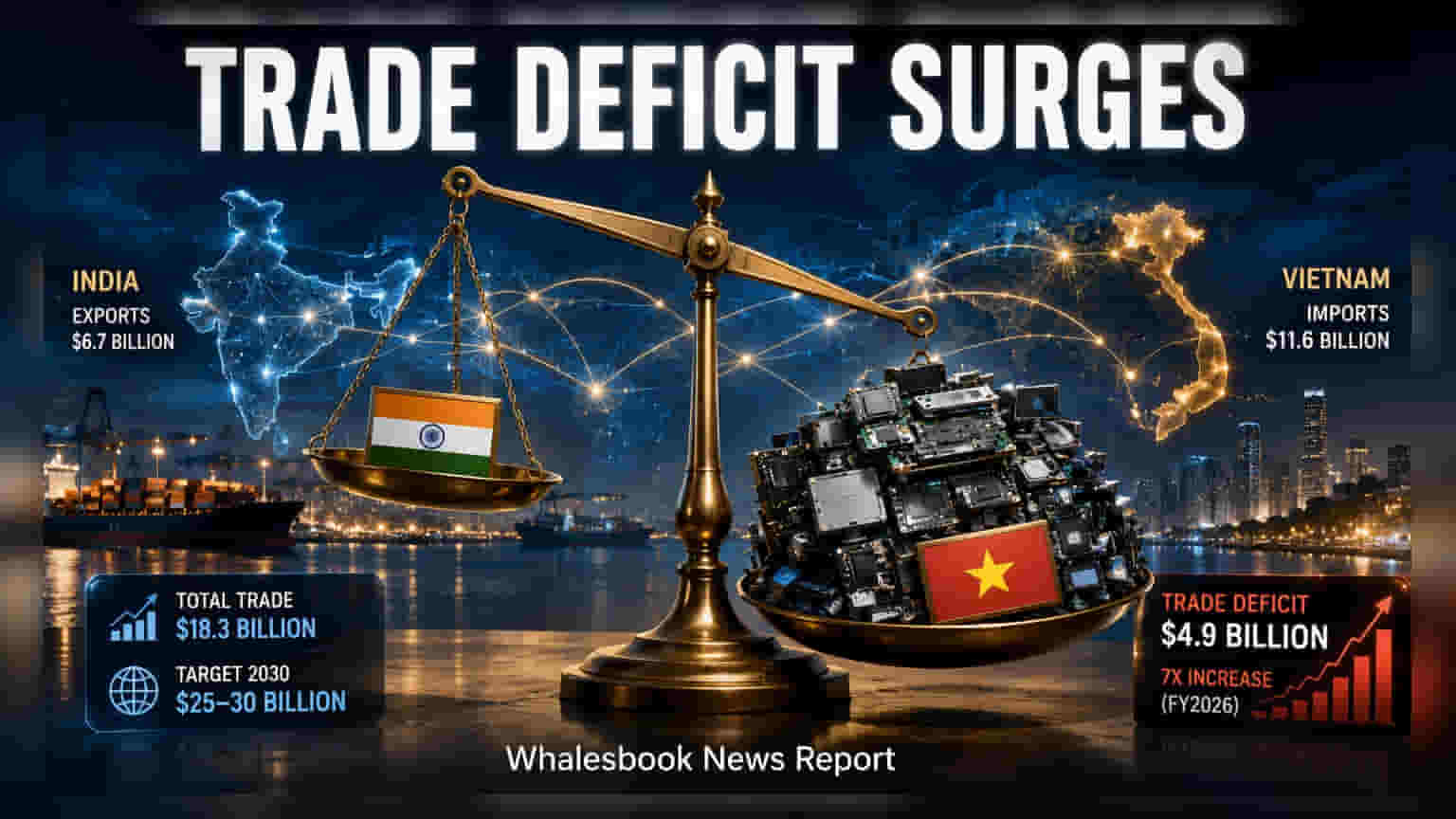
India's trade with Vietnam reached $18.3 billion in FY2026, but the trade deficit surged to $4.9 billion. Rising imports of high-tech electronics are outpacing export growth, highlighting a structural challenge as India expands its local manufacturing and assembly capabilities.
India’s bilateral trade relationship with Vietnam has expanded significantly, reaching a total volume of $18.3 billion in the fiscal year 2026. While this reflects a deepening economic connection, it has come with a notable challenge: a widening trade deficit that has surged to $4.9 billion. This seven-fold increase in the gap between imports and exports signals a structural shift in how India integrates into global supply chains.
At the core of this imbalance is a rapid rise in imports. While bilateral trade has grown at a compound annual rate of 7% over the last four years, India’s imports from Vietnam have accelerated at a faster 12% annual pace, totaling $11.6 billion in FY2026. This trend is driven by the country's growing demand for high-value technology and electronics components. Vietnam has emerged as a key node in the supply chain, providing India with critical inputs such as flat-panel displays, computing peripherals, and telecom equipment needed for domestic assembly operations.
This dynamic highlights an important economic transition. Indian firms are increasingly sourcing parts from Vietnam to fuel domestic manufacturing. While this supports the expansion of local assembly, it also creates a heavy reliance on imported components, which temporarily widens the trade gap. Until domestic manufacturing of these components scales up, this dependency is likely to persist.
On the export side, India is adjusting its portfolio. The traditional reliance on commodities like iron and steel is fading, replaced by a more diversified list of goods. Frozen bovine meat, unwrought aluminium, and various marine products have become primary exports, suggesting that Indian businesses are finding new niches in the Vietnamese market. Despite these efforts, the volume of these exports has not yet been able to offset the surging value of tech and electronics imports.
Looking ahead, both nations have established a target to scale bilateral trade to $25 billion to $30 billion by 2030. This goal is supported by the Enhanced Comprehensive Strategic Partnership signed in May 2026, which aims to improve cooperation in logistics and technology. For investors and policymakers, the key monitorable will be whether India can increase its value-added exports—specifically in the technology sector—to balance the trade equation. Additionally, logistical constraints and the potential for supply chain bottlenecks remain factors that could impact the efficiency of this trade corridor in the coming years.