

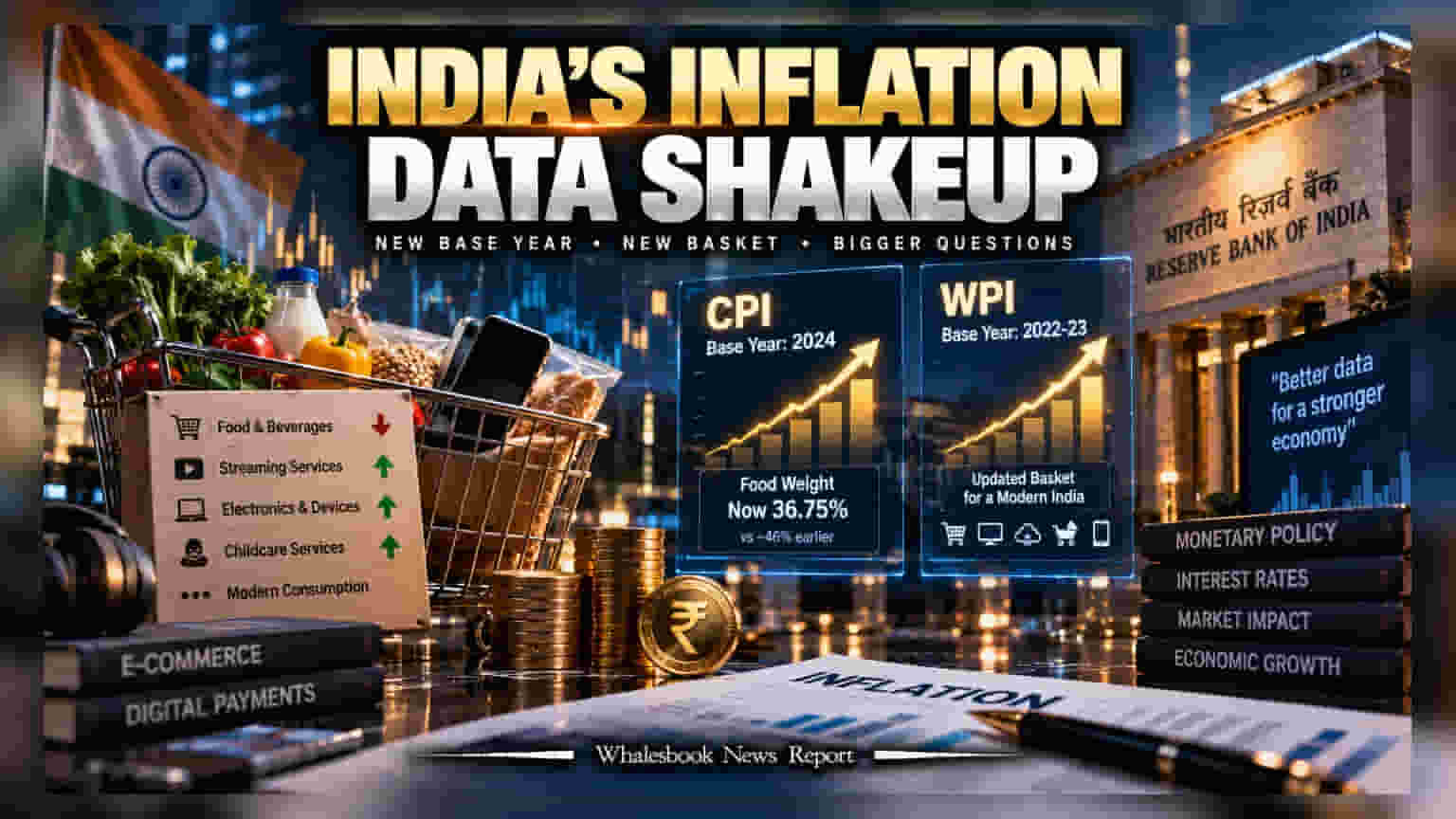
India has updated its Consumer Price Index (CPI) and Wholesale Price Index (WPI) with new base years, significantly lowering the weight of food items to 36.75%. This revision alters how the Reserve Bank of India measures inflation, potentially impacting future interest rate decisions and market sentiment.
The Indian government has officially updated its primary inflation benchmarks, shifting the Consumer Price Index (CPI) to a 2024 base year and the Wholesale Price Index (WPI) to a 2022-23 base. These changes are designed to better reflect modern consumption habits in an economy that has seen rapid digital transformation over the last decade. While the government aims to align data with current economic reality, the changes have sparked a debate among economists regarding potential gaps in how price movements are captured.
Impact of Lower Food Weighting
The most significant change in the new CPI basket is the reduction in the weightage of food and beverages. The weight has decreased to 36.75%, down from approximately 46% in the previous series. For the average investor, this is a crucial shift. Food prices are often the most volatile part of India's inflation basket. By assigning less weight to food, the overall CPI headline number may appear less sensitive to sudden spikes in vegetable or grain prices. Investors should note that while this might smooth out the index, it could also mask the actual cost-of-living pressure felt by households if food prices remain high.
Modern Consumption and Data Accuracy
The updated basket has been modernized to include items like streaming services, external storage devices, and paid childcare services, while removing older items such as VCRs and radio equipment. Despite these updates, critics have raised concerns about the methodology. A key issue cited by experts is the potential exclusion of data from the rapidly growing e-commerce sector and digital payment transactions. Because the updated indices may not fully track the nuances of online shopping, some analysts worry that the official inflation data could underrepresent the true economic activity of the formal sector. If the indices fail to capture these digital spending patterns, policymakers may receive a distorted picture of the economy.
Why Investors Should Monitor the Data
The Reserve Bank of India (RBI) relies heavily on these inflation indices to set interest rates. If the methodology underestimates or misreads inflationary trends due to these structural changes, it could lead to unexpected monetary policy decisions. For the stock market, interest rates are a primary driver of valuation, particularly for sectors sensitive to borrowing costs like banking, real estate, and consumer durables.
Going forward, the key monitorable for investors will be the RBI’s commentary on the new data series. The market will likely watch the first few monthly data releases closely to see how the new indices perform compared to the old ones. Investors should pay attention to whether the gap between the official inflation numbers and ground-level consumer spending trends widens or narrows, as this will determine the credibility of the new series in the eyes of financial markets.