

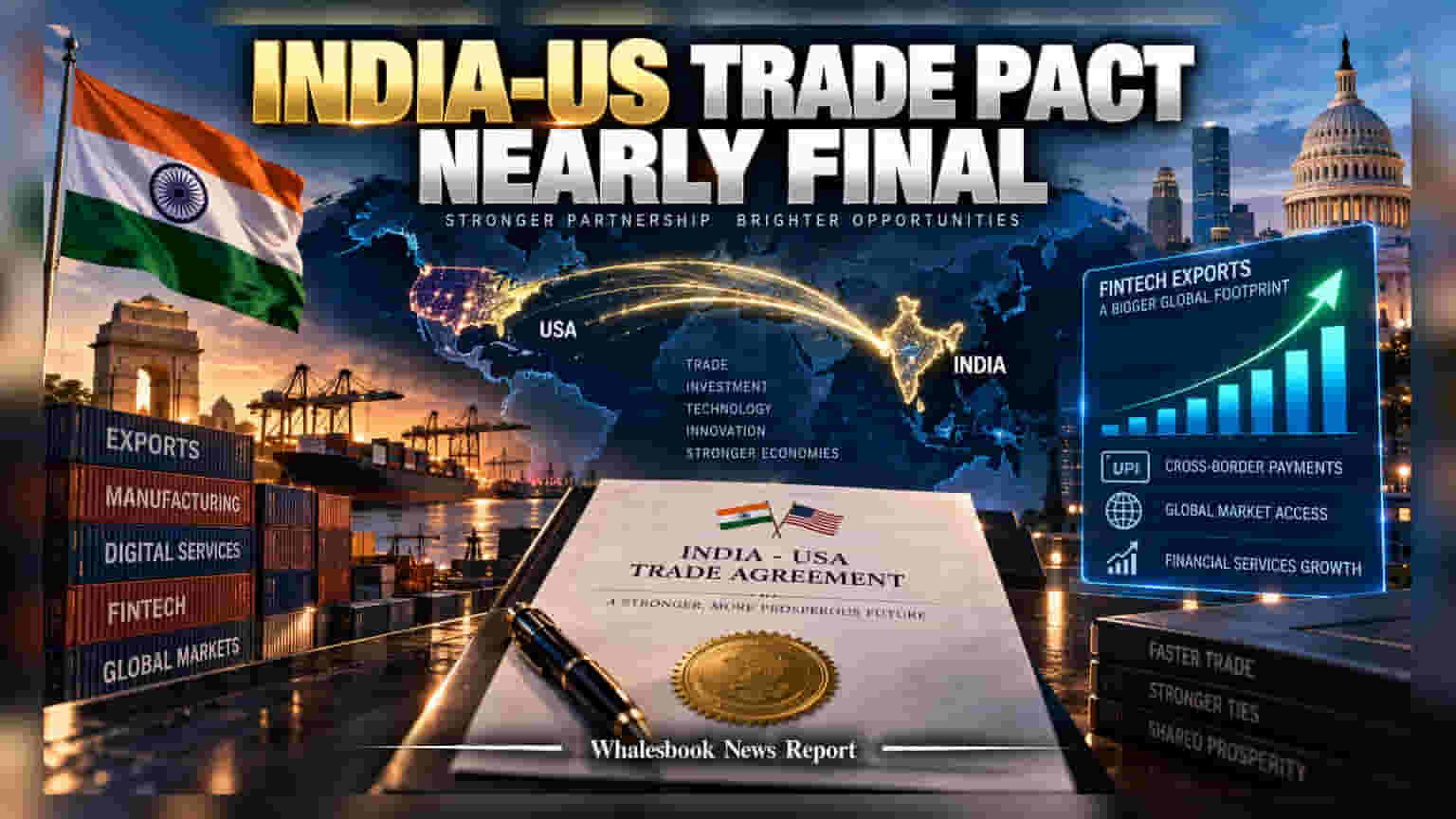
India and the US are nearing the completion of a trade agreement, with current talks centered on harmonizing tariff structures. Beyond this, the government is accelerating trade deals with Chile and New Zealand to boost export diversity. For investors, the strategy to pivot from traditional IT services toward fintech and cross-border payments represents a significant structural shift in India’s export engine.
The framework for a landmark trade agreement between India and the United States is approaching its final stages, according to Commerce Secretary Rajesh Agrawal. While the deal is not yet signed, officials have described it as "more or less" finalized, with negotiators currently working to align the two nations' different tariff structures. The primary hurdle involves reconciling India’s Most-Favoured-Nation (MFN) tariff system with the specific executive tariff framework used by the United States, creating a structure that allows for mutual market access without disrupting existing trade policies.
While the India-US discussions dominate the headlines, the government is actively expanding its broader trade network. A trade agreement with New Zealand, which was signed in April 2026, is scheduled to become operational in October 2026. Simultaneously, negotiations with Chile are moving forward, with officials expecting meaningful progress in the next two to three months. These initiatives are part of a wider government push to secure ties with diverse economies and move beyond a reliance on traditional major markets.
Beyond just manufacturing, a major part of India’s economic strategy involves shifting the profile of its services exports. Currently, IT and ITeS services account for roughly 50% of total service exports, a concentration the government is looking to dilute. The focus is now on capturing a larger slice of the global financial services market, where India currently holds a small share of about 1%. To achieve this, authorities are promoting the export of digital public infrastructure—specifically the Unified Payments Interface (UPI)—to facilitate cheaper, faster cross-border payments.
This shift carries important considerations for investors. The ambition to grow financial services exports from $8 billion to a target range of $60-80 billion creates significant opportunities for domestic fintech companies involved in payment integration. However, this sector faces its own set of hurdles. Competition in the global payment space is intense, and Indian firms must navigate complex international banking regulations and high operational costs when entering new markets.
Investors should also remain mindful of the risks inherent in these trade shifts. Despite the optimism surrounding new agreements, trade policy volatility in the US, including the potential impact of Section 301 duties, continues to affect the price competitiveness of Indian exports. Furthermore, exporters are currently facing margin pressure due to unhedged foreign currency exposure and rising global freight costs. As these trade deals move toward implementation, the key monitorables for the market will be the actual timeline for operationalizing the New Zealand and Chile agreements, and whether Indian fintech firms can successfully scale their cross-border payment solutions in a competitive global landscape.