

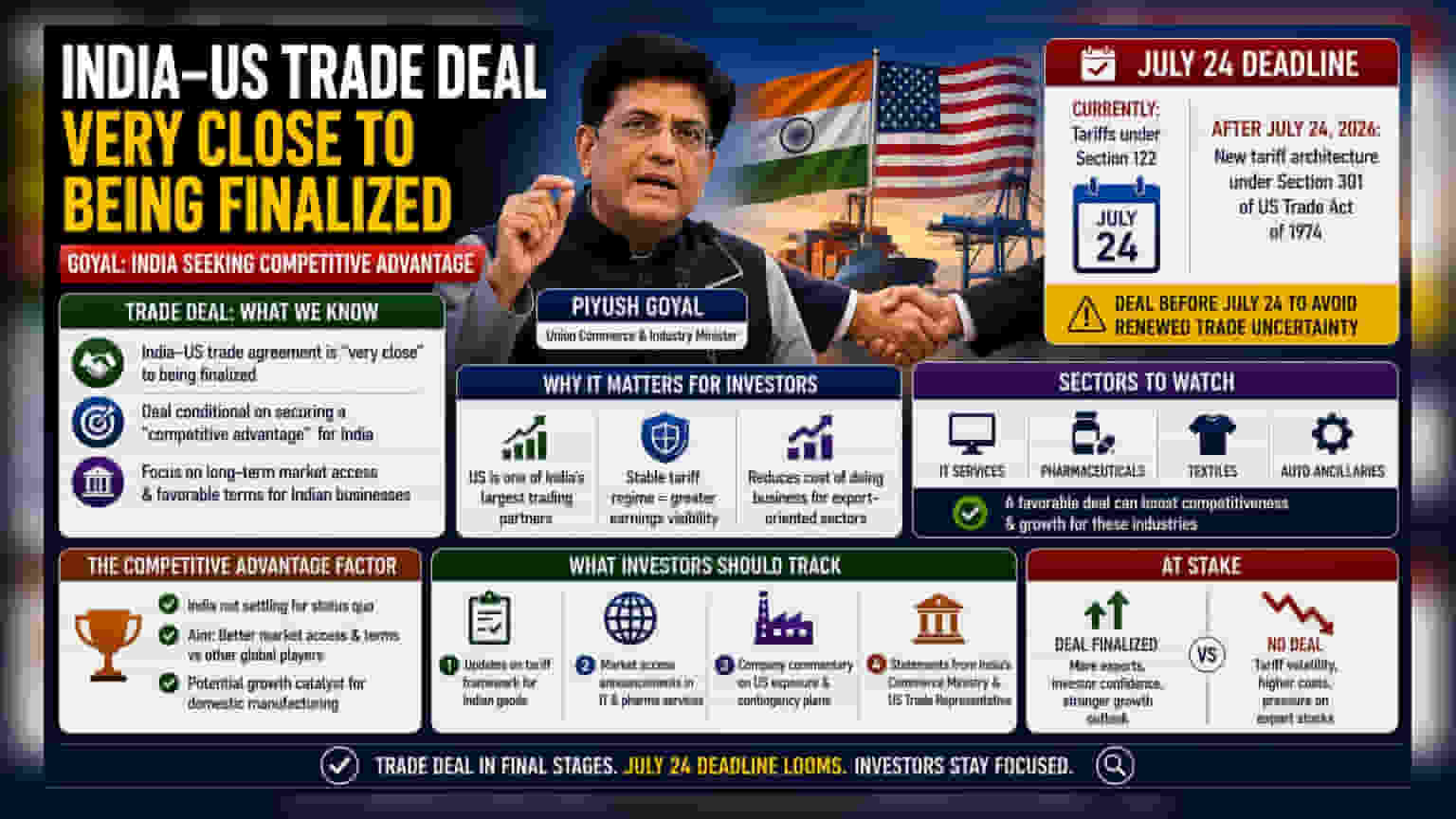
Commerce Minister Piyush Goyal says an India-US trade deal is nearing finalization, contingent on the US offering India competitive advantages. Investors are watching for a resolution before the July 24 deadline, as tariff uncertainties impact export-oriented sectors like IT, pharmaceuticals, and manufacturing.
What Happened
Union Commerce and Industry Minister Piyush Goyal has stated that a trade agreement between India and the United States is "very close" to being finalized. Speaking at the India Global Forum's UK-India Week 2026 in London, the minister emphasized that while negotiations are in their final stages, the deal remains conditional. Goyal clarified that India is seeking a framework that grants it a "competitive advantage" over other trading partners. This condition highlights that the final structure of the pact is not just about concluding negotiations, but about securing meaningful, long-term market access and favorable terms for Indian businesses.
The July 24 Deadline
For investors, the timing of these comments is significant. The India-US trade discussions are currently operating against the backdrop of changing US tariff policies. Temporary tariff measures implemented by the US under Section 122 of its trade laws are set to lapse on July 24, 2026. After this date, the US is expected to transition to a new tariff architecture under Section 301 of the US Trade Act of 1974. Consequently, finalizing a deal before this deadline is seen as critical to avoiding a period of renewed trade uncertainty, which could impact export volumes and supply chain planning for Indian companies.
Why This Matters For Investors
Trade agreements are rarely just about policy; they directly affect the operating environment for export-heavy sectors. Since the US is one of India's largest trading partners, any framework that clarifies tariff structures and reduces non-tariff barriers can provide greater earnings visibility for Indian exporters.
In previous trade discussions, Indian investors have focused on sectors like Information Technology (IT) services, pharmaceuticals, textiles, and auto ancillaries. If a deal provides a stable tariff regime, it could reduce the cost of doing business for these industries and help them maintain their price competitiveness in the US market. Conversely, if negotiations remain unresolved, the potential for new tariff structures after the July 24 deadline could lead to volatility in export-oriented stocks.
The Competitive Advantage Factor
Goyal’s focus on a "competitive advantage" suggests that India is prioritizing terms that allow its products to compete effectively against other global manufacturers. Investors may read this as a signal that the Indian government is not willing to accept a deal that merely maintains the status quo. The goal appears to be a shift toward more favorable market access, which could act as a growth catalyst for domestic manufacturing if successful.
What Investors Should Track
As the July 24 deadline approaches, the most important monitorables for investors include:
- Official updates on the tariff framework for Indian goods.
- Any announcements regarding market access in the IT and pharmaceutical services sectors.
- Management commentary from companies with high US revenue exposure regarding their contingency plans for export logistics.
- Further statements from both the Indian Ministry of Commerce and the US Trade Representative (USTR) office regarding the final deal structure.