

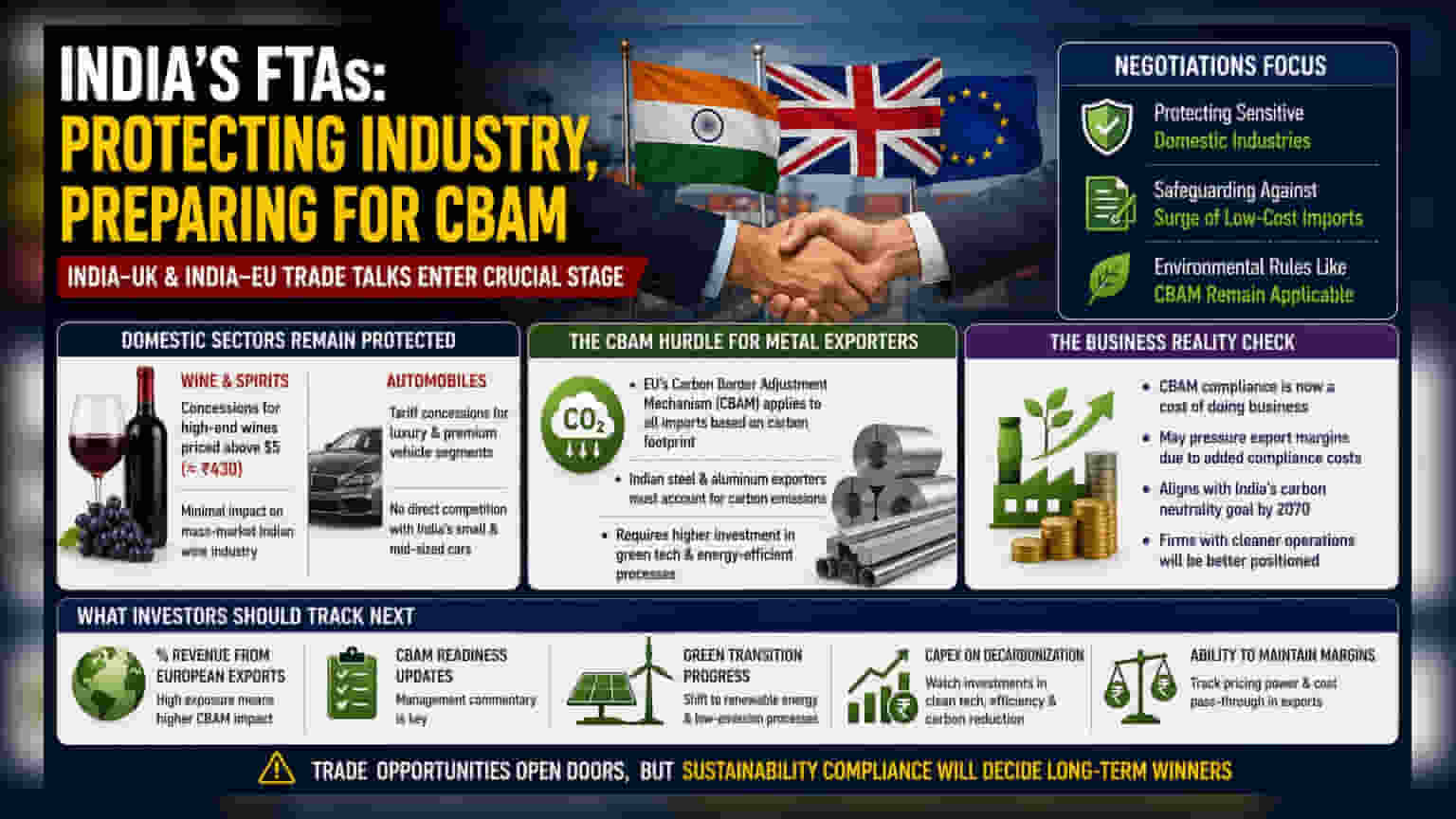
Upcoming trade deals with the UK and EU are set to shield local industries like automobiles and spirits from direct import competition. However, Indian metal exporters face a hurdle from the European Union's Carbon Border Adjustment Mechanism (CBAM), which mandates costly investments in greener production technologies.
What Happened
India’s ongoing free trade agreement (FTA) negotiations with the United Kingdom and the European Union have reached a stage where negotiators are focusing on protecting sensitive domestic industries. According to updates from industry body FICCI, the government has aimed to structure these deals to prevent a surge in low-cost imports that could hurt Indian manufacturers. While the framework provides a safeguard for sectors like automobiles, wine, and Scotch whisky, it does not exempt Indian exporters from environmental regulations like the European Union's Carbon Border Adjustment Mechanism (CBAM).
Why Domestic Sectors Remain Protected
Negotiators have reportedly used specific pricing and segment-based mechanisms to shield Indian businesses. For the wine and spirits industry, concessions are targeted at high-end products, specifically wines priced above $5 (approximately ₹430). Since this is a premium segment that does not directly compete with the mass-market Indian wine industry, the impact is expected to be minimal. Similarly, in the automotive sector, any tariff concessions are focused on the luxury and premium vehicle segments. This approach avoids direct competition with India’s domestic strength in small and mid-sized cars.
The CBAM Hurdle For Metal Exporters
While the trade deals offer some protection, they cannot bypass the European Union’s Carbon Border Adjustment Mechanism (CBAM). This is a regulatory policy, not a trade barrier, and it applies to all imports into the EU based on their carbon footprint. For Indian steel and aluminum producers, this presents a real business challenge. To continue exporting to the European market, these companies must account for the carbon emissions produced during manufacturing. This will likely necessitate higher capital spending on green technologies and energy-efficient processes to remain cost-competitive.
The Business Reality Check
For investors, the key takeaway is that compliance with CBAM is now a cost of doing business for export-oriented metal companies. While this shift aligns with India’s long-term goal of carbon neutrality by 2070, it also implies that profitability in the export segment could come under pressure due to these additional compliance costs. Companies that have already invested in renewable energy and cleaner manufacturing processes may find themselves better positioned than those relying on traditional, high-emission production methods.
What Investors Should Track Next
Investors tracking major steel and aluminum exporters should watch for management commentary regarding CBAM readiness. Important monitorables include the percentage of revenue generated from European exports, progress on green energy transition projects, and any updates on capital expenditure specifically earmarked for decarbonization. The ability of companies to pass on these compliance costs or maintain margins while absorbing them will be a critical factor for financial performance in the coming quarters.