 Whalesbook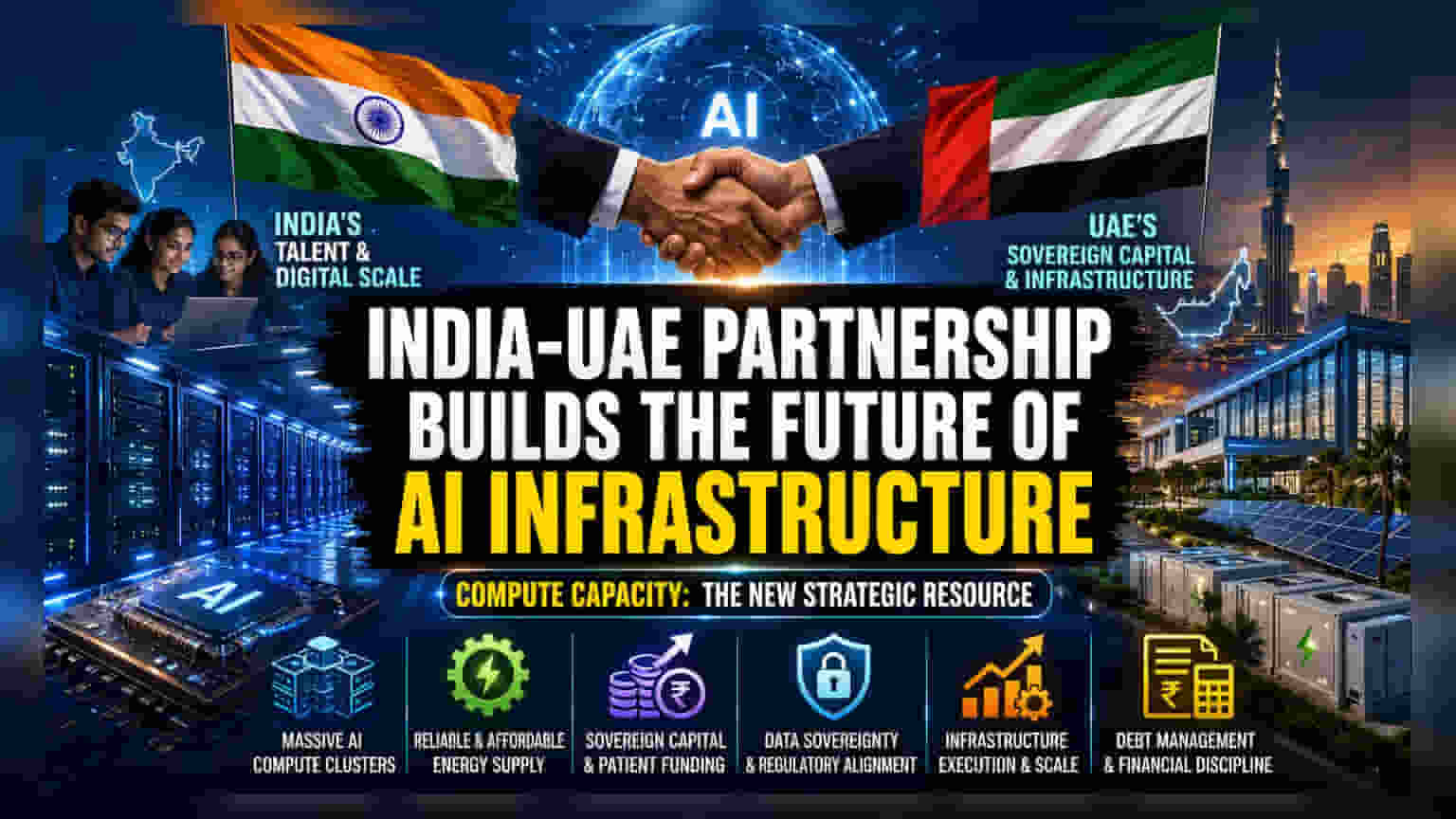


India and the UAE are collaborating to build critical AI infrastructure, positioning computing power as the next essential economic resource. This shift signals an era where specialized tech capacity—like data centers and AI clusters—is becoming as vital as traditional energy. For investors, this marks a pivot toward capital-intensive digital infrastructure, highlighting both new long-term growth opportunities and unique financial risks related to energy, technology obsolescence, and funding.
What Happened
India and the UAE are expanding their strategic cooperation to build large-scale AI and computing infrastructure. This partnership brings together India's pool of technical engineering talent and digital market depth with the UAE's sovereign capital and infrastructure expertise. At the heart of this development is the concept that 'compute capacity'—the massive processing power required to run artificial intelligence models—is evolving into a scarce and critical economic resource, much like oil was in the 20th century.
Why This Matters For Investors
This partnership marks a transition in the tech investment landscape. For years, investors focused on software companies that required low physical investment. Now, the industry is moving toward 'computational capitalism,' where the competitive advantage comes from who owns the infrastructure of intelligence. This means large-scale investments in data centers, cooling systems, specialized energy supplies, and high-end chip clusters. Investors should view this as a shift toward asset-heavy tech, where the business model relies on massive capital spending and long-term infrastructure stability rather than just code.
The Financial Challenge
Building AI infrastructure is fundamentally different from traditional tech projects. It is expensive and lumpy, meaning money is spent in huge, uneven chunks. The financing models are also becoming more complex. Traditional bank loans may not always fit the bill because these projects carry high uncertainty regarding technology cycles. For example, the chips needed for AI today might become less efficient compared to newer versions in a few years, leading to the risk of technology obsolescence. To manage this, we are likely to see more hybrid financial tools, such as convertible bonds, being used to fund these long-term assets.
The Energy And Resource Constraint
One of the biggest, often overlooked risks for investors is the massive energy requirement. High-performance AI clusters consume enormous amounts of electricity. This puts pressure on power grids and energy costs. Any company or project operating in this space needs a reliable, affordable, and large-scale power supply. If a company cannot secure this, its operational costs will spike, which can hurt profit margins. Investors tracking this sector should watch for how companies manage their power supply and if they are investing in dedicated energy sources to avoid grid instability.
Peer And Sector Check
The AI infrastructure sector is crowded and capital-intensive. Unlike a software firm that can scale with minimal cost, a company building data centers is locked into its physical capacity. Peers in this space often face high debt-to-equity ratios because they must borrow heavily to fund construction before the servers even start generating revenue. The India-UAE corridor aims to address this by providing access to sovereign capital, which can offer more patience than traditional private equity or high-interest bank debt.
What Investors Should Track
Investors looking at this space should move beyond just looking at the 'AI' label. The first monitorable is project execution. Are these data centers being built on time? Second, watch the power cost. Profitability in this sector is directly tied to the cost of electricity and cooling. Third, keep an eye on regulatory updates from India regarding the AI mission and data sovereignty, as government policies will dictate how foreign capital can participate in domestic infrastructure. Finally, monitor the management of debt. As these companies spend heavily to build, their balance sheets will be stretched, and their ability to manage this debt over several years will be the true test of their success.