

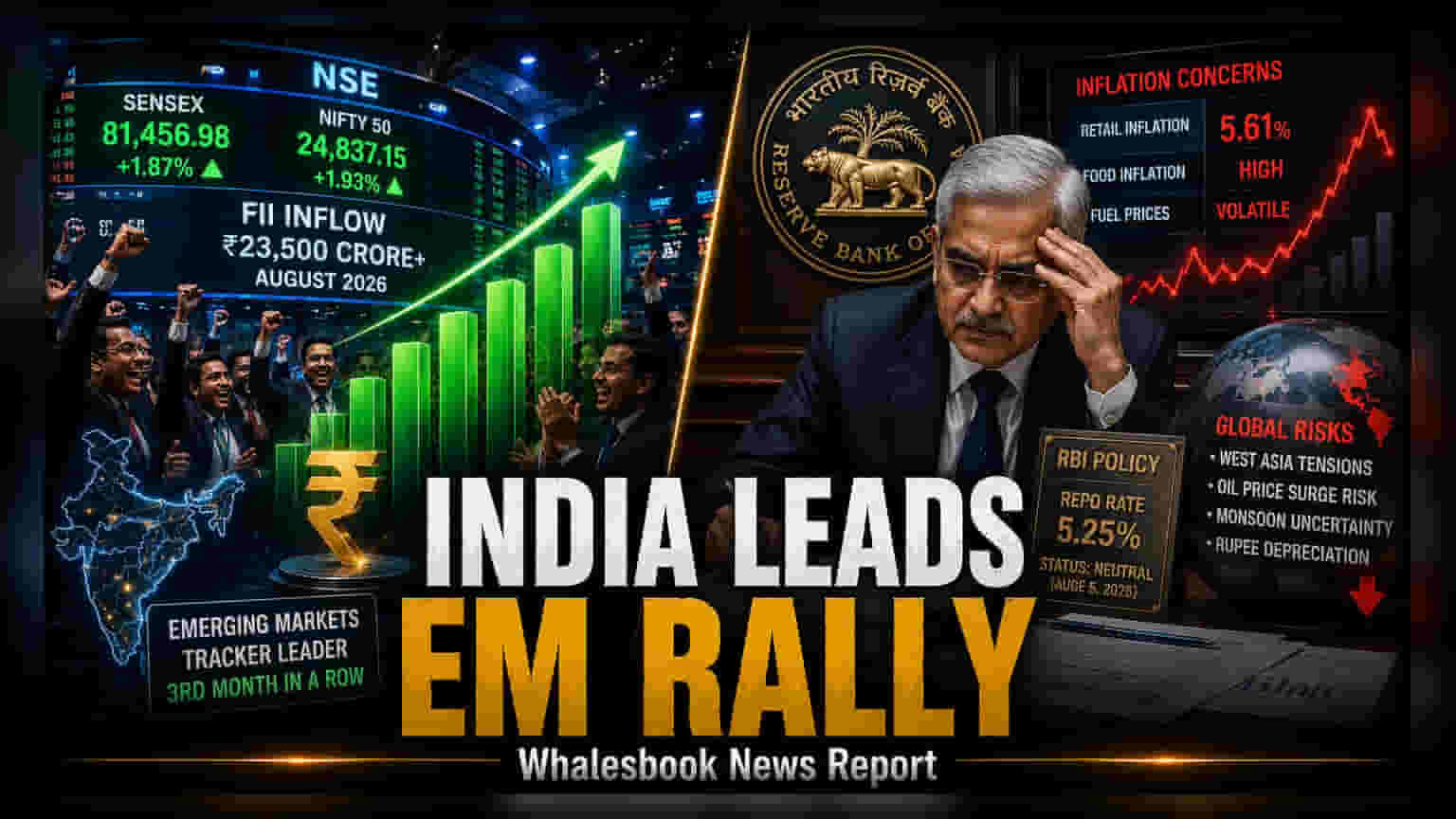
India has secured the top rank in the Emerging Markets Tracker for the third consecutive month, driven by strong foreign portfolio inflows exceeding ₹23,500 crore in August. Despite this momentum, investors remain focused on rising food inflation, geopolitical tensions in West Asia, and currency volatility that continue to challenge the economic outlook.
India has maintained its position as the leader in the Emerging Markets Tracker for the third straight month as of August 2026. This sustained performance is largely fueled by a significant return of foreign portfolio investment. After recording an inflow of ₹20,200 crore in July, foreign investors poured over ₹23,500 crore into Indian equities in August, signaling renewed confidence from global participants.
Economic Growth And Monetary Policy
The country’s macroeconomic foundation remains firm, with projected GDP growth for the financial year 2027 standing at 6.7%. Supporting this growth, the Reserve Bank of India (RBI) has opted for stability in its latest policy meeting held on August 5, 2026. The central bank maintained the repo rate—the interest rate at which the RBI lends money to commercial banks—at 5.25%. The RBI has kept a neutral policy stance, adopting a data-dependent approach to determine if any future adjustments are required based on evolving inflation trends.
Inflation And Global Risks
While the stock market has shown strength, the economic environment faces notable pressures. Retail inflation remains a concern, driven by volatile prices in food and fuel sectors. Economists warn that these costs could lead to persistent inflation if they remain elevated for an extended period. Additionally, the Indian rupee continues to face depreciation pressure against the US dollar, which can impact import costs and profit margins for companies reliant on foreign raw materials.
Investors are also tracking geopolitical risks, particularly tensions in West Asia. Any disruption in energy supply routes, such as the Strait of Hormuz, could lead to a spike in global oil prices, which directly impacts India’s import bill and current account balance. Potential weather-related events, including irregular monsoon patterns, also pose a risk to agricultural output and rural consumption, which are essential components of the broader economy.
MSCI Index Rebalancing
Market activity is also being influenced by upcoming changes to the MSCI India Standard Index, which is scheduled for rebalancing on August 31, 2026. This event typically leads to shifts in institutional holdings, as global funds adjust their portfolios to match the updated index composition. The inclusion of companies such as Laurus Labs, Adani Energy Solutions, and others in this cycle is expected to drive specific trading volume and capital allocation in these stocks as funds realign their positions.
The key focus for investors moving forward will be the monthly inflation data and any updates from the RBI on its monetary stance. The stability of the currency and the impact of global geopolitical developments on oil prices will also remain critical factors in determining whether India can sustain its current market leadership.