

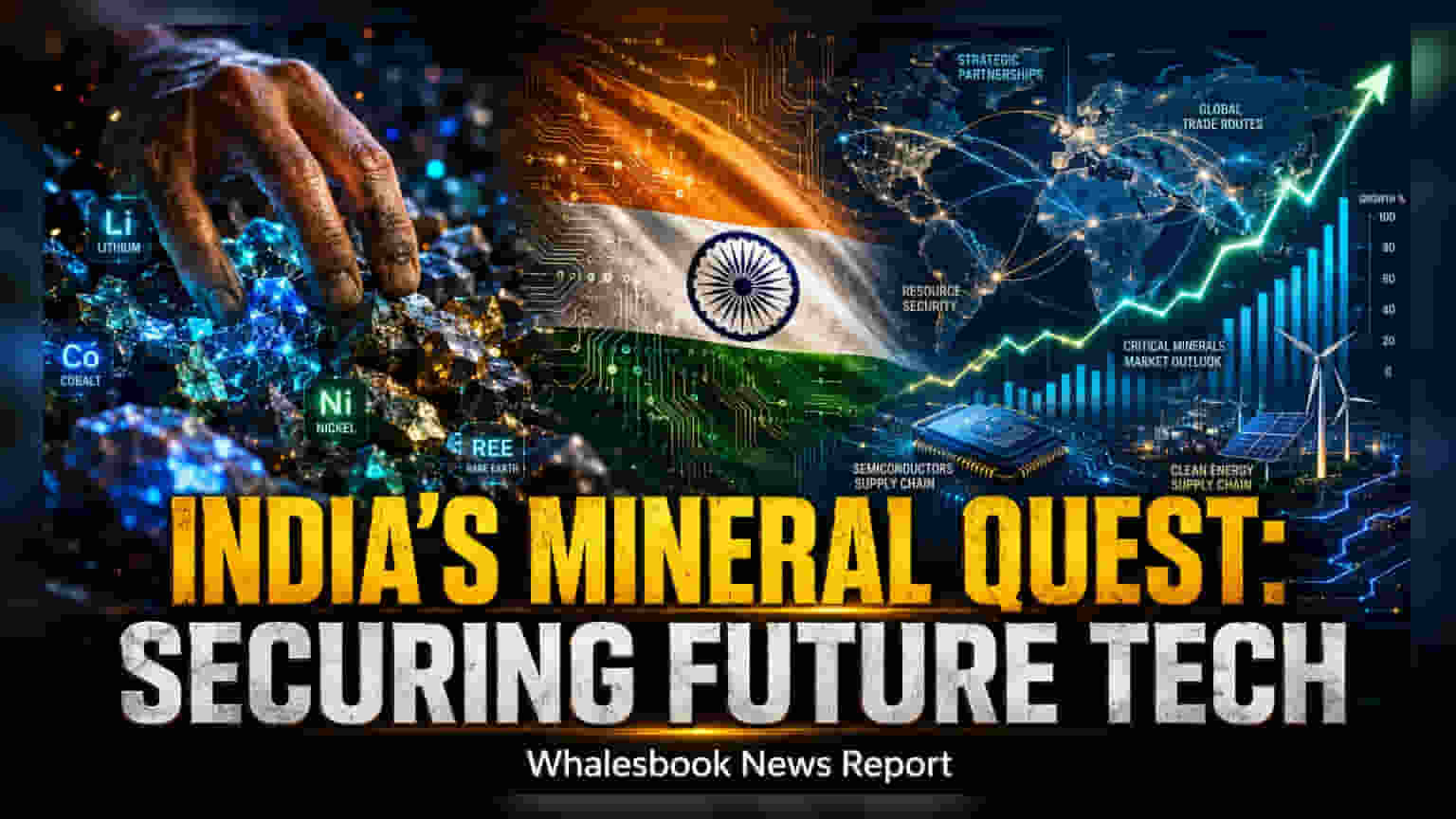
India is integrating critical minerals like lithium, nickel, and cobalt into its trade and investment strategy to secure supply chains for the EV and semiconductor sectors. By prioritizing these materials in international agreements, the government aims to reduce reliance on single-source suppliers like China. Investors should track how these trade pacts and domestic capacity-building efforts shape manufacturing costs and supply stability.
India is officially shifting its trade focus to prioritize secure access to critical minerals, energy resources, and semiconductors. Union Minister Piyush Goyal recently confirmed that the government is embedding these strategic areas into free trade agreement negotiations and broader economic partnerships. This shift is designed to fuel India's clean energy, electric vehicle (EV), and high-tech manufacturing ambitions, which rely heavily on specialized raw materials.
The Strategic Pivot
The government has identified 30 critical minerals, including lithium, cobalt, nickel, and rare-earth elements, as essential for the country’s industrial roadmap. India’s current manufacturing push—particularly in EVs and electronics—requires a stable and affordable supply of these materials. Because domestic production is currently limited, international trade deals have become a primary tool to ensure consistent supply and diversify sources.
A significant step in this direction was the signing of the India-U.S. Critical Minerals Framework in May 2026. This partnership is designed to strengthen supply chain resilience and lower the risk of being dependent on a single country for essential resources. By formalizing these ties, India aims to create a more predictable procurement environment for its private sector.
Navigating Supply Chain Risks
While trade deals are a key component of the strategy, India faces structural challenges that investors should understand. The country remains highly dependent on imports for critical minerals like lithium and cobalt, often sourcing them from dominant global suppliers, including China. This concentration creates vulnerabilities, such as the potential for price volatility, supply chain disruptions, and exposure to geopolitical tensions.
Furthermore, the lack of large-scale domestic high-purity processing and refining capacity remains a hurdle. Even if raw materials are secured through trade pacts, India must invest in refining capabilities to convert these minerals into battery-grade or semiconductor-grade materials. Without this midstream capability, the country may continue to struggle with value addition and cost competitiveness.
Trade Deficit and Industrial Growth
Regarding the widening merchandise trade deficit, the government has maintained that this is a byproduct of growth rather than economic weakness. Data indicates that a significant portion of imports consists of intermediate goods and raw materials used to fuel domestic production. Officials argue that these imports are necessary to support infrastructure and export-oriented manufacturing, rather than representing an uncontrolled consumption of luxury goods.
What Investors Should Monitor
As this strategy unfolds, investors should look for updates on three main fronts. First, the progress of the Production Linked Incentive (PLI) schemes will be vital, as these are meant to build the domestic capacity to process and use these minerals. By March 2026, the PLI framework had already seen significant investment applications, which serves as a baseline for measuring future progress. Second, track any new trade pacts that specifically include clauses for mineral security or technology transfer. Finally, watch for policy changes related to domestic mining and private sector participation in mineral exploration, as these will determine how quickly India can reduce its dependency on imports.