

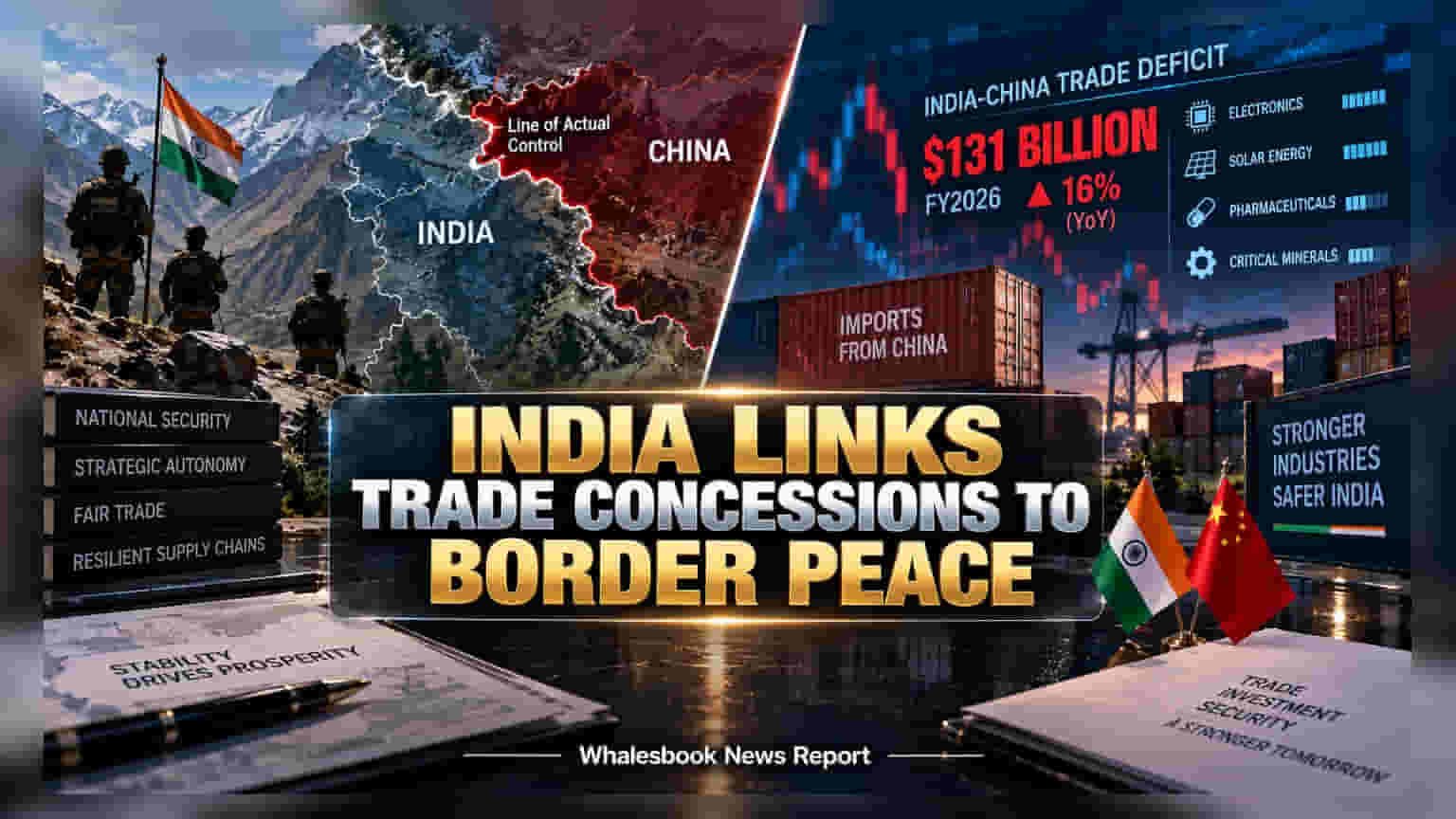
The Indian government has officially linked future trade concessions for China to border stability, ending the policy of separating commercial ties from national security. With the bilateral trade deficit rising to $131 billion in FY26, this shift emphasizes domestic capacity building over unconditional market access, potentially impacting industries heavily reliant on Chinese intermediate components.
New Delhi has officially signaled a major policy shift by conditioning future trade and investment concessions for China on the restoration of border peace. This move marks the end of the previous strategy that tried to isolate commercial relations from territorial disputes along the Line of Actual Control. The government has clarified that national security and sovereignty will now take precedence over unconditional economic engagement.
The timing of this policy recalibration follows recent volatility along the border and concerns over territorial arrangements involving China and Pakistan. Indian officials have emphasized that while selective relaxation of investment norms—such as the 10 percent minority holding threshold under Press Note 3—was permitted earlier this year, the era of open-ended market access has concluded.
Economic data highlights the scale of the challenge for Indian industries. The bilateral trade deficit with China reached $131 billion in the fiscal year 2026, representing a 16 percent increase compared to the previous year. This widening gap has become a core concern for policymakers, especially as the country seeks to reduce its dependency on external supply chains.
Sectors including electronics, solar energy, and pharmaceuticals are particularly sensitive to these changes. These industries rely significantly on Chinese intermediate components and critical minerals to maintain production levels and cost competitiveness. The government is now framing the development of domestic capacity across these supply chains as a primary national security objective, rather than just an industrial goal.
For investors and market participants, this policy shift suggests potential friction for companies heavily dependent on Chinese imports. While the government aims to strengthen domestic manufacturing, the transition period may involve supply chain complexities or cost adjustments for industries reliant on Chinese inputs. Investors may monitor how businesses adapt their sourcing strategies and how the government accelerates domestic production capabilities to offset the reliance on imports. The long-term success of this pivot will depend on the speed of domestic supply chain development and the ability of Indian manufacturers to bridge the reliance gap.