

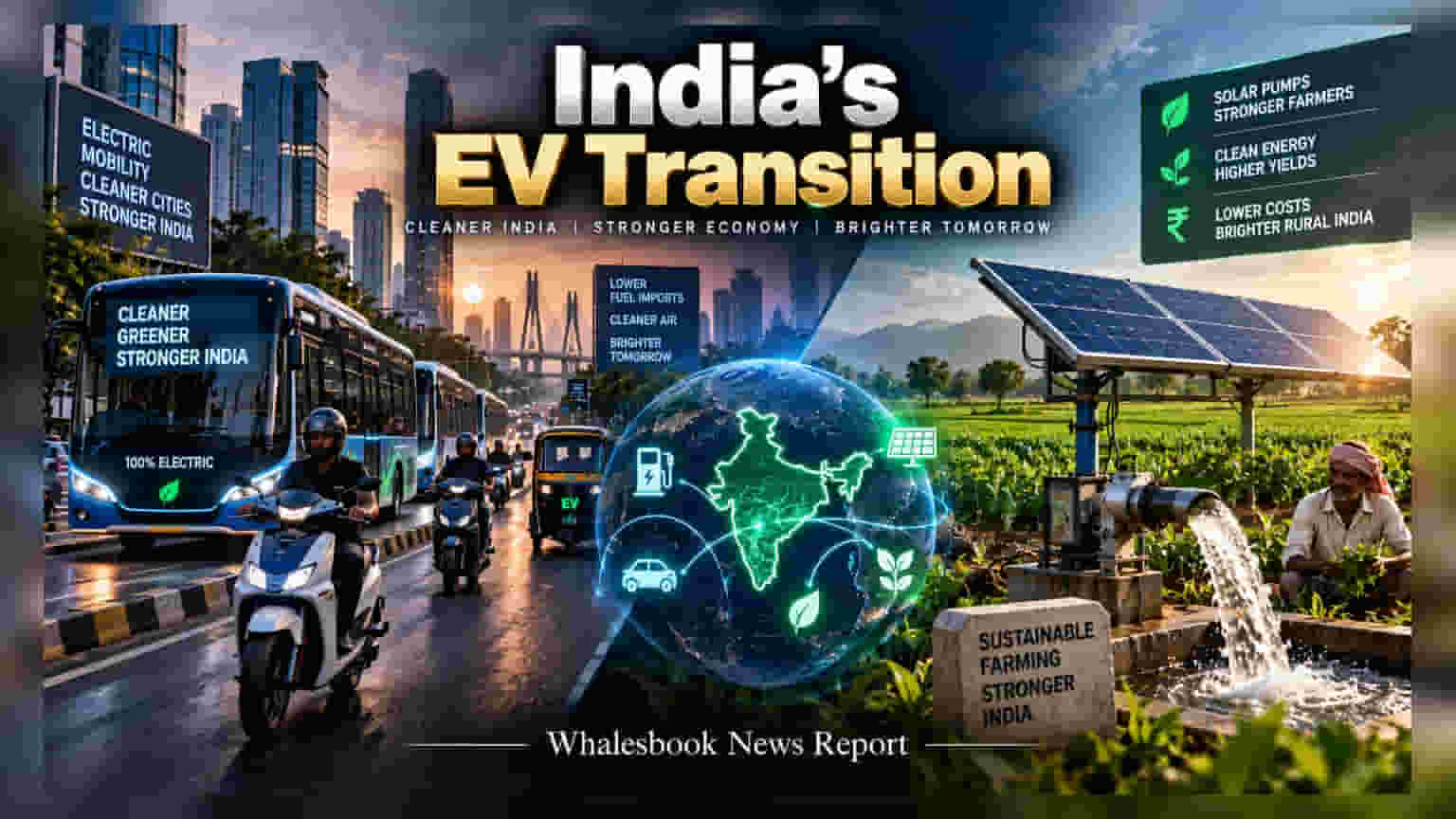
India is aggressively transitioning road transport and agriculture to electric power to reduce its $100 billion annual oil import bill. This strategic shift aims to insulate the economy from global oil price volatility and currency fluctuations, while boosting local manufacturing through renewable energy and battery infrastructure.
India’s high dependence on imported crude oil, which accounts for over 90% of the country’s total requirement, has long been a challenge for its fiscal deficit and currency stability. With an annual import bill exceeding $100 billion, the government is shifting focus toward total electrification across key sectors like transport and agriculture to decouple economic growth from international oil market volatility.
The transport sector is the primary target, as it consumes a significant portion of the country's fuel. Electric two-wheelers and three-wheelers have already gained traction, supported by lower operating costs and government-backed Production Linked Incentive (PLI) schemes. For investors, this creates a clear shift in market dynamics. While internal combustion engine (ICE) manufacturers continue to dominate in volume, the rapid entry of pure-play electric vehicle (EV) companies and the expansion of legacy players like Tata Motors and Mahindra & Mahindra into the EV space indicate a permanent shift in capital allocation strategies. Commercial fleets, such as electric buses and delivery trucks, are also becoming more viable due to improved lifetime cost efficiency, even with high initial spending requirements.
Agriculture is another critical area for this transformation. Diesel-powered irrigation pumps have been a major burden on rural energy costs. The PM-KUSUM (Pradhan Mantri Kisan Urja Suraksha evam Utthan Mahabhiyan) initiative is driving the adoption of solar-powered irrigation pumps. By moving away from diesel to solar energy, farmers can potentially lower their costs while reducing the country's collective diesel burn. This alignment of renewable energy generation with rural energy needs is expected to stabilize energy consumption patterns across the country.
However, this transition is not without significant business and economic risks. The primary challenge remains the infrastructure bottleneck. Rapid electrification places immense pressure on the national power grid, requiring substantial investment in transmission and distribution networks. Furthermore, while India aims to reduce fuel imports, the country faces a new dependency risk: the import of critical battery minerals like lithium, cobalt, and nickel. Without a domestic supply chain for these raw materials, the economy may simply swap its dependence on oil for a dependence on foreign battery components and minerals.
From an investor perspective, the move toward an electrified economy changes the valuation drivers for multiple sectors. Companies involved in renewable energy generation, such as NTPC Green and Adani Green, are benefiting from the increased demand for clean power. Meanwhile, the manufacturing of EVs and EV components is becoming a competitive space under the government’s PLI schemes, which encourage domestic production. Investors may closely track the commissioning of these new manufacturing capacities and the actual utilization rates of the charging infrastructure being set up across highways and cities.
The next crucial monitorables for the market include the pace of infrastructure development, the stability of raw material costs for battery manufacturing, and the execution of large-scale renewable energy projects. As the government continues to push for electrification, the ability of companies to secure efficient supply chains and manage the cost of capital will determine their long-term growth and profit margins.