

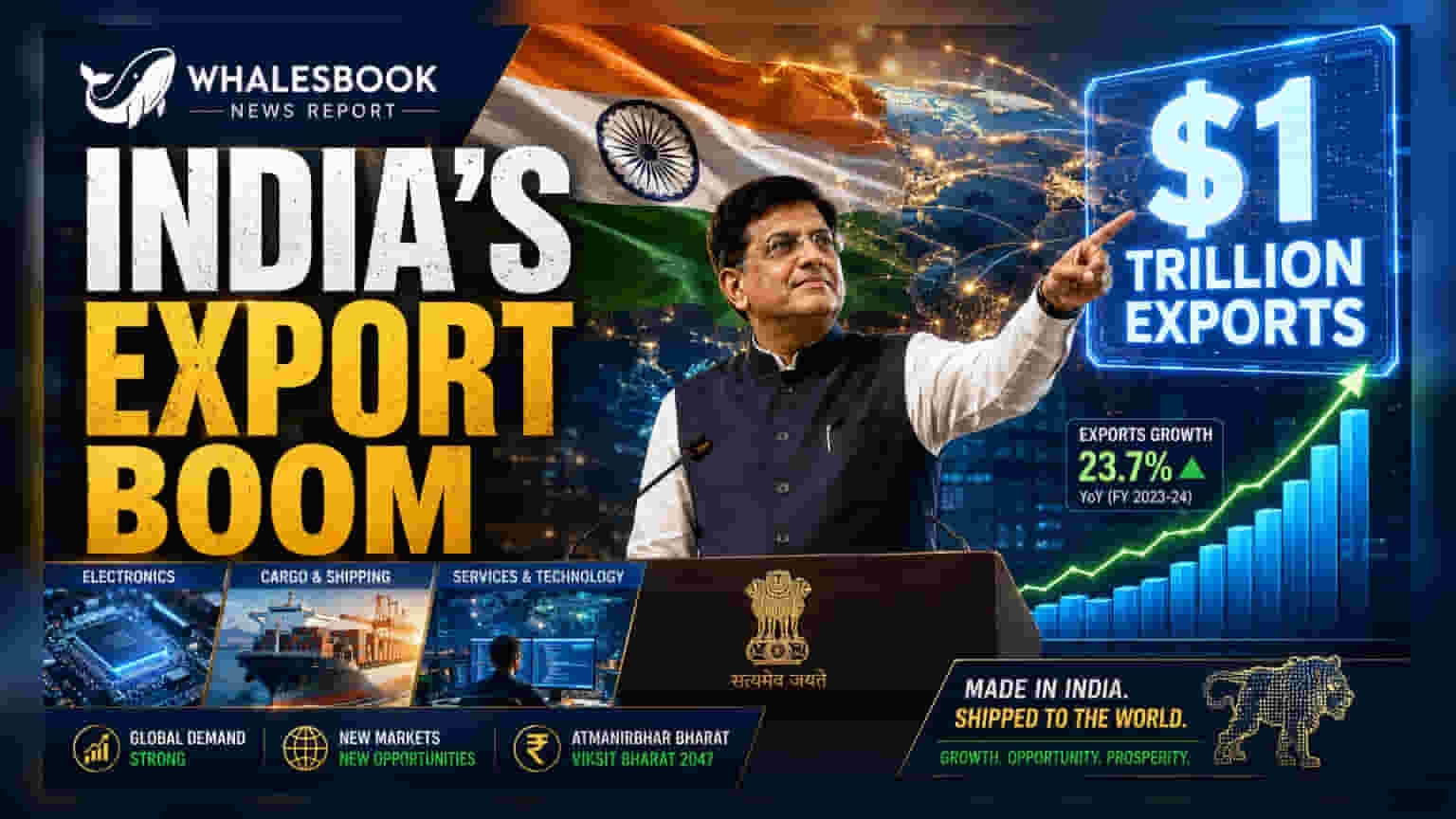
India aims to hit a $1 trillion export milestone by FY2027, requiring a sustained 16-17% growth rate in merchandise trade. The strategy relies on manufacturing expansion through the PLI scheme and new trade agreements to navigate global economic uncertainties.
What Happened
India has set an ambitious target to reach $1 trillion in total exports—covering both goods and services—by the end of the 2027 financial year. To achieve this, the government is aiming for a 16-17% annual growth rate in merchandise exports. Currently, merchandise exports stand at approximately $442 billion, and the goal is to increase this to nearly $530 billion. The strategy is designed to integrate India more deeply into global supply chains while moving beyond traditional export models.
The Role of Manufacturing and PLI
A central pillar of this export strategy is the Production-Linked Incentive (PLI) scheme. Launched in 2020, the scheme provides financial incentives to companies that increase domestic production and exports. Key industries currently benefiting include electronics manufacturing, pharmaceuticals, and automobiles. For electronics, the focus is shifting toward local component manufacturing rather than just final assembly. This change is intended to increase the domestic value-added portion of products, which is a critical step for long-term export competitiveness.
Services as a Growth Engine
While merchandise exports have faced fluctuations due to global supply chain shifts, the services sector remains a consistent performer. Sectors such as IT services, telecommunications, and business consulting form the backbone of service exports. The current goal assumes that services will continue to grow steadily, potentially outpacing goods if the sector successfully integrates artificial intelligence and high-end tech services into its global offerings.
Trade Agreements and Market Access
India is actively pursuing Free Trade Agreements (FTAs) to lower tariff barriers. These agreements are expected to provide domestic exporters—particularly in the textile, leather, and chemical industries—better access to major markets in the European Union and the United Kingdom. By reducing costs in foreign markets, these deals aim to make Indian products more price-competitive against global peers.
Challenges to Export Growth
Despite the targets, reaching the $1 trillion mark involves significant hurdles. Global protectionism and ongoing geopolitical instability can disrupt trade flows, often leading to reduced demand in key markets. Additionally, the need for improved domestic logistics and infrastructure remains a bottleneck for scaling up manufacturing. For investors, the long-term success of this initiative will depend on whether companies can successfully transition from assembly-based operations to higher-value design and specialized component manufacturing. The ability of the private sector to maintain quality standards and scale production efficiently will be a key factor in determining if these goals are met.