

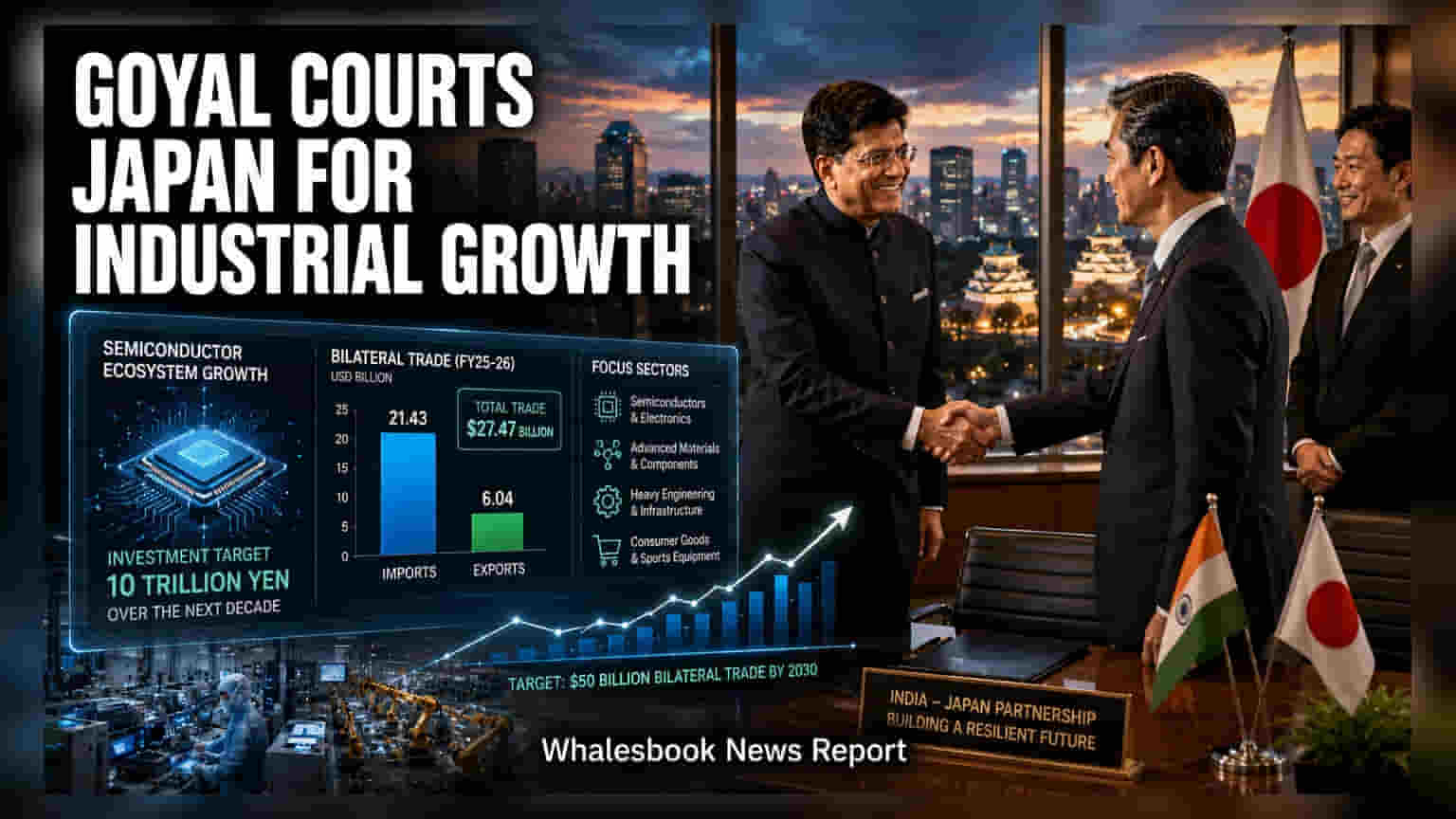
Union Commerce Minister Piyush Goyal recently led a major business delegation to Japan, focusing on attracting investment in semiconductors and advanced manufacturing. The goal is to deepen industrial ties and reduce the trade deficit, supported by a 10 trillion yen investment target over the next decade.
Union Commerce and Industry Minister Piyush Goyal concluded a high-level diplomatic and business outreach in Japan this week, aimed at accelerating India’s industrial capabilities. Leading a delegation of over 200 Indian business representatives, the Minister visited Osaka, Nagoya, and Tokyo to engage with Japanese leadership. The visit was structured to attract foreign investment into critical sectors, including semiconductors, electronics, and heavy manufacturing, while integrating Indian producers more deeply into global supply chains.
Targeting High-Value Industrial Sectors
The discussions in Japan prioritized sectors where India seeks to reduce import dependency. Minister Goyal held meetings with executives from ROHM Co. Ltd. to discuss expanding electronic component production within India. The government’s intent is to leverage India's growing domestic market to encourage these firms to establish robust manufacturing footprints, rather than just exporting finished goods to India.
Additional meetings focused on materials and infrastructure. Engagements with leaders from Daiki Aluminium and Nippon Paint Holdings were aimed at aligning Japanese technical expertise with India’s current infrastructure growth cycle. Furthermore, the delegation explored opportunities in consumer and sports goods, with Mizuno Corporation evaluating potential joint ventures that could boost India’s manufacturing output for both local and international markets.
Addressing the Trade Deficit
For Indian investors and analysts, the economic backdrop of this visit is significant. In the 2025-26 fiscal year, bilateral trade between India and Japan totaled $27.47 billion. However, this relationship is heavily skewed, with India importing $21.43 billion worth of goods and exporting only $6.04 billion.
Addressing this trade imbalance is a key driver for the government's current diplomatic push. The long-term strategy, backed by a target of 10 trillion yen in private investment over the next decade, aims to transform India from a consumer of Japanese technology into a regional manufacturing hub. Industry bodies like ASSOCHAM have projected that bilateral trade could grow to $50 billion by 2030, provided these investment targets materialize.
Investor Monitorables and Risks
While the commitment from Japanese firms is promising, investors should remain mindful of execution risks. Scaling complex ecosystems, particularly in high-tech areas like semiconductors, requires significant policy support, infrastructure, and skilled labor.
The primary monitorable for the market will be the speed at which these boardroom discussions translate into concrete project commissioning and plant ground-breakings. Additionally, observers will track whether these partnerships effectively lead to a reduction in the import bill for industrial components, which remains a key factor in improving India’s manufacturing trade balance.