 Whalesbook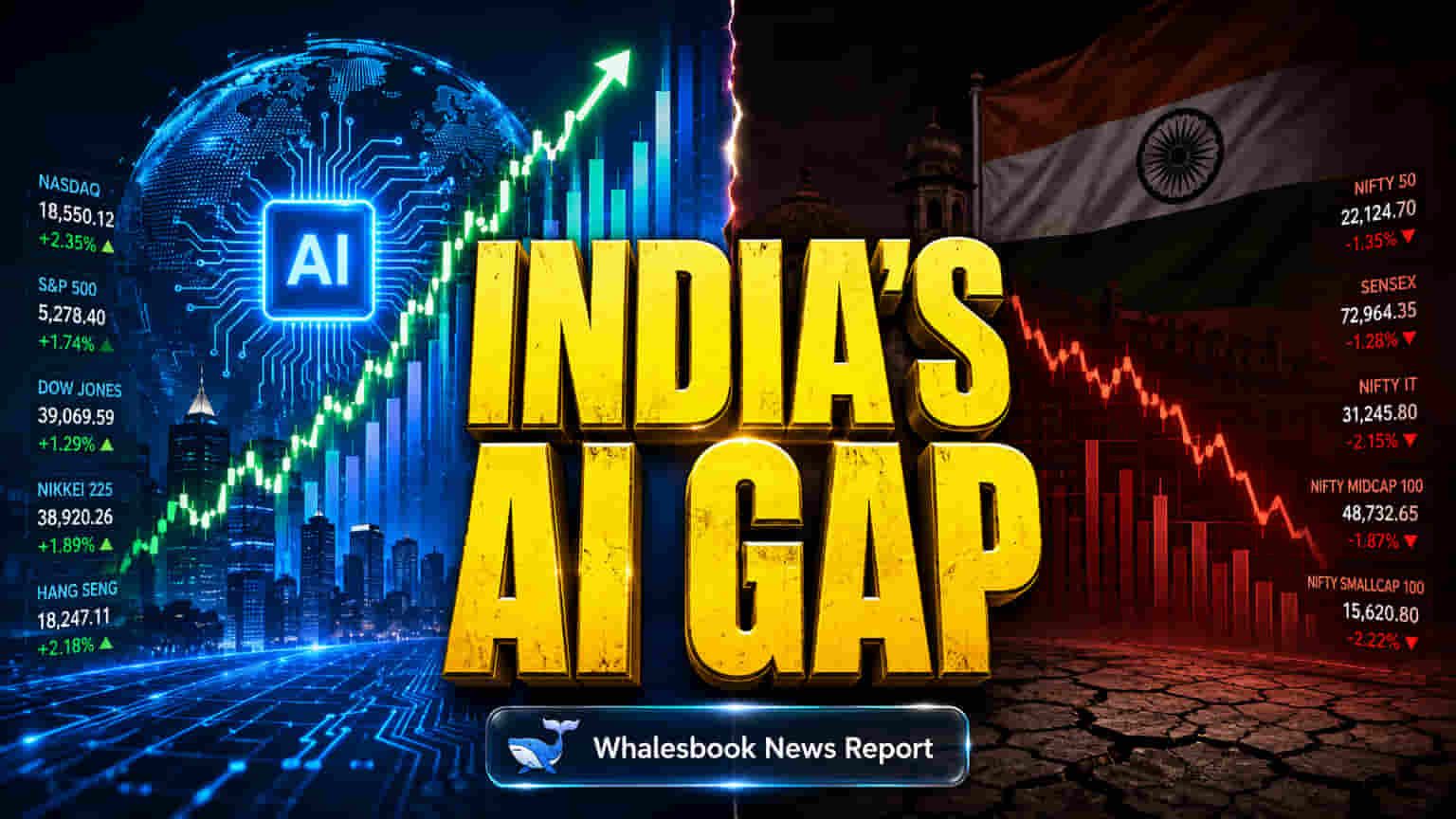


India's stock market is underperforming global peers not because of domestic economic problems, but due to its limited involvement in concentrated global sector trends. The market shows more resilience when IT services are excluded, indicating that current challenges stem from specific global patterns rather than underlying domestic weakness.
The AI Concentration Impact
India's headline market performance has significantly underperformed major global markets since the start of 2026, primarily due to its minimal participation in the artificial intelligence (AI) hardware and semiconductor-linked rally. Markets like South Korea and Taiwan have surged, with the KOSPI up 77.49% year-to-date by May 2026, and Taiwan's market value showing substantial growth. In contrast, India's Nifty has declined approximately 8.5% year-to-date in local currency terms, reflecting a structural 'exposure gap' rather than a broad economic downturn. Motilal Oswal's report emphasizes that India's lower participation in this narrow, concentrated global AI trade has disproportionately impacted its headline figures. When IT services are excluded, India's broader equity market performance shows a narrower gap, signaling underlying resilience.
Defence Sector Momentum
Concurrently, the global defence sector has experienced a significant rally, driven by escalating geopolitical tensions and a resultant surge in defence spending and orders. The aggregate market capitalization of global defence companies has expanded substantially, with the report noting a 19% CAGR from 2021 to mid-2026. This trend is supported by consistent inflows into India's defence sector, aligning with global patterns.
Commodity Pressures and Macro Concerns
Despite the resilience in certain domestic sectors, elevated crude oil prices, which have spiked above $100 per barrel amidst West Asia tensions, continue to pressure global markets and corporate profitability. This poses risks to India's economy, raising concerns over growth, current account deficit (CAD), inflation, and INR depreciation. India's CAD is projected to widen, with forecasts ranging from 1.3% to 2.5% of GDP for FY27. Inflation also remains a concern, with CPI expected to rise towards 3.8% in April 2026. The Indian Rupee has shown volatility, trading around 0.0105-0.0106 USD to 1 INR, with forecasts suggesting a potential weakening to Rs 95 per USD by year-end.
Investor Flow Dynamics
Domestic institutional investors (DIIs) have provided a crucial buffer against market volatility, injecting over ₹3 lakh crore into Indian equities in the first four months of 2026. DII ownership has risen to approximately 18.9% as of April 2026. In stark contrast, foreign institutional investors (FIIs) have been net sellers, pulling out over ₹2 lakh crore year-to-date in 2026. FII ownership has consequently fallen to a 14-year low of 14.7% by April 2026. This shift signifies a growing dominance of domestic capital in the Indian market.
Underlying Risks and Bearish Concerns
Despite strong domestic investor buying, sustained foreign investor outflows signal global caution towards India. India appears to be missing its fair share of emerging market investments, as capital flows into AI leaders like Taiwan and South Korea. The narrow focus of the AI rally on hardware and semiconductors leaves India structurally disadvantaged. Persistent crude oil price volatility adds ongoing threats to India's economic stability, risking wider current account deficits and inflation. A weakening rupee could further fuel capital outflows. The key risk remains whether domestic buying can sustain against prolonged foreign selling.
Future Outlook
Motilal Oswal suggests that any moderation or unwinding of the global AI trade could redirect foreign investor flows back towards domestic growth-oriented markets like India. The continued geopolitical tensions are likely to sustain increased defence spending globally and domestically. However, the market's trajectory will be significantly influenced by global capital flows, the path of commodity prices, and India's ability to navigate its structural challenges in key global growth sectors.