

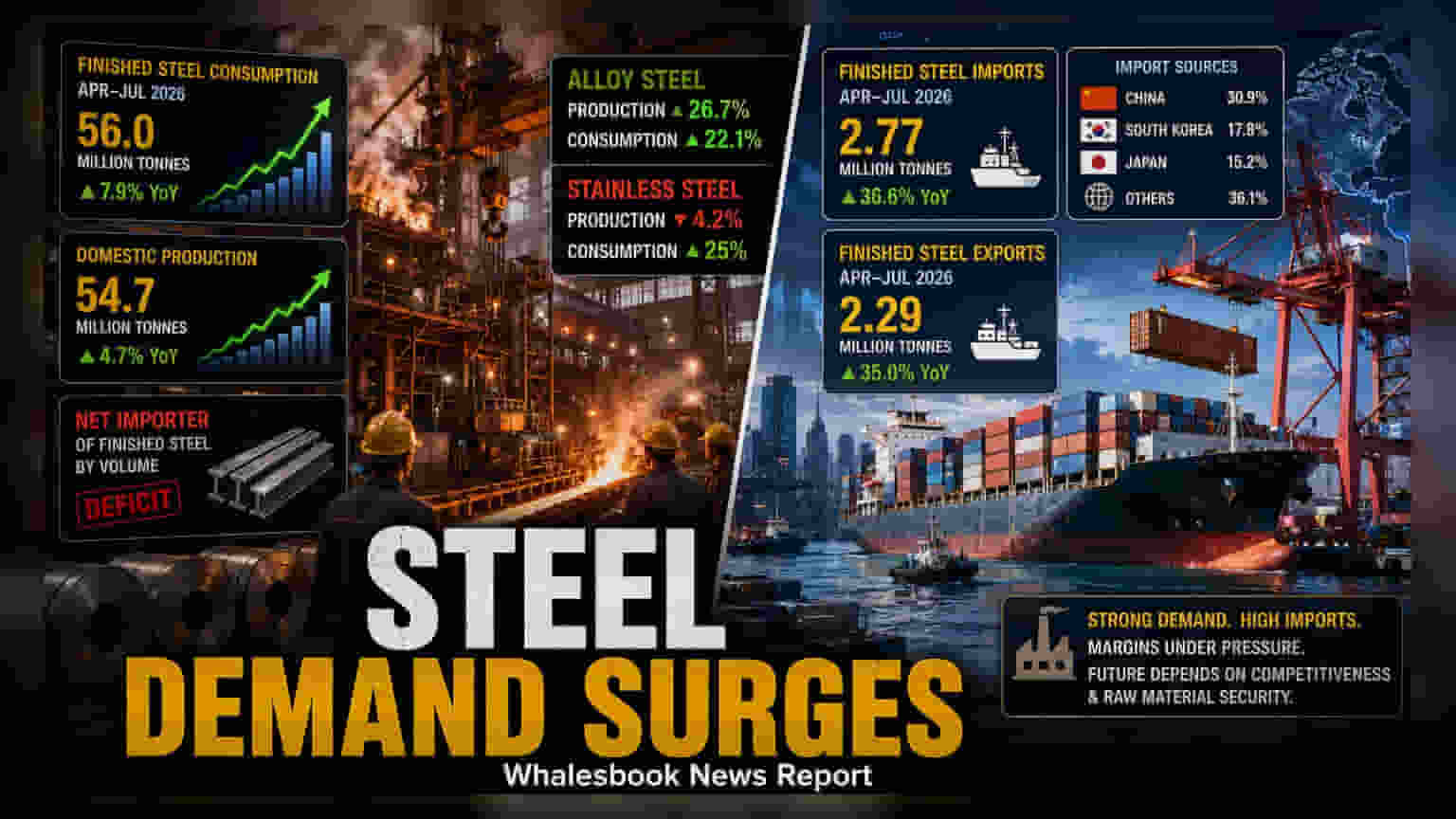
India’s steel consumption grew 7.9% to 56 million tonnes in the first four months of the fiscal year, surpassing domestic production of 54.7 million tonnes. This rising demand has led to a 36.6% surge in imports, highlighting competitive pressures despite robust infrastructure growth.
The Indian steel sector is navigating a period of high demand, but domestic output is struggling to keep pace. Data for the period of April to July 2026 shows that finished steel consumption climbed 7.9% to 56 million tonnes. In contrast, domestic production grew at a slower rate of 4.7%, reaching 54.7 million tonnes. This gap between rising demand and local output has fundamentally changed the trade balance, with India becoming a net importer of finished steel by volume.
This consumption surge is closely tied to ongoing infrastructure and manufacturing activity across the country. However, the inability of domestic production to meet this demand entirely has opened the door for increased foreign supply. Finished steel imports jumped 36.6% to 2.77 million tonnes during the four-month period. China was the primary source, accounting for 30.9% of these imports, followed by South Korea and Japan. While exports also saw a healthy increase of 35% to 2.29 million tonnes, the volume of incoming steel remains higher, creating a trade deficit in the finished steel segment.
Within the industry, performance has varied by product type. Alloy steel has been a clear winner, with production rising 26.7% and consumption growing by 22.1%. Conversely, the stainless steel segment has faced challenges, where production dipped by 4.2% even though demand grew by 25%. This suggests that while there is an appetite for high-value and specialized steel products, producers may be facing specific operational or supply chain constraints.
To address long-term raw material security, the government recently introduced the Mines and Minerals (Development and Regulation) Amendment Act, 2026. This regulation is designed to improve the environment for mining investment and increase the domestic availability of essential minerals like iron ore, which are critical for steel manufacturing.
For investors and market participants, the current trend presents a mixed picture. While strong consumption growth is a positive sign for the economy, the sharp rise in imports poses a risk to the profit margins of domestic steelmakers. Companies are currently managing these pressures through volume-led recovery and protective measures, such as existing safeguard duties. However, profitability will remain sensitive to fluctuating raw material costs, particularly coking coal, and the ability of domestic producers to compete with the influx of foreign steel. Investors may track future import volumes and domestic pricing trends to gauge how effectively companies can defend their margins against import competition.